
Book Review: A World Appears
Here’s my review of A World Appears by Michael Pollan. Leave a comment if you’ve read it, plan to read it, or have any book recs to share. And don’t miss today’s writing prompt in the chat!
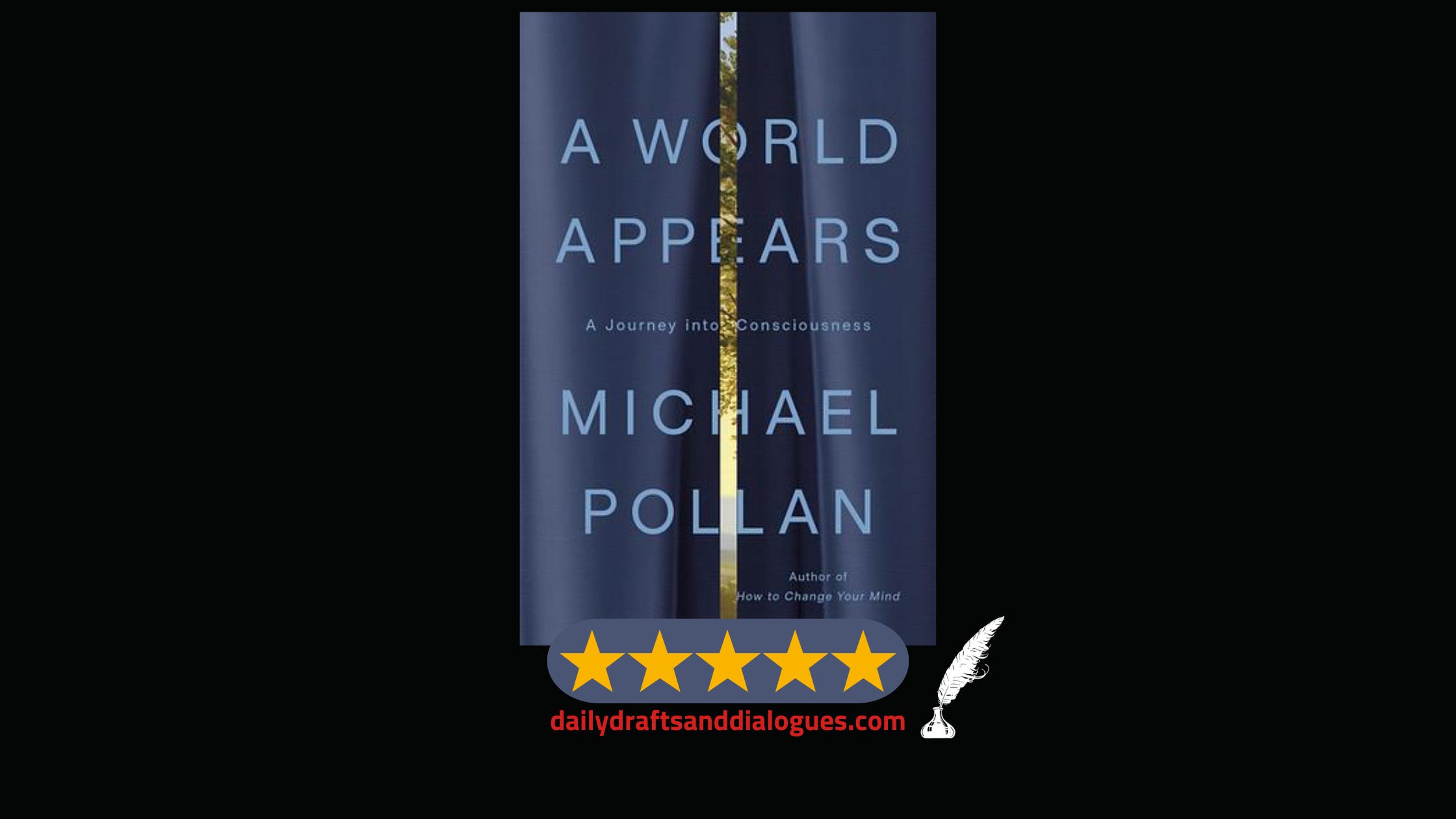
A World Appears: A Journey into Consciousness by Michael Pollan is a book for those who love to get lost in philosophical ideas and concepts, as well as the science and theories that support and refute their assumptions surrounding those concepts. I urge all potential readers to adopt an open mind (pun intended) when picking up this book, and to be prepared to unpack everything they think they know while also realizing they likely know absolutely nothing about what they think they know.
First, a warning. If the following philosophical statement does not appeal to you, neither will this book: “All I know is that I know nothing.” — often attributed to Socrates.
A World Appears is expertly organized into four sections: Sentience, Feeling, Thought, and Self. The Sentience section examines the earliest, most elementary manifestations of consciousness in nature, including the seemingly conscious nature of plants. The Feeling section explores how emotion and feeling shape conscious experience. The Thought section investigates how mental operations and thoughts arise in the brain’s neocortex, and our limitations behind fully understanding this. And the Self section analyzes the ‘perceiver of our perceptions’ that focuses on the complex creation of self-awareness, which is linked to consciousness and our limitations in understanding it.
Over these four sections, Pollan conducts a deep investigation into the mystery of human consciousness, exploring how humans and their brains create subjective reality, subjective experience, and selfhood— the ‘hard problem’ behind fully understanding the nature of consciousness. And he relies on everything from personal experience and literature to the expertise of neuroscientists, philosophers, meditators, and Indigenous cultures to try and make sense of it all, ultimately positing that consciousness is deeper and more participatory, yet simpler and more elusive, than modern materialism and Descartes-driven science and philosophical inquiry and innovation suggest.
As someone with a philosophical mind, I couldn’t get enough of the questions Pollan asks in this book, of which there are hundreds. Here are a few that stood out: How does a tangle of neurons generate a subjective ‘self’? Why are we conscious of so little? If the brain does not need conscious awareness for most of its functions, what is the evolutionary purpose of conscious experience? What is it like to have the subjective internal and personal ‘feeling’ of existence that differs from mere mechanical brain function? We know we are distinct from each other and that we have our own distinct sense of an internal self, but how and why is that? Are plants and other non-human organisms sentient or capable of consciousness, or is consciousness only present in humans— if so, why? Can AI ever truly be conscious if they have no sense of mortality and can’t experience true feelings in a mortal body or emotions like humans can? How do memory and the concept of time construct a stable consciousness, as well as a stable sense of self? And can we trust what we think we know about consciousness when we are trapped inside the very subjectivity of consciousness that we are trying to analyze?
While there are no new hard truths about consciousness revealed in this book, it does leave readers with a more nuanced appreciation for and, ironically enough, realistic understanding of what consciousness is and how we should analyze and study it. It challenges our preconceived notions of consciousness, which are mostly centered on strict and faulty materialism, making it clear that a full understanding of consciousness will require much more than empirical research and data. It also reminds readers how much we have yet to learn about the brain and ourselves, and that neither can be reduced to simple computing machines.
Overall, I appreciated Pollan’s humor and candor throughout the book. While its material is dense, and he does a superb job discussing it in depth, his analyses were enjoyable to read because he never took himself or any one of the theories he was exploring too seriously or as hard, static truths. He kept a focused and attentive yet open mind while writing the book, which will allow readers to keep a focused and attentive yet open mind while reading it, easily making it one of my favorite nonfiction reads of 2026.
Have you read this book yet, or plan to read it soon? Leave a comment to start a discussion. Or tell us what we should read and review next!
And don’t forget to subscribe to receive future book reviews in your inbox, along with other engaging posts.
© This work is not available for artificial intelligence (AI) training. All Rights Reserved by K.E. Creighton; Creighton’s Compositions LLC.
Want to express your appreciation for this post?
Daily Drafts & Dialogues is fueled by loyal readers, caffeine, and shares with kind words, so any support you can offer to keep it and me going is greatly appreciated. Thank you so much! — K.E. Creighton
Community Notes (NEW!)
In this new section of Daily Drafts & Dialogues, you will see additional notes on posts and what’s going on in the broader Daily Drafts & Dialogues community, more in depth questions to spur further dialogue, polls, discounts, contest opportunities, helpful links and resources, and opportunities to have your comments and work featured in the new Community Spotlight section below in future posts.
Community Spotlight
This new section will FEATURE YOUR WORK AND VOICES.
Leave a thoughtful comment on a Daily Drafts & Dialogues post for a chance to have your writing, links, and profile featured here.
Egalitarian Book Club
Currently Reading: Westward Women by Alice Martin (Join the buddy read here.)
Recommended Reading Schedule:
Week 1 (May 1-10) — Chap. 1-7 (Part I)
Week 2 (May 11- 17) — Chap. 8-14 (Part II- III)
Week 3 (May 18- 24) — Chap. 15-21 (Part III- IV)
Week 4 (May 25- 31) — Part V, remaining chapters
June Pick: TBD (Look here in future posts for an upcoming poll to help us select our June pick!)
Join the Egalitarian Book Club in Storygraph today if you:
🎯Believe reading is fundamental to changing minds, expanding hearts, and building meaningful connections
🎯Enjoy reading a variety of genres and books, or are at least interested in trying to do so
🎯Read works by authors who have diverse backgrounds from you, or are at least interested in doing so
Daily Drafters Features and Exclusives
Paid Subscribers, check today’s chat for: New Community Chat Guidelines, and new daily writing prompts!
Daily Drafters = NEW and exclusive Daily Drafts & Dialogues writing community in Substack Chat
SEE YOUR WRITING FEATURED HERE IN FUTURE POSTS
In addition to seeing featured Daily Drafters’ work in this section, you will also see important reminders, updates, opportunities, and access to exclusive Daily Drafters paid content here, which will include:
✔ Daily writing prompts and writing tips (only ~$0.17 per prompt!)
✔ BONUS writing prompts, in addition to daily prompts (NEW!)
✔ Weekly Drafters Dialogue Chat Threads (NEW!) — posted at the end of each week.
✔ Daily Drafts & Dialogues Monthly Digest (NEW!)
✔ Opportunities to build your writing portfolio and get recognition
✔ Additional perks TBA
Message me after you switch to Paid by this Friday, May 8, 2026 to receive your first 30 days free.
Note that Founding Members of the NEW Daily Drafters writing community will also be entered into a randomized drawing to receive free lifetime access.


