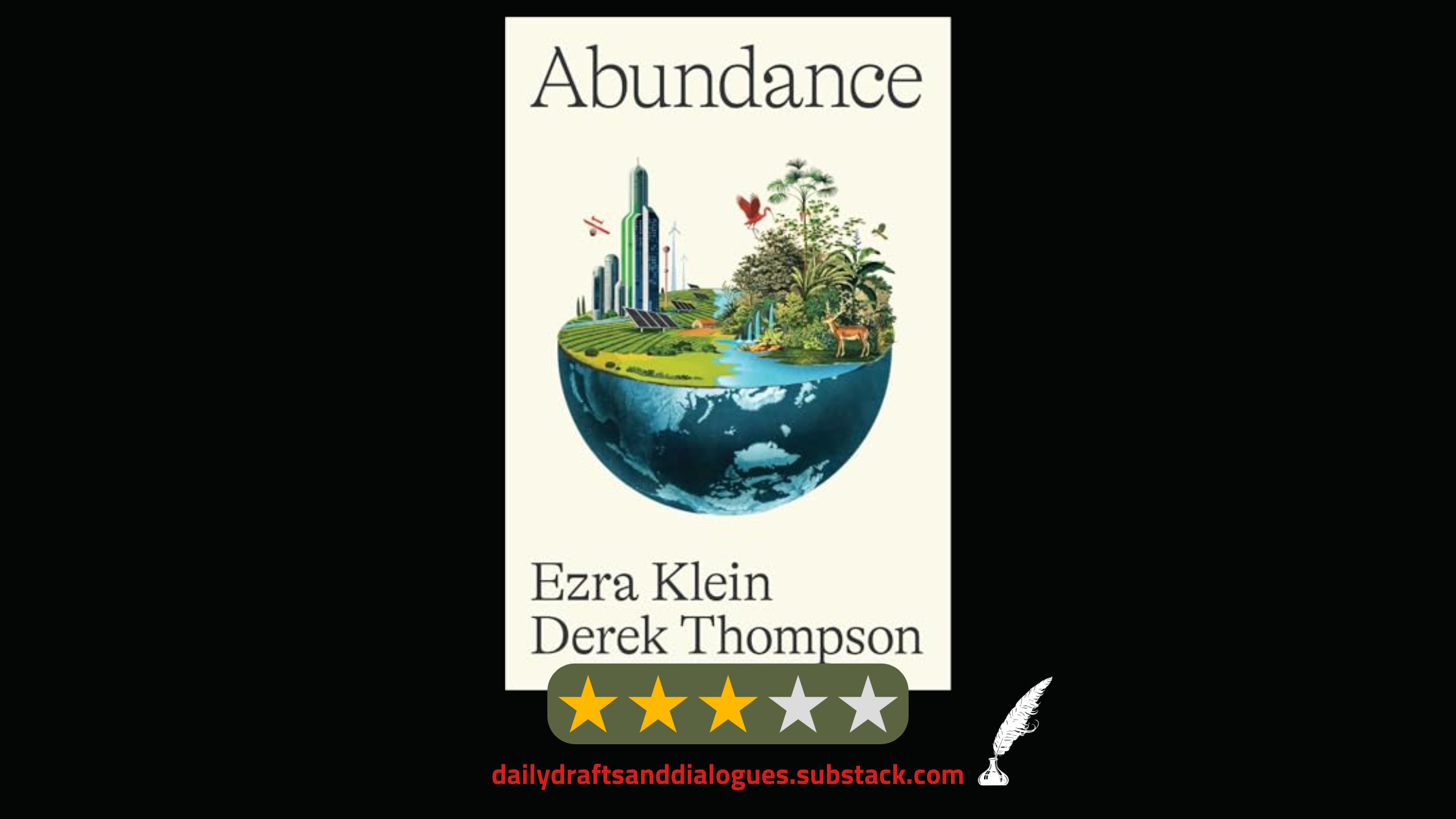
Book Review: Abundance
Here’s my review of Abundance by Ezra Klein and Derek Thompson. Don’t forget to leave a comment if you’ve read it or plan to read it, or if you have any other book recommendations to share.
Abundance by Ezra Klein and Derek Thompson is a book for those who dislike bureaucracy of any kind and are skeptical of how the US government works to innovate and get things done (or often doesn’t, as it were). And believe it or not, this book is more critical of how liberal government and politics work than anything else … but in a productive and even-keeled way, for the most part.
Overall, the premise of the book is simple, as stated by the authors:
“This book is dedicated to a simple idea: to have the future we want, we need to build and invent more of what we need. That’s it. That’s the thesis. It reads, even to us, as too simple. And yet, the story of America in the twenty-first century is the story of chosen scarcities. Recognizing that these scarcities are chosen—that we could choose otherwise—is thrilling. Confronting the reasons we choose otherwise is maddening.” (p.4)
I very much agree with that premise, and am glad that this book exists, truly. It’s refreshing to read a book that suggests we’re still more than capable of creating a future world that isn’t strictly based on the scarcity narrative we’re so used to hearing all the time. At the same time, however, I kept waiting to read more examples of how we can build our future world on a narrative of abundance and wish the book would have been more emotive and moving overall, to actually inspire readers to act. There was a lot of data and examples of what’s gone wrong or right in the past, but not much of an explicit and moving call to action for the future, though there is a small glimmer of this in the Conclusion.
Most of the book lays out plenty of examples (most of them set in California) of how we continue to misunderstand and contort the ways in which our politics and policies influence our economics, innovations, and overall progress (or lack thereof) in both obvious and not so obvious ways. And it offers a practical account of how both liberals and conservatives focus on scarcity, as well as their assumed political typologies, instead of how we can build a world of abundance where government and industry are effective now and in the future.
“Too often, the right sees only the imagined glories of the past, and the left sees only the injustices of the present. Our sympathies there lie with the left, but that is not a debate we can settle. What is often missing from both sides is a clearly articulated vision of the future and how it differs from the present.” (p.15)
Yet most of what the book lays out is widely known by most people living inside the US. While I didn’t know some of the specific examples and data shared to illustrate certain points, I still think it’s safe to say that most Americans understand and are woefully aware of the unnecessary and arbitrary limitations of bureaucracy and how it limits innovation and the appropriate type and amount of growth and progress. And we know that our government is not working for us because they are focused on the wrong things, instead of real-world results that benefit our neighborhoods and communities.
All in all, I do think this book is worth reading and would recommend it to those who want specific examples of how the government has chosen scarcity over abundance (especially in California), and some suggestions for what we might want to focus on in the future, if we want to follow a narrative of abundance.
Subscribe below to receive future book reviews in your inbox, along with other engaging posts. And don’t forget to leave a comment with your book recommendations.
© This work is not available for artificial intelligence (AI) training. All Rights Reserved by K.E. Creighton; Creighton’s Compositions LLC.
Want to express your appreciation for this post?
My writing and I are fueled by loyal readers, caffeine, and kind words, so I appreciate any support you can offer that keeps me writing. Thank you so much!


