Book Review: Cleopatra
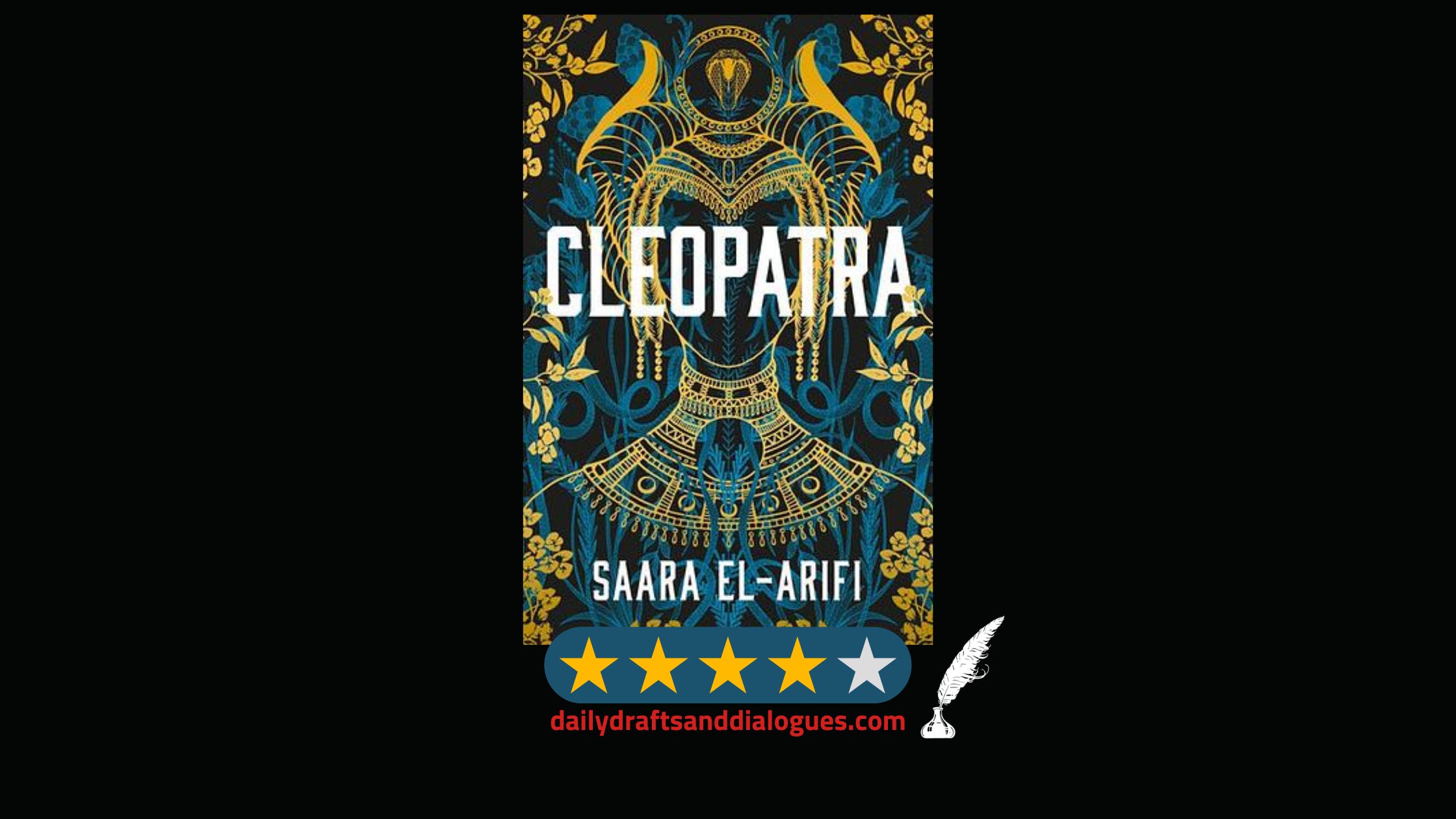
Here’s my review of Cleopatra by Saara El-Arifi. Leave a comment if you’ve read it, plan to read it, or have any book recs to share. And don’t miss today’s writing prompt.
Cleopatra by Saara El-Arifi offers readers the rare opportunity to see the world from Cleopatra’s perspective and rewrite the versions of her history that have been destroyed, lost, or written by men who include her enemies. And it is a captivating read. Readers will become entranced by the complexities of who Cleopatra was and the decisions she could have very well made in real life with each page they turn.
From the beginning, Cleopatra isn’t supposed to be Pharaoh of Egypt, but due to her older sister’s execution and her father’s death she becomes the supreme ruler of Egypt at the young age of eighteen. And this is where the novel starts: her first day as Pharaoh. Yet it’s also important to note that the novel starts with an intimate scene, in which Cleopatra is playing a game of senet with her close friend and handmaiden, Charmion— a game that represents the symbolic journey of the soul through the afterlife that Cleopatra apparently never wins. So, from its first pages, the novel introduces a more intimate account of Cleopatra, who she was, and continues to be to us.
Because the novel is told from Cleopatra’s first-person perspective, readers will be introduced to her inner workings as a young, then seasoned pharaoh. While members in her court and her siblings plot against her, and her people doubt her ability to lead, and she loses people she cares about, readers get an up-close look at how she feels about it all and processes it all, and what ultimately influences her decisions and alliances in the end: her love for and loyalty to Egypt and those who represent Egypt.
Readers will also experience the complexities of Cleopatra’s character and what and who she cared about through this intimate first-person perspective in this novel, perhaps for the first time. Instead of seeing her as only a witch, whore, or villain (like the men who first wrote her history do), they will see her as a human who had the weight of Egypt on her shoulders yet held it as nobly as she could.
While Cleopatra sends thousands to their certain death in one instance, she will do all she can to heal the average people of Egypt under the cloak of night and build hospitals for their wellbeing in another, and ensure they receive rations of food in another. We also see her complicated relationship with her siblings, who are also her rivals, and how they make her vulnerable. And while she falls deeply in love with her would-be-conquerors, she also never allows them to rule her or Egypt without her consent, partnership, or leadership, and always chooses Egypt in the end. And while she claims to be blessed by the goddess Isis, she struggles with her inability to exhibit Isis’s gifts throughout the novel, and goes to great lengths to hide this insecurity, which opens her up to serious vulnerabilities.
Overall, I did appreciate this fresh perspective of Cleopatra’s story. Who better to tell her story than herself, even if she had to do it from beyond? Yet I must confess, there was a part of me that wanted to see more of her intellect in action, especially when it came to her scholarship and ability to speak multiple languages and the maneuvering she had to do to keep her throne, as well as her prowess when executing complicated military strategies. There was some of this in the novel, but personally, I would have added two or three more chapters of Cleopatra being a smart, calculating badass, and one or two less chapters about her yearning for Julius or Marcus to come back. But might this just be a personal preference?
Some of my favorite scenes in the novel took place on the ship and in the Library of Alexandria and the temples Cleopatra frequented and built, as they really pulled me into the scenery of Ancient Egypt and what it would have been like to be a ruler in that place and time. I also enjoyed the intimate scenes with Charmion, who was likely the only person who ever really knew the whole complicated story of Cleopatra and her life, aside from Cleopatra herself.
I would recommend this novel to readers interested in Cleopatra’s story, and how she might have actually told it had she been given the chance to be honest and vulnerable with those listening. And to those who are intrigued by this passage included in the author’s opening note to the novel:
“Cleopatra’s myth has permeated collective memory. Her story lives in the minds of many, far beyond what history has provided. I sought Cleopatra’s voice in the dust between tomes. And from that ancient stillness, she spoke back. This novel is not history, it is memory.”
Subscribe to receive future book reviews in your inbox, along with other engaging posts. And don’t forget to leave a comment with your own book recommendations.
© This work is not available for artificial intelligence (AI) training. All Rights Reserved by K.E. Creighton; Creighton’s Compositions LLC.
Want to express your appreciation for this post and writing prompt?
My writing and I are fueled by loyal readers, caffeine, and kind words, so I appreciate any support you can offer that keeps me writing. Thank you so much!
Today’s Writing Prompt
Writing Prompt: Ancient Egypt
Write a piece of flash fiction about Ancient Egypt and or a jounral entry about what you know or want to learn about Ancient Egypt.
Writing Tip:
Before you begin writing, consider whose perspective you’d like to use. Do you want to use your perspective from the future? The perspective of a ruler, a merchant, a slave? Next, consider what is happeneing and why, or explore questions about Ancient Egypt you’d like answered.


