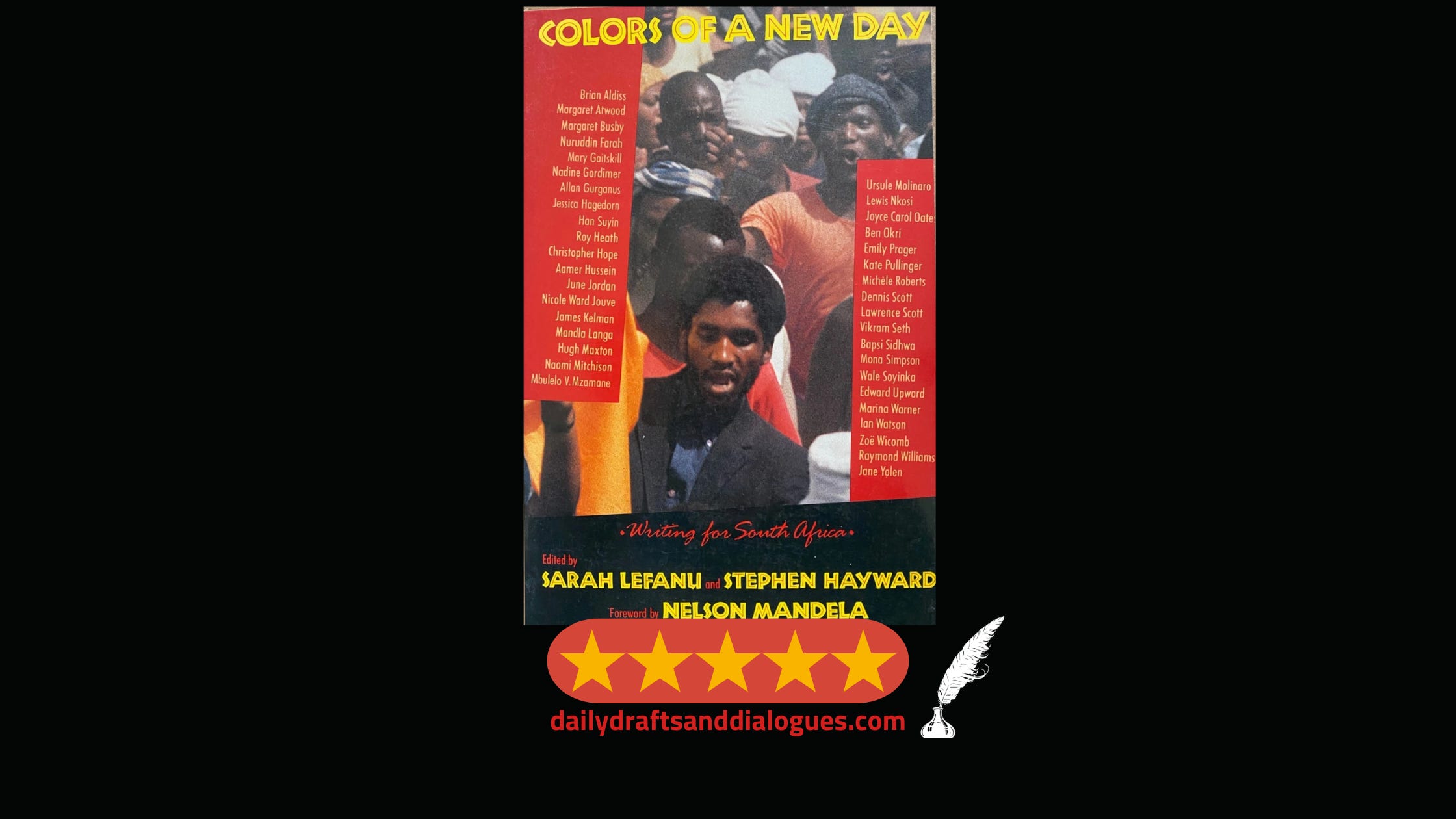
Book Review: Colors of a New Day
Here’s my review of the 1990 anthology, Colors of a New Day. Leave a comment if you’ve read it, plan to read it, or have any book recs to share. And don’t miss today’s writing prompt.
Colors Of A New Day: Writing For South Africa edited by Sarah LeFanu and Stephen Hayward is an anthology I acquired at a used bookstore a few years back, though I didn’t pick it up again until last week when I used a random number generator to select a book from my TBR shelf (I’ll tell you about that process some other time.). Yet it ended up being a serendipitous reading experience because, unbeknownst to me prior to picking it up, this time of the year falls right in the middle of the anniversary of Nelson Mandela’s release from prison in early 1990 and the beginning of the end of legal apartheid in South Africa.
This anthology offers vivid depictions of South Africa’s landscape and cities that are so rich you’ll feel transported there. It also paints a picture of systematic segregation and the devastating effects such systems have on those landscapes and cities, as well as the people who live there, and captures everything from intentionally delayed ambulances for predominantly Black neighborhoods to seizures of family land and property to outright physical abuse to everyday injustices and micro aggressions that add up and spread across not only the country but the globe, within its stories and literature.
While the anthology is centered around South Africa, its entries span the globe as well, including scenes and characters in other countries too, which reflect the aim of the collection to confront and tackle inequality felt across the world while building a vision for a post-apartheid, post-colonial world. Its structure thoughtfully lays out a map for recognizing and eradicating apartheid and racial injustice in South Africa and internationally while retaining those memories and legacies of those that colonial systems wanted to exploit and or eradicate. At times, the inclusion of a few entries is confusing until they’re read within the context of the anthology and its early 1990s aims because apartheid itself was confusing and globally pervasive, both an import and export of the country’s economic and social practices, its multicultural hubs, and strategic racism.
While each entry contributes something important to this collection, poems like Poem to Free Nelson Mandela by June Jordan and I Have Had Enough in German by Hugh Maxton, and short stories like Strydom’s Leper by Christopher Hope and Nobody Likes a Refugee by Naomi Mitchison, and most of the entries at the end of the collection, paint a vivid account of what life was really like inside the minds and hearts of writers and readers at this time and place in history, at the inception of strong and lasting historic legal and social change, which consequently makes it even more relevant to our current times in 2026 than one might think at first.
When you read the stories in this collection, it’s impossible not to draw parallels to the current world we live in and how certain groups are being targeted and treated. However, its most remarkable quality lies in its ability to convey the complexities of what was happening in the 1990s, precisely what people were resisting, and what they were doing to resist (via literature) such injustice, as it offers invaluable insight for current writers who are interested in leveraging literature to be not only a human-centered historical record but a catalyst for activism and change.
I would recommend this book to readers who are interested in learning more about the effects of apartheid in South Africa, as well as those readers who are interested in exploring the ways literature can influence real reflection and change. It will also offer further context to more popular books like Born a Crime by Trevor Noah (born and raised in South Africa during this time) and Long Walk to Freedom by Nelson Mandela (pivotal anti-apartheid leader in the 1990s, as well as South Africa’s first Black president).
Have you read this book yet, or plan to read it soon? Leave a comment to start a discussion. Or tell us what we should read next. And don’t forget to subscribe to receive future book reviews in your inbox, along with other engaging posts.
© This work is not available for artificial intelligence (AI) training. All Rights Reserved by K.E. Creighton; Creighton’s Compositions LLC.
Want to express your appreciation for this post and writing prompt?
My writing and I are fueled by loyal readers, caffeine, and kind words, so I appreciate any support you can offer that keeps me writing. Thank you so much!
Today’s Writing Prompt
Writing Prompt: 1990s
Write a poem or fictional scene that takes place in the 1990s. Or write a journal entry about your thoughts and feelings about the 1990s.
Writing Tip
Close your eyes and imagine you’re living in the 1990s again, or for the first time. Where are you exactly? What are you wearing or doing? Who are you with and why? Can you hear any music or smell anything unique to that decade?