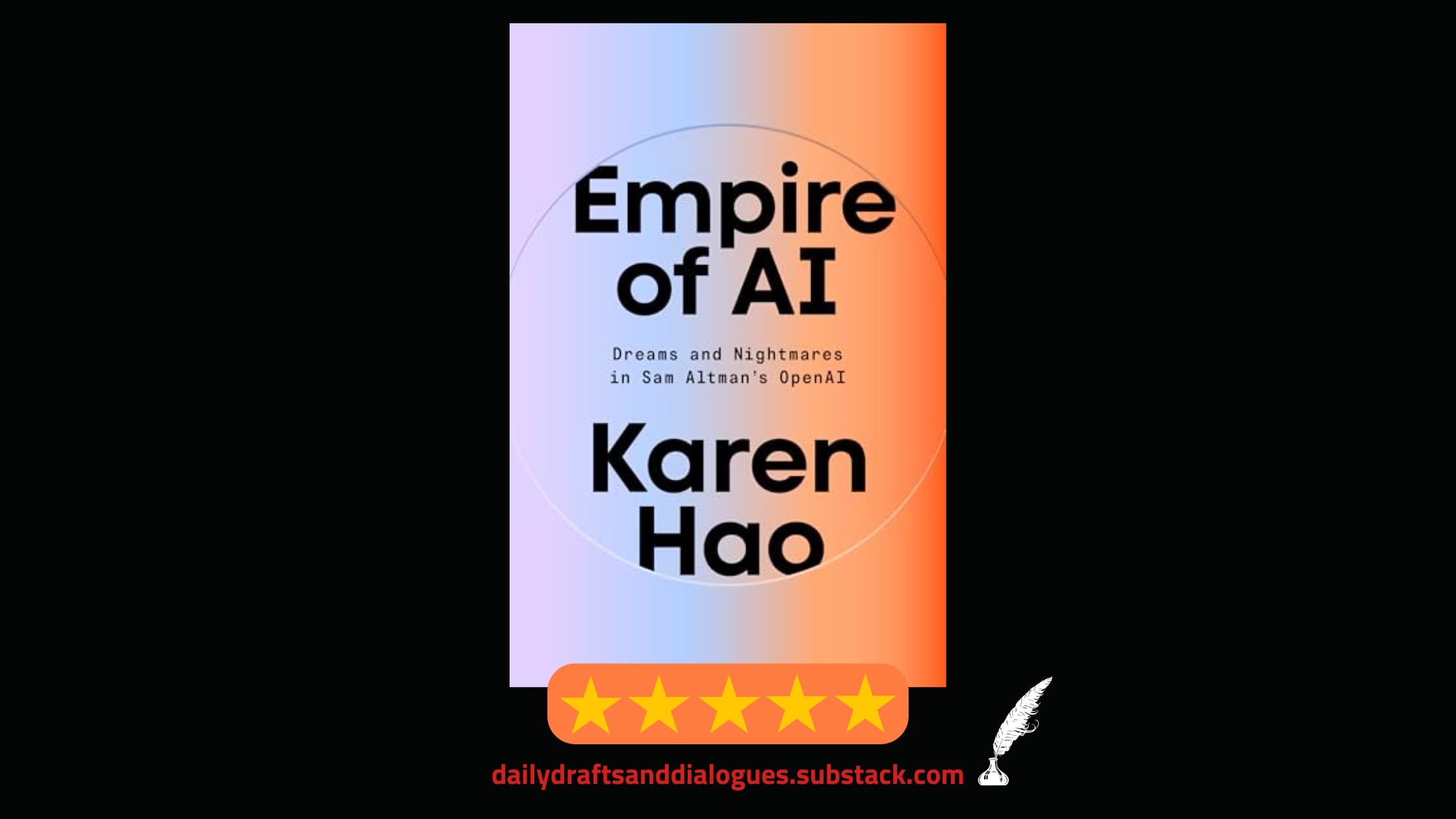
Book Review: Empire of AI
Here’s my review of Empire of AI by Karen Hao. Don’t forget to leave a comment if you’ve read it or plan to read it, or if you have any other book recommendations to share.
Empire of AI: Dreams and Nightmares in Sam Altman’s OpenAI by Karen Hao is a well-researched account of how Sam Altman has vied to create an empire of AI via OpenAI from its inception, often affording him more altruistic credit at the dawn of his pursuits and endeavors than he’s probably due. It also ultimately serves as a rallying cry for the careful, intentional stewardship we need to amass when using and developing AI now and in the near future if we truly want it to ‘benefit humanity.’
Altman’s push to scale OpenAI and his own interests at any cost is as alarming as it is predictable if you remember the playbook of colonialists (some of the original empire-builders), as Hao does throughout this book. Hao expertly makes the case for how OpenAI, with Altman’s leadership, has engendered modern-day colonialism in the AI industry by stealing and exploiting ideas, labor, land, resources, market share, and more, to create an empire that more-or-less became a monopoly with unprecedented economic and political power that spans continents via scaling its operations at any and all costs (both literal and figurative).
This book offers plenty of scathing insider accounts of Altman’s proclivity for obfuscation and grandiose narratives that continually derail or ignore crucial AI safety regulations and concerns, balanced and unbiased AI research, AI oversight and innovation, as well as organizational cohesion at OpenAI. By meticulously disclosing and summarizing communications and interviews, Hoa paints a vivid picture of how Altman has used his power to oust or shun those who disagree with him in ways that have had ripple effects across not only OpenAI but the entire AI industry.
Additionally, this book offers detailed perspectives of those outside Silicon Valley and its AI tech bubble— people who are greatly impacted by AI’s pervasive reach, probably more so than those inside the bubble itself. Through extensive interviews and detailed reporting, Hao gives us a large lens through which to view the impact of OpenAI’s burgeoning empire. We see how the AI industry’s exploitative outsourcing practices disenfranchise real workers across the globe while keeping them unhealthy and trapped in poverty. We also see how the AI industry’s incessant drive to scale computing power and data centers, no matter the cost or consequence, leads to resource consumption and extraction that is not viable for the planet or the communities who live where resources are being consumed and extracted at exorbitant rates.
Overall, I appreciated how Hao explores what can be done about the colonial nature of AI development right now, deferring to ideas and projects researchers, activists, and local communities around the world have worked on and brought to life. And for this reason alone, I believe this book is invaluable to getting important conversations regarding AI development and usage started as soon as possible. While parts of the book might seem gossipy to many readers (especially those inside Silicon Valley), its key takeaways will help facilitate invaluable conversations around the most powerful player in AI right now and how we should all be keeping them in check for the sake of all our futures— AI doomers and boomers alike.
Here are some notable passages from the book:
“Over the years, I’ve found only one metaphor that encapsulates the nature of what these AI power players are: empires. During the long era of European colonialism, empires seized and extracted resources that were not their own and exploited the labor of the people they subjugated to mine, cultivate, and refine those resources for the empires’ enrichment. They projected racist, dehumanizing ideas of their own superiority and modernity to justify—and even entice the conquered into accepting—the invasion of sovereignty, the theft, and the subjugation.”
“We don’t need to accept the logic of unprecedented scale and consumption to achieve advancement and progress. So much of what our society actually needs—better health care and education, clean air and clean water, a faster transition away from fossil fuels—can be assisted and advanced with, and sometimes even necessitates, significantly smaller AI models and a diversity of other approaches. AI alone won’t be enough, either: We’ll also need more social cohesion and global cooperation …”
“Finally, we can all resist the narratives that OpenAI and the AI industry have told us to hide the mounting social and environmental costs of this technology behind an elusive vision of progress.”
“Both his media savvy and dealmaking, two pillars of his rise, rest on his remarkable ability to tell a good story. In this Altman is a natural. Even knowing as you watch him that his company would ultimately fail, you can’t help but be compelled by what he’s saying.”
“It was a bizarre and incoherent strategy that only made sense under one reading: OpenAI would do whatever it needed, and interpret and reinterpret its mission accordingly, to entrench its dominance.”
“Controlling knowledge production fuels influence; growing influence accumulates resources; amassing resources secures knowledge production.”
Subscribe below to receive future book reviews in your inbox, along with other engaging posts. And don’t forget to leave a comment with your book recommendations.
Want to express your appreciation for this particular post?
Buy me a coffee one time, or become a free or paid monthly suscriber for less than the cost of a fancy coffee. Please and thank you! My writing and I are fueled by loyal readers, caffeine, and kind gestures.


