Book Review: Searches
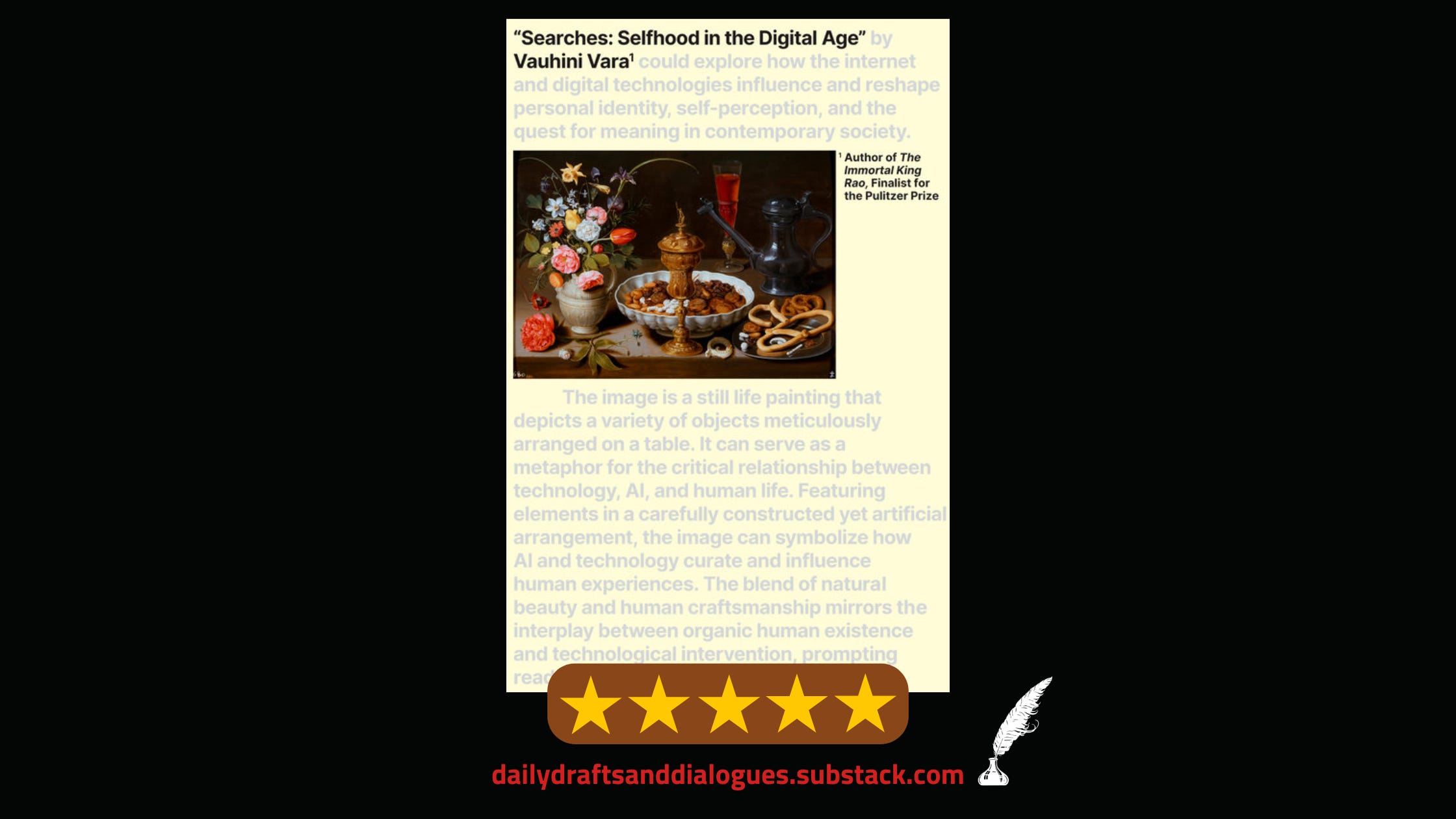
Here’s my review of Searches by Vauhini Vara. Don’t forget to leave a comment if you’ve read it or plan to read it, or if you have any other book recommendations to share.
Searches: Selfhood in the Digital Age by Vauhini Vara is a unique book I highly recommend reading at the dawn of AI innovation. It’s been a while since I’ve read a piece of nonfiction as poignant and creative as this, as it is as informative and interesting as it is vulnerable and inspiring.
The book starts with our complicated history with technology as humans, particularly AI, alongside the author’s personal history with AI and technology as a writer. I found the way Vara uses her own personal narratives to test the power and limits of AI fascinating and illuminating. She shares her interactions with AI and others to introduce insightful dialogues surrounding not only AI’s power and limitations, but our shared experiences and individual responsibilities when using it. In this way, this book is as much memoir as it is novel and persuasive.
While ‘Ghosts’ will likely be a favorite chapter of many readers (and for good reason), my favorite chapters were ‘Searches’, ‘Record the World’, ‘Resurrections’, and ‘What Is It Like to Be Alive?’.
In ‘Searches’ we learn more about Vara and her personal daily life than we do in other chapters by simply looking at her seemingly innocuous search history, making this chapter as personal as it is technically unnerving. Because if we readers can learn about her personal story via her search history, what are the companies vying for such data learning about her, and to what end?
In ‘Record the World’ and ‘Resurrections’ we see how AI can inspire stories that need to be recovered and told. We see the more inspiring, creative side of AI and how it can be used for more nuanced and diverse storytelling, as long as we are fully aware of its current biases and limitations and what that means to how we want to use and advance its capabilities.
And in ‘What Is It Like to Be Alive?’ we encounter dialogues real people in the real world are having about who they are and their lineages, what they remember, the world they want to live in, and how they want to live in it— and how AI can be a part of designing that world, given the stories and information we are feeding it, and how much responsibility we own for its endeavors. I honestly can’t think of a better ending for this book, as it ends with a conversation that we need to keep having.
If you want to read a more nuanced, personalized, and creative take on AI and our (or your) relationship with it, I highly recommend this book. Unlike other books about AI, it neither fiercely lauds nor condemns AI and its potential. Instead, it invites us humans to understand AI and take responsibility for how we want to continue to evolve and use it in the future.
Subscribe below to receive future book reviews in your inbox (~2 per week), along with other reading and writing inspiration. And don’t forget to leave a comment with your book recommendations.
Want to express your appreciation for this particular post?
Buy me a coffee one time, or become a free or paid monthly suscriber for less than the cost of a fancy coffee. Please and thank you! My writing and I are fueled by loyal readers, caffeine, and kind gestures.


