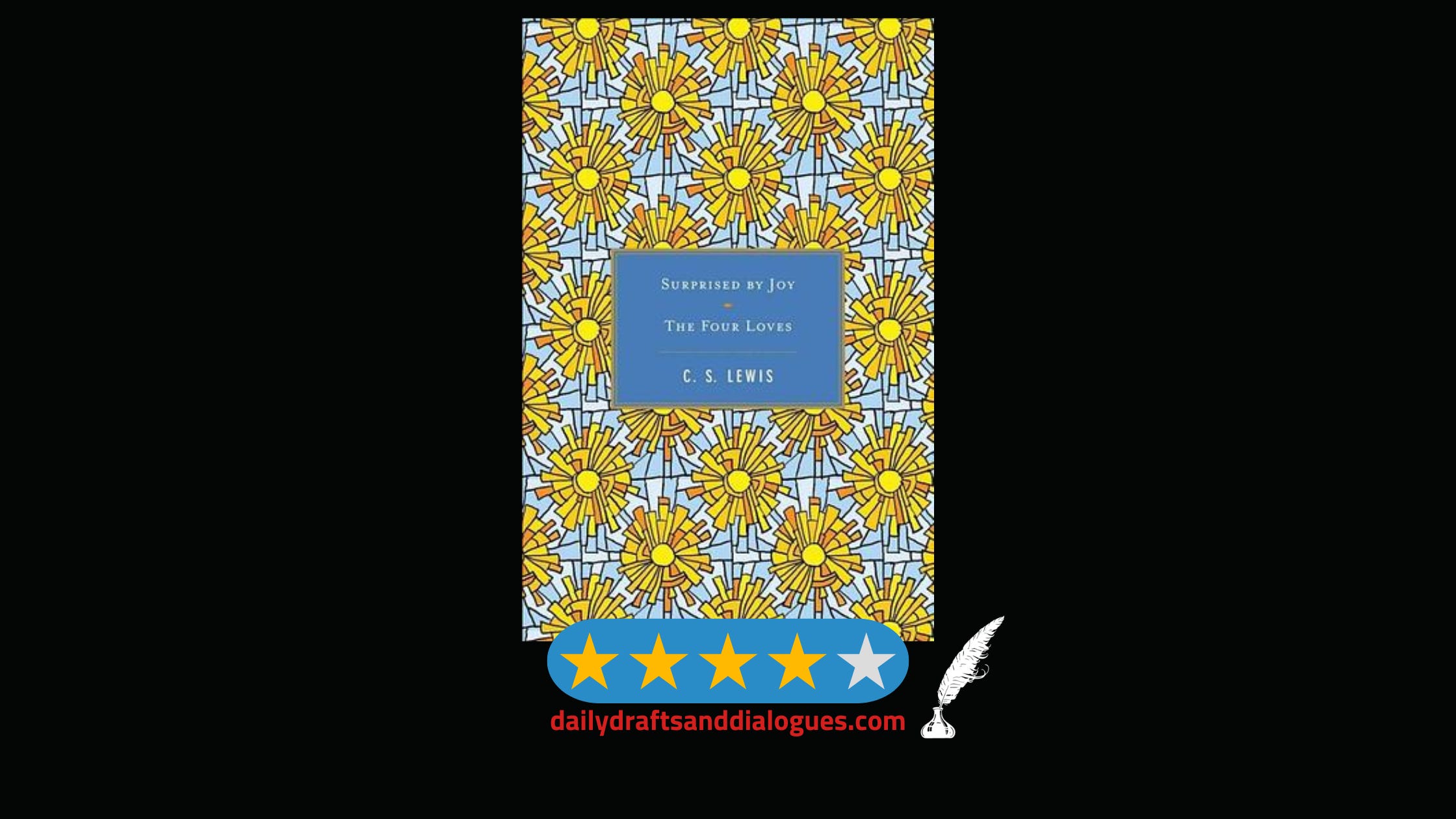
Book Review: Surprised By Joy and The Four Loves
Here’s my review of Surprised By Joy and The Four Loves by C.S. Lewis. Leave a comment if you’ve read it, plan to read it, or have any book recs to share. And don’t miss today’s writing prompt.
Surprised By Joy and The Four Loves by C.S. Lewis is a book with two interesting works to read back-to-back, as their underlying messages do overlap. The first work, Surprised by Joy, covers Lewis’s literary and educational experiences and influences, and outlines how he was surprised by joy in his young adult life, which eventually led to his Christian spiritual awakening. And, one can assume, The Four Loves is a work that came out of such a formidable experience, which he wrote later in his life.
In the first work included, Lewis details the stories and literary works that inspired him to write and keep reading, especially those that ignited his imagination and brought him joy. From a young age, he was a voracious reader, which influenced the entire trajectory of his young adult life, as well as his life-long desire to find intellectual and imaginative joy. He also details how introverted he was when he started going to boarding school and how his life shifted after his mother’s death. And how, though he and his older brother were close, there were extended periods of time that he was alone to endure educational institutions that he found uninspiring and subpar (to put it mildly), until he started being tutored by Mr. Kirkpatrick at Great Bookham, which is where he learned how to think more critically and prepare himself for his education at Oxford.
Lewis admits to being a lackluster Christian growing up but also mentions how he detested socialism and the rules of the collective, eventually becoming a strict materialist … until he winds up becoming a true Christian believer via philosophical inquiry when he is at Oxford. Which is not usually how people end up becoming Christians. In fact, this path to conversion is quite uncommon. (I would recommend reading Mere Christianity by Lewis if you are interested in exploring more about this, as well as his arguments for Christianity.)
Overall, I enjoyed learning about the books and experiences that influenced Lewis’s Animal Land and his world of Boxen, which undoubtedly influenced his later work, The Chronicles of Narnia. I also appreciated how literature and critical thinking inspired true joy for him, and how nature and poetry inspired him to believe in magic in various ways, and that he paused to reflect on these things throughout his young life, which isn’t the norm. However, sometimes I did feel a little bogged down by the minutiae of his early life.
In the second work included in this book, Lewis discusses the four types of love he identified at some point after his conversion. I must confess that for this portion, I set the book down to listen to the audio recording of Lewis talking about the four loves instead. It is the only surviving audio recording of him speaking available to the public, so I felt compelled to listen to it. And it does follow the main arguments in the book closely.
In both audio and text versions, Lewis explores four types of love previously identified by the ancient Greeks, amending them to match his Christian theology: Storge (affection), Philia (friendship), Eros (romantic), and Agape (charity). He analyzes how these human loves can become demonic and or destructive or selfish when wrongly prioritized, urging that they be directed by Divine Love, or God’s love.
Storge is the most basic, familiar, and natural love, often found in familial bonds or bonds of dependency. Philia is considered the least jealous or instinctive love, built on common interests and mutual admiration, and is the least natural or necessary when compared to the other loves. Eros is passionate, typically including an ‘in-love’ longing, focusing intensely on another person rather than just sexual desire. And Agape is the highest form of love, representing selfless, unconditional, Divine love that enables the other ‘natural’ loves previously mentioned to function properly.
Even if you aren’t a Christian, you might find The Four Loves interesting, as it allows readers to explore the intersection of human experience with theological, sociological, and psychological concepts and relationships. I, for one, could not stop thinking about how Lewis’s ideas on Philia love could help us better understand the current loneliness epidemic we’re facing, as well as the inner and outer workings of the online manosphere.
While I didn’t always agree with where Lewis’s arguments landed, I did find his work compelling enough to spur important dialogues about everything from the power of literature to why genuine human bonds and friendships are important when trying to understand spirituality. And I would recommend this book to C.S. Lewis fans as well as readers who want to read something a bit more introspective and philosophical.
Have you read this book yet, or plan to read it soon? Leave a comment to start a discussion. Or tell us what we should read next. And don’t forget to subscribe to receive future book reviews in your inbox, along with other engaging posts.
© This work is not available for artificial intelligence (AI) training. All Rights Reserved by K.E. Creighton; Creighton’s Compositions LLC.
Want to express your appreciation for this post and writing prompt?
My writing and I are fueled by loyal readers, caffeine, and kind words, so I appreciate any support you can offer that keeps me writing. Thank you so much!
Today’s Writing Prompt
Writing Prompt: Free Write, Joy
Set a timer for ten minutes. Once you start the timer, start free writing about joy or the last time you experienced joy.
Writing Tip
Write down whatever comes up as soon as it comes to your mind and don’t overthink what you’re writing about. Don’t stop writing until the timer goes off. And feel free to repeat this free writing exercise for any topic in the future, especially when you find yourself stuck or needing a bit of creative inspiration.