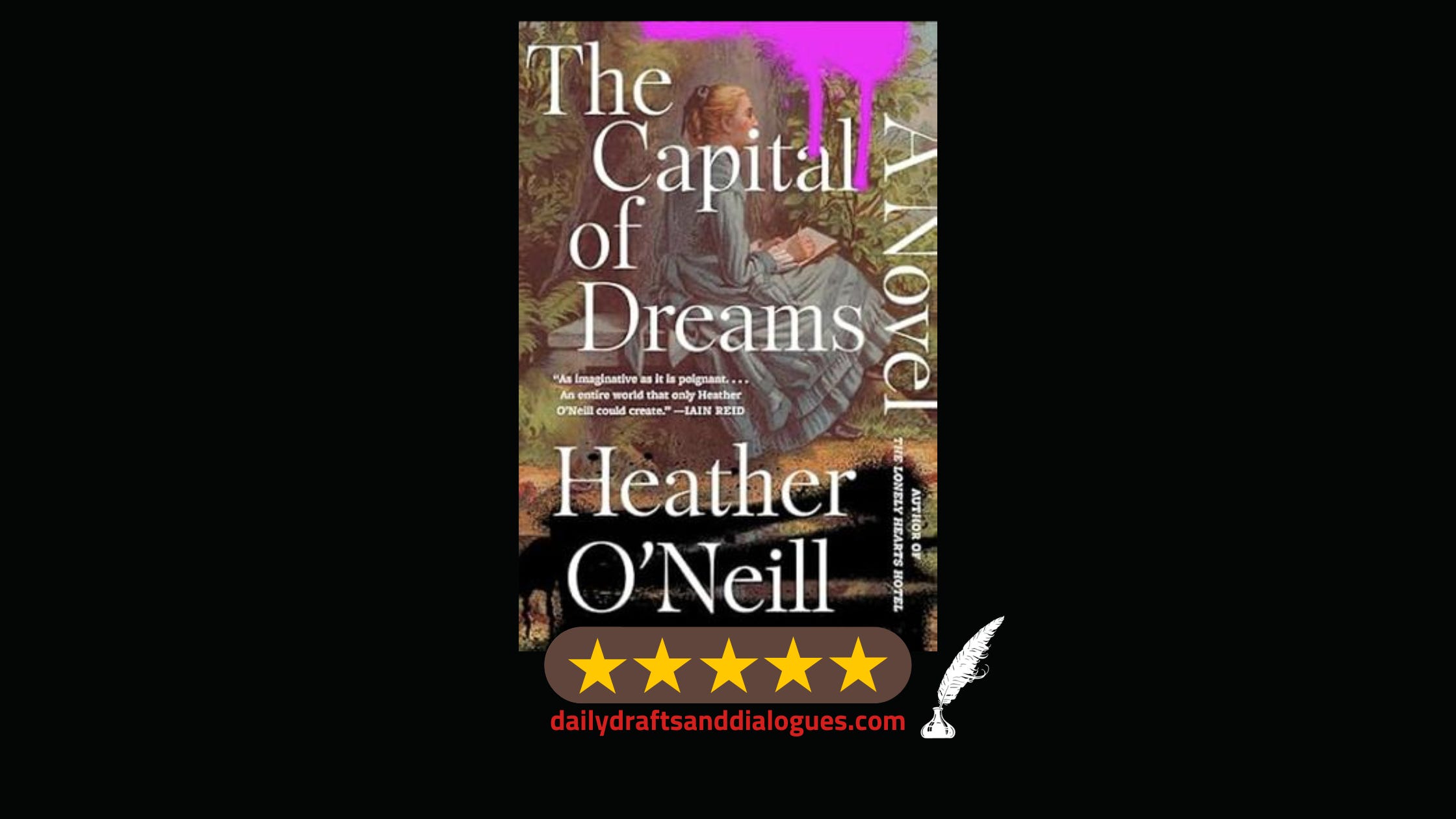
Book Review: The Capital of Dreams
Here’s my review of The Capital of Dreams by Heather O’Neill. Don’t forget to leave a comment if you’ve read it or plan to read it, or if you have any other book recommendations to share.
The Capital of Dreams by Heather O’Neill is a surprising book that may seem simple on its surface, though it is anything but, as it is an interesting and striking example of metafiction unpacked via ruminations and stories told during wartime, which are all intermingled with a complex mother-daughter relationship that unfolds as the main character is coming of age. It is oddly nostalgic and humorous and heart-warming and enlightening and shocking and tragic and endearing all at the same time.
Could there be anything worse than being a girl going through puberty during wartime? I think not. Unless maybe you’re Sofia, the novel’s main protagonist, and have been influenced by the stories your strongly opinionated mother has told you your whole life about the power of art and creativity as well as who you should be, along with the stories you read over and over again in your favorite children’s book, which she abhors.
At the beginning of the novel, we follow Sofia’s seemingly absurd encounters with a talking goose (who ends up being her travel companion for most of the novel) and two boys who commandeer her grandmother’s country house. And you can’t help but laugh at some of these encounters at first, as it feels like you’re reading a silly nursery rhyme, where nothing makes sense, anything is possible, and everyone is going off the rails.
But as you’re being entertained, you’ll still begin to wonder: Does anything ever make sense during wartime anyway, particularly to a child? And do the stories we tell about a war or during a war ever make sense either? So, why not tell fairytales about it all? Especially because, as we all know, every good fairytale has some sort of moral or lesson to be revealed by its ending, which is ultimately what makes them truer than any seemingly objective historical account somehow … which will keep you reading.
Everything is absurd and Sofia seems so childish at the beginning of the novel, to the point that she may annoy you. But remember: this is a coming-of-age tale. So, keep reading. You won’t be disappointed because midway through the novel you’ll be starkly reminded of how nursery rhymes, as with most parables we tell children, reveal lessons on how to survive, think for yourself, find yourself amid chaos, make untrustworthy friends, and ultimately, thwart or outwit evil.
You’ll be reminded that while we bemoan the silliness of fairytales, and how they’re such a waste of time— especially during war! — as Sofia’s mother does via flashbacks, that they still influence how we form most of our opinions about the world and how to survive in it when we are younger and impressionable, along with opinions about who we are and what kind of person we want to become in such a world.
As Sofia becomes a young woman, we see her grapple with her mother’s opinions and literal words, as she continues to search for her mother’s ‘lost’ manuscript and forge her own path in a lost world with many places that only exist in one’s imagination. And when we learn of her ultimate betrayal toward the end of the novel, a major WTF kind of plot twist which is also oddly honorable somehow, we learn the true value of the stories we tell ourselves and share with others and how they can quite literally keep us alive and forge our trajectories and who we become in life.
Overall, I would recommend this novel to literary fiction readers who relish metaphors and analogies and other literary devices that are mixed with nuance and subtle-yet-not-so-subtle feminist narratives and satire and believe in the power of storytelling.
Here are some notable passages from the novel, of which there are many:
“Oh, she had had it with this war! The Enemy’s persecution of artists was only giving them a ridiculous pompous view of themselves. And they had rendered going to the store a perilous adventure. How she longed for the simplicity of her former boring life in the Capital.”
“‘Oh, Sofia, you can’t always read children’s books for the rest of your life. It will break my heart if you don’t grow as a reader. There’s so much out there for you to read and discover. Talking hares are a waste of time. They are there to amuse children. But they can’t really teach you about the world. The modern world, Sofia! Don’t you want to read books by living writers? With new ideas? Rational ideas? It’s through reading that I became an adult. You can’t learn anything in your enchanted forests.’ Throughout this entire diatribe, Sofia looked at her mother with a blank expression on her face. When she saw that her mother had finished what she was going to say, she calmly cast her eyes back to the pages of her book and continued to read it. She would continue to read, even were she to grow carsick. She liked that her mother disapproved of this book. It was a way for her to feel as if her reading had nothing at all to do with her mother. Which was not an easy thing to do, considering how attached her mother was to everything literary in the country. How could Sofia look at books, any pile of books, and not feel a certain resentment towards them? And in any case, Clara was wrong. Because Sofia had evolved as a reader. It was simply that she liked to read the same book over and over. When you reread a book multiple times, you begin to find secrets in the text. You can dip your toe in the book and feel the delightful cold of the subtext.”
“The country had put so much effort into creating newspapers and presses and radio shows. And now here she was, hearing about the war from two boys in her grandparents’ clothing.”
“She had believed in the survival of her mother’s book because she still put stock in make-believe. And in a fable, an object as precious as her mother’s manuscript could never disappear. It could only ever transform into a stream, or a wolf, or a tree, or a road, or a talking bird. She had to come to the Black Market to stop believing such a thing was possible. To trade in her childhood desires for new ones.”
“The thing about the metamorphosis out of girlhood is that there is a buoyancy to it. It is a moment in life, a brief flash when you must at least try to run. To see if you can run fast enough to catch up to that feeling of being yourself. And claim it as your own.”
“And it was by listening to this girl sing a contraband song that she knew the Enemy had not won and would never truly win. There would always be artists. There is a need to create art. And the nature of good art is to express freedom. It finds a way to reject oppression. And some people might say that artists are silly. And that art is a frivolous and unessential part of life. And that artists are irrational and live ridiculous lives and never truly grow up. And that you cannot equate art with necessities like food and shelter. But here was a song that had survived a war. And when Rosalie sang it, whenever she sang it, it would be a reminder that the Leader’s vision had not penetrated the souls of everyone in their country. There was a dissident voice. This song written by the executed singer was contagious. Rosalie might sing it around a group of soldiers, and they would then have the song in their heads. And it would cause them to think in an irreverent way. That was why Sofia’s mother’s book was of such radical importance. If she could save anything from the artists, if she could take even a single clipping from the branches of their thoughts, it could be put in a glass on a windowsill by a child with an imagination and it would grow into a beanstalk.”
© This work is not available for artificial intelligence (AI) training. All Rights Reserved by K.E. Creighton; Creighton’s Compositions LLC.
Want to express your appreciation for this post?
My writing and I are fueled by loyal readers, caffeine, and kind words, so I appreciate any support you can offer that keeps me writing. Thank you so much!


