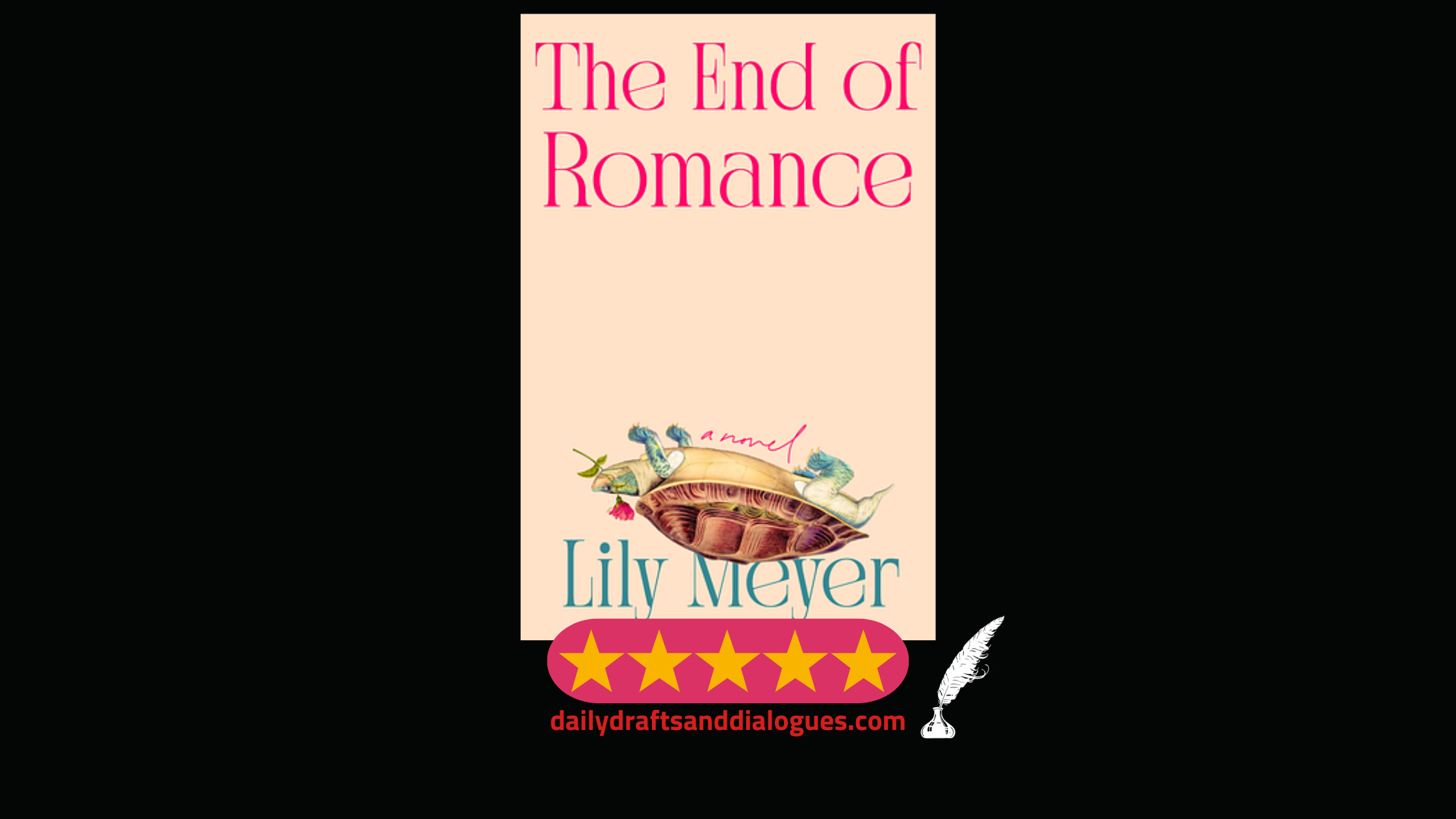
Book Review: The End of Romance
Here’s my review of The End of Romance by Lily Meyer. Leave a comment if you’ve read it, plan to read it, or have any book recs to share. And don’t miss today’s writing prompt.
The End of Romance by Lily Meyer is a philosophical coming-of-age romance novel with a ton of excellent dialogue. It will appeal to those who want to explore a variety of arguments for and against romance, as well as those who are even loosely familiar with a bit of philosophy of feminism or feminist political movements and thought to some degree, though familiarity with those fields is definitely not a requirement to read this book. This novel will also appeal to readers who enjoy written works that allow them to reflect on their own romantic and sexual impulses on deeper psychological and sociological levels as well as philosophical levels. But it could even appeal to readers who just want to read a good coming-of-age story that is highly realistic and not overly traumatic.
The novel starts with Sylvie coming into her sexuality during high school, and how it is quickly monopolized by her high school boyfriend, Jonah. Many arguments could be made regarding how and why their relationship develops the way that it does as they enter college together and stay together— in fact, Sylvie ends up making many of these arguments herself in the novel. And most readers will be frustrated with Sylvie and some of the decisions she makes during this time in her life since she still has a lot of self-reflection and growing up to do. Jonah can be unkind, controlling, and manipulative, but Sylvie tolerates his behavior… until she doesn’t.
Remembering how much she enjoyed philosophical dialogues with her grandfather and friends from college, Sylvie ends up leaving Jonah and going back to college to study philosophy, then winds up working on a dissertation exploring the end of romance. As she works on her dissertation, she explores many avenues of inquiry based on other modes of philosophical thinking, continually tweaking her theories on romance and how individuals, especially women, can and should free themselves from its grasp— when Robbie and Abie show up in her life and cause her to question everything she thinks she knows and feels about romance, as well as love. (Side note: Be sure to read this novel to its very last page if you want to know where Sylvie ends up in her theories on romance and love. It may not be what you expect.)
Following Sylvie’s inquiries will encourage readers to question many things about her relationships, as well as their own. They’ll begin to ask things like: How much, and what, should be made public or private in a relationship? In what ways is physical pleasure connected to and or separated from emotional intimacy? How much does our first sexual encounter(s) affect our later sexual encounters in life? How much does the broader social discourse on sexuality and femininity and victimhood affect our own sexual and intimate relationships? How much does the affection our parents give (or don’t give) us when we are small affect us when we grow older? And, most importantly, when does philosophical inquiry help us better understand ourselves, romance, and love, and when does it not? Or in what ways can philosophical inquiry itself be improved to better understand such things?
Fair warning: There are a lot of references to sex in this novel, and for good reason, though I will admit they became tedious at times. Yet so many references to sex do square with the issues Sylvie is grappling with and trying to understand over the course of the novel. Plus, it is a coming-of-age story, and people coming-of-age do tend to be obsessed with sex and their relationship with it, as well as their understanding of it.
Most of all, I enjoyed the philosophical dialogues between Sylvie and her best friend, Nadia. They were enlightening and often funny. But they were also intimate and essential to how Sylvie winds up exploring and understanding her own relationship to romance and love. And they’re also a testament to women existing within the limitations of hegemonic philosophy and institutionalized philosophical thinking and inquiry, for better and worse.
Overall, I would recommend this novel to readers who are interested in exploring the inner and outer workings of romance and when it becomes helpful and or problematic. I should also note that this novel is not likely to appeal to readers who aren’t curious about the nature of their own relationships or relationship dynamics, or who are more interested in fast-paced plots than genuine character development.
Have you read this book yet, or plan to read it soon? Leave a comment to start a discussion. Or tell us what we should read next. And don’t forget to subscribe to receive future book reviews in your inbox, along with other engaging posts.
© This work is not available for artificial intelligence (AI) training. All Rights Reserved by K.E. Creighton; Creighton’s Compositions LLC.
Want to express your appreciation for this post and writing prompt?
My writing and I are fueled by loyal readers, caffeine, and kind words, so I appreciate any support you can offer that keeps me writing. Thank you so much!
Today’s Writing Prompt
Writing Prompt: Romance Woes
Write a scene in which someone has an embarrassing or undesirable romantic experience. Or write about a similar experience you have had yourself.
Writing Tip
If you’re having issues figuring out what to write, think about some of your favorite rom coms for inspiration. Or think about what makes you uneasy or nervous when you’re around someone you’re romantically attracted to.