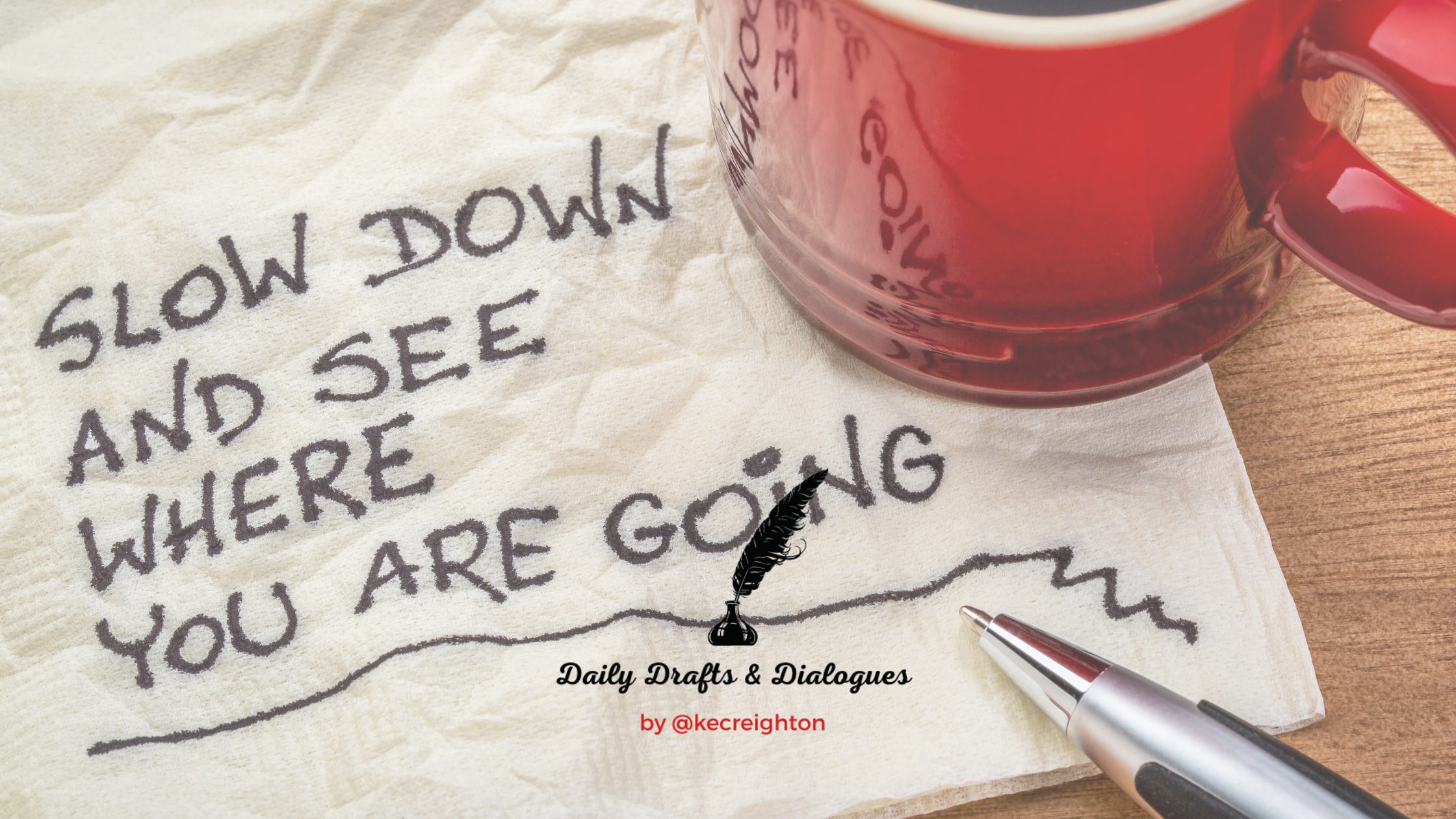
If you really want to be revolutionary, slow the f*ck down, then write.
Taking time to reflect before responding to anything, especially on the wilds of the internet, is a revolutionary act now. Read more, leave a comment, then scroll to see today’s writing prompt.
I know, I know. The headline of today’s post makes me sound like some old curmudgeon who is yelling at the kids across the internet for stamping across her well-manicured lawn, digitally and metaphorically speaking. And maybe in a way I am. Because, like a lot of other folks out there (especially those in my Substack community), I am tired, so very tired of needing to wade through all the surface-level, negative, reactive content on the internet before I can reach anything remotely reflective or interesting these days. It’s exhausting.
Mini rant aside, however, I do truly believe that in order to get anything worthwhile done these days, it’s essential to slow down and reflect. And that such essential reflection requires one to disconnect from their feeds and devices for hours at a time, sometimes days at a time, before they write. Chances are good I don’t need to convince you that writing is essential to reflection if you’re already reading this post, which is an amazing start. But more than that, I want to emphasize how slowing down to write more intentionally is itself a revolutionary act these days, and how it’s the first critical step to writing something revolutionary, whether for yourself, others, or both.
Indeed, writing without ever slowing down long enough to reflect on what you’re writing about first could lead to more harm than good in the long run, for everyone. In our age of incessant reactivity, attracting attention and collecting as many likes and as much engagement as soon as possible, whether it’s meaningful or not, positive or not, is the sole aim of most writers and content creators. But this requires them to leverage tactics and strategies that, even if they don’t want or mean to, leverage the rage-inducing algorithms which keep rage-baiting content alive and prominent. A lack of a deeply human-centered strategy, one that is separate from the algorithmic gods of rage and chance, in other words, can lead to even more harm.
So, what would happen if more writers and content creators stopped to think critically about the language they were using, how, when, and why first, before they wrote or shared anything with others. What if more writers (this includes traditional media journalists too, btw) took a beat to actively question fleeting trends pervading the internet before reacting to them? What if more writers wrote private journal entries to further develop and understand their own thoughts and feelings about something first, before they wrote or shared anything they wanted the entire world to have access to? What if more writers adopted a curious mindset, instead of a defensive or hostile mindset, in other words? What if more writers … slowed the f*ck down before they wrote anything they intended to publish one day— all writers, from novice bloggers to well-established freelance journalists to award-winning novelists, and so on? Would we have more revolutionary content that would stand the test of time and lead to effective, long-lasting change then?
I will fully admit that I’m no saint. I can fall prey to the whims of the rage-baiting algorithms and their arbiters too if I’m not diligent about my own online activity. But I do try my best to pause and reflect on what I think and feel as I write first and second drafts. In fact, one of the main reasons I started Daily Drafts & Dialogues is to hone and maintain this practice of consistent reflection as a writer.
I also do my best to never publicly react to the content I’m reading or seeing online (via liking it or commenting on it) without considering its purpose and actual value first, which is particularly important for the content that gives me the most visceral reactions. If something makes me feel anger or disgust or sorrow in the span of a millisecond, I am immediately skeptical of it and who is trying to leverage it to elicit such emotions from me and why. Because in my experience, emotions can help you determine what really matters to you, and there is immense value in that, but only critical thinking and reflection can tell you what you can and should practically do about those emotions in the real world. (This of course does not apply to cute animal videos, because of course I’ll like and heart them all as soon as I see them!)
This practice of slowing down to reflect as you write first and second drafts, or before you hit that Publish button, will also allow you to slow down long enough to smell the flowers, both literally and figuratively. Reflecting on what you’re seeing and experiencing isn’t always bad and dystopic, though rage-baiting algorithms will make you believe otherwise— especially during the springtime, when the world is literally in bloom.
Slowing down long enough to reflect on the world around you can permit you to notice all the beauty and good in the world too, offering you a more balanced and realistic perspective outside of the terrible things being sold to you as the ‘truth’ via your more personalized and siloed version of ‘truth’ on the internet. Yes, there are evil people in the world, but there are also just as many, if not more, inherently good and wonderfully weird and creative people, as well. So, instead of doomscrolling, start bloomscrolling. (Yes, that was a cheesy thing to say. You’re welcome.)
Oh, and when you slow the f*ck down to reflect, please think critically about what you’re reading too, as well as what you’re writing. In Read everything slower. I discuss this in detail. Here’s an excerpt:
“Most people in our society aren’t critical about what they themselves think, say, or do before they think, say, or do it anymore. And I believe this is happening because people aren’t slowing down to intentionally read and process language as often as they should, if ever. They’re just too busy reacting to the language they come across instead, regurgitating language they’ve consumed but haven’t fully processed.
I believe that reading everything slower, and more intentionally, can not only improve critical thinking skills but possibly quell most of the anxiety a lot of us are feeling. Truly, I don’t think it’s possible to have critical thinking skills, or remain sane, if you aren’t intentionally processing language when you come across it on a regular basis, especially when it’s written.”
It’s easy to mimic what’s popular and get people to react, which is why that’s what everyone is doing. And doing so can and likely will prove a profit-generating strategy, for a little while at least. But any writing created to propagate such strategies will not stand the test of time as they are, in essence, based on lies of varying degrees. And people of all stars and stripes, quite famously, do not like being lied to or being sold to once they are aware of what’s going on and how their emotions are being manipulated for profit or other nefarious reasons.
It’s revolutionary, however, to slow down and pause and reflect as you write first and second drafts, and before you hit Publish, especially when the entire profit-driven world we live in is based solely on attracting immediate reactive attention, not genuine understanding or human connection.
In our world, it is a revolutionary act to slow the f*ck down, then write, as well as read, because it requires you to stand your ground (sometimes quite literally), as the algorithms and people who leverage them are insisting that you don’t. Seriously, if you want to be a revolutionary, stand still and reflect on what you genuinely think and feel about something so that you can genuinely use your critical thinking skills to connect with others.
I don’t know about you, but I am so ready to read more of the writing that will come out of whatever this next digital creative revolution, full of thoughtful, intentional, creative thinkers and doers will look like and stir up.
As I close today’s post, I want to offer you some relevant words of advice to consider:
“Resistance and change often begin in art, and very often in our art, the art of words.” — Ursula K. Le Guin
“Rome wasn’t built [or destroyed] in one day.” - common idiom
“No, I do not weep at the world—I am too busy sharpening my oyster knife.” ― Zora Neale Hurston
“Not causing harm requires staying awake. Part of being awake is slowing down...” — Pema Chödrön
“If something inside of you is real, we will probably find it interesting, and it will probably be universal. So you must risk placing real emotion at the center of your work. Write straight into the emotional center of things. Write toward vulnerability. Risk being unliked. Tell the truth as you understand it. If you’re a writer you have a moral obligation to do this. And it is a revolutionary act—truth is always subversive.” and “Almost everything will work again if you unplug it for a few minutes, including you.”— Anne Lamott
“No need to hurry. No need to sparkle. No need to be anybody but oneself.” ― Virginia Woolf
“For women, then, poetry is not a luxury. It is a vital necessity of our existence. It forms the quality of the light within which we predicate our hopes and dreams toward survival and change, first made into language, then into idea, then into more tangible action.” and “Revolution is not a one time event.” —Audre Lorde
“Critical thinking requires us to use our imagination...” — bell hooks
“Slow down to the speed of wisdom.” — Vicki Robin
“It was not in my nature to be an assertive person. I was used to looking to others for guidance, for influence, sometimes for the most basic cues of life. And yet writing stories is one of the most assertive things a person can do. Fiction is an act of willfulness, a deliberate effort to reconceive, to rearrange, to reconstitute nothing short of reality itself. Even among the most reluctant and doubtful of writers, this willfulness must emerge. Being a writer means taking the leap from listening to saying, ‘Listen to me.’”― Jhumpa Lahiri
“Put your ear down close to your soul and listen hard.” — Anne Sexton
What are your thoughts on this topic? Leave a comment to join this dialogue, and don’t forget to share this post with others so they can join this dialogue too.
© This work is not available for artificial intelligence (AI) training. All Rights Reserved by K.E. Creighton; Creighton’s Compositions LLC.
Want to express your appreciation for this post and writing prompt?
My writing and I are fueled by loyal readers, caffeine, and kind words, so I appreciate any support you can offer that keeps me writing. Thank you so much!
Today’s Writing Prompt
Writing Prompt: “Slow down.”
Write a piece of flash fiction in which someone says to someone else, “Slow down.” Or write about the last time you said this to yourself or someone else, or someone else said it to you.
Writing Tip
Before you begin writing, consider: Who is saying this, why, and to whom? Where are they and what time of day is it?


