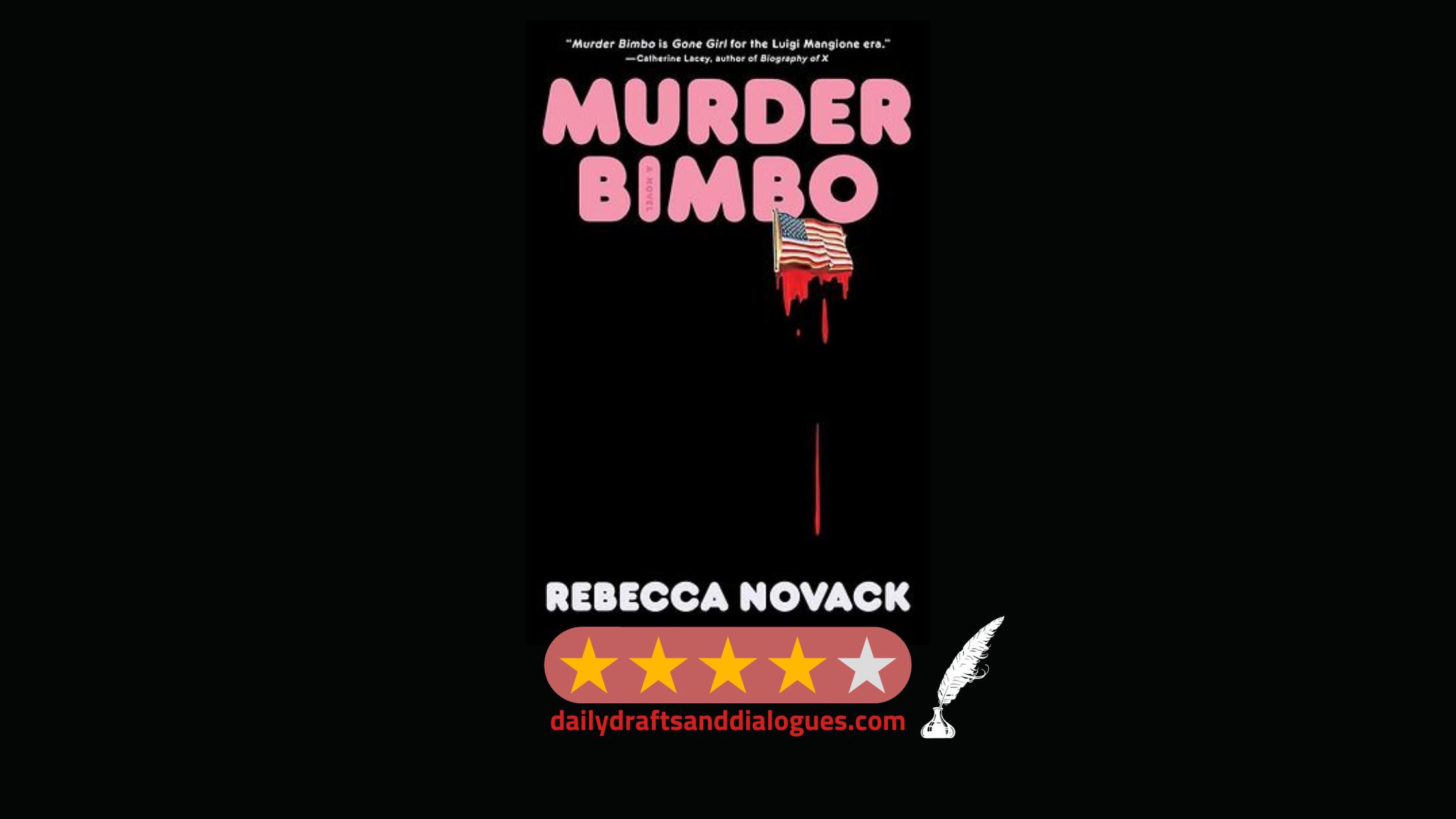
Notes on Murder Bimbo
Murder Bimbo by Rebecca Novack offers a wild ride for readers who don’t mind ethically ambiguous stories. Read my notes and leave a comment to discuss. Then scroll to see today’s writing prompt.
Murder Bimbo by Rebecca Novack is one of those novels that will make you question your own moral compass when you get done reading it. It’s dark and twisty, and at a certain point you’ll start questioning everything you thought you knew and are learning about the narrator. I would suggest reading it when you’re in the mood for something that will mess with your head a little bit, while making you think about your own ethics and internalized stereotypes.
The novel starts with the narrator, Murder Bimbo, writing an email to Justice Bimbo, a prominent podcaster who covers stories about major crimes against women (Both names are aliases.). In the email, which spans multiple chapters, Murder Bimbo explains a little bit about who she is and her background, why she’s on the run, and how she got involved in the murder of a well-known misogynistic talking head turned politician, Meat Neck, all while nudging Justice Bimbo to tell her side of the story. Then, about a third of the way through the novel, the narrator, still on the run, is telling the tale of how she got involved in her current situation in emails to X (also an alias), her ex-girlfriend. And while the stories she tells both email recipients overlap in a lot of ways, there are critical details that are told differently, especially those surrounding the underlying motives of the narrator and her interactions and involvement with her nazi-sympathizing co-conspirators and clients.
As you keep reading this novel, it’s impossible not to evaluate your own ethics and internalized stereotypes regarding sex work and sex workers, as the narrator is an unapologetic sex worker who claims multiple times that she enjoys her job and didn’t fall into her line of work due to unresolved trauma from her past. However, in all the versions of the tale she tells, she is estranged from her parents, doesn’t have real friends she can rely on, has an unhealthy and or inconsistent understanding of what love is and how it should be expressed, is extremely isolated, lives outside the law and doesn’t trust law enforcement, and has been a victim of various forms of violence and or degradation perpetrated by Meat Neck and or plenty of men like him. So, readers paying attention to the gaps in her narratives will be left wondering who Murder Bimbo really is and what motivates her by the end of the novel. Is she motivated by love, revenge, carnal desire, ardor, resentment, boredom, bravado, ego, or a mix of all those things? Or is she motivated by something else entirely, or simply cold-blooded?
Overall, I appreciated how this novel explored the inner workings of a morally grey character who most people probably won’t have sympathy for in the beginning, as her narrative(s) begs the question of who we care about and listen to in society (or don’t) and why. Why would we listen to and believe a ‘bimbo’ sex worker, it seems to ask. It also challenges the stereotypes surrounding sex work and sex workers and who they are and what they’re capable of, especially once you realize, as you read the novel, that they have connections to men in every single corner of society, and therefore shouldn’t be underestimated or mistreated as much as they are. Yet the narrator’s perspective also calls into question the ethics surrounding vigilante justice and lethal motives.
That being said, I wished there were more chapters told from the narrator’s perspective, outside of the emails she wrote, as I wanted to read more about her inner workings and what truly motivated her via her direct voice. I also wanted to know more about her history and previous interactions with Meat Neck, which took place prior to the main timeline in the novel, as well as her history with her ex, via flashbacks or something similar perhaps? I suppose I was left wanting to read more of the narrator’s uncensored perspective, when she is no longer filtering her narrative for her email recipients, though I am sure that was likely intentional?
Here are some notable passages from the novel:
“Like with all of them, it would be hard to step back and look at me without thinking that I brought the danger on myself. I am not entirely innocent. At least I should have known better. That’s the world we live in, right? You can either make every effort to be and appear innocent, if you’re a woman, and usually still get fucked and blamed for it. Or you can live your life, hope the happiness outweighs the danger, and sort the rest out when you have to. I guess now I have to.”
“Here’s your chance to catch me before I become a scapegoat, a punching bag, or a monster who needs reputation restitution. Please, please, please turn me into a feminist antihero.”
“The sad parts of sex work don’t come from the sexual nature of the work itself but from the systems around it: getting arrested for doing a job that is constantly in demand, doing that job without any benefits or safety net, and then feeling like even though you’re working your ass off, you’re the one who is supposed to be ashamed of it. Those things absolutely affect me. But most people think only abused and traumatized people become sex workers. The truth is, it’s just a job like any other job.”
“But like most humans, in the moment, I ignored the red flags. I saw things the way I wanted to see them. I made the choices I wanted to make. The real question now is: If you do something great for the common good, don’t the benefits to society outweigh the personal gain?”
“I am telling you all of this because I want you to know that I am capable of great love and connection. I am not disposable. No one is, but I’m not, either. Please don’t let people forget me. When all this assassination stuff started I just so happened to be in a place in my life where none of my loves were actively reciprocal. I was less connected to people than I have been at other times.”
“You’re my witness, too. You know I always clean up the story of my past a bit for the audience, so I don’t get pigeonholed as a tragic figure. It’s hard to be a sex worker from alcoholic, abusive parents who disown you for being gay. It’s so cliché! You’ve heard me tell the toned-down version so many times and nodded along. Thanks for being the person who knows it’s so much worse than what I tell everyone else. It helps me remember the truth.”
“Why was it my responsibility to hurt myself more in order to possibly protect other women? Why does so much of the burden to stop harm fall on women? Especially when we both knew I probably wouldn’t be successful. Much more respected women had gone up against much less powerful men and been destroyed—women with college degrees, real jobs, lawyers.”
“I want to explain that no, actually, I have filled my time with productivity, women fill their time with productivity, they don’t just wait around to do stuff. I want to tell him that having him here ‘to look out for me’ doesn’t make me feel better. Women don’t feel better alone with one man. They feel better alone.”
Have you read this book yet, or plan to read it soon? Leave a comment to start a discussion about it. Or tell us what we should read next!
© This work is not available for artificial intelligence (AI) training. All Rights Reserved by K.E. Creighton; Creighton’s Compositions LLC.
Want to express your appreciation for this post and writing prompt?
My writing and I are fueled by loyal readers, caffeine, and kind words, so I appreciate any support you can offer that keeps me writing. Thank you so much!
Today’s Writing Prompt
Writing Prompt: Clandestine
Write a scene in which someone is doing something clandestine. Or write about a time you or someone you knew did something clandestine.
Writing Tip
Before you begin writing, consider: What is this person doing? Are they alone? Where are they? And why must they be secretive or clandestine about what they are doing?