August Theme: The Creative Life
Big Question: How do we build a creative life that works for us?
Week 4: Preparing for What Comes Next
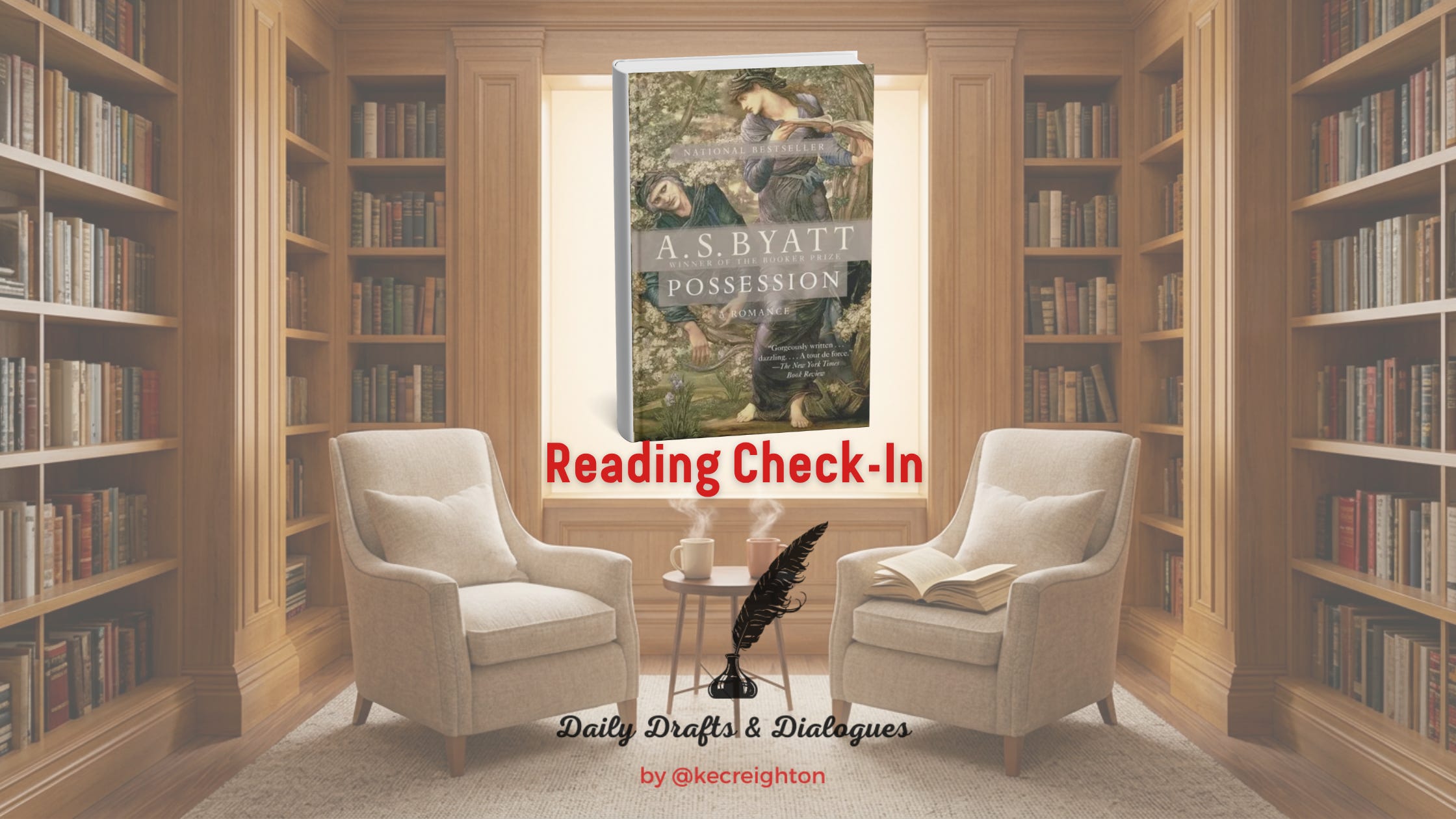
This week we’re reading our fourth book club pick in August together: Possession (1990) by A.S. Byatt.
According to Storygraph: “Winner of England’s Booker Prize and the literary sensation of the year, Possession is an exhilarating novel of wit and romance, at once an intellectual mystery and triumphant love story. It is the tale of a pair of young scholars researching the lives of two Victorian poets. As they uncover their letters, journals, and poems, and track their movements from London to Yorkshire—from spiritualist séances to the fairy-haunted far west of Brittany—what emerges is an extraordinary counterpoint of passions and ideas. An exhilarating novel of wit and romance, an intellectual mystery, and a triumphant love story. This tale of a pair of young scholars researching the lives of two Victorian poets became a huge bookseller favorite, and then on to national bestellerdom.”
And this novel is ideal for “someone who enjoys slow-burning love stories intertwined with scholarly discovery and historical mysteries.”
Possession: A Romance explores The Creative Life by comparing and contrasting the passionate, messy nature of Victorian artistic production with the modern, often detached and technical process of literary analysis. The plot unfolds as two contemporary academics, Roland Michell and Maud Bailey, discover hidden correspondence between fictional Victorian poets Randolph Henry Ash and Christabel LaMotte. As they piece together this secret nineteenth-century love affair, the narrative constantly shifts between the past and present, and fiction and history.
Byatt uniquely captures the creative life by structuring the novel around the letters, journals, and complete poems of the fictional Victorian authors. This formal choice forces readers to engage directly with the actual text of artistic creation rather than just its biographical summary. For Ash and LaMotte, creativity is an all-consuming, biological necessity. Their intense romantic affair directly sparks a highly productive burst of mythic poetry, illustrating that great art requires vulnerability and a willingness to be consumed or ‘possessed’ by inspiration, and often the literal possession of literature.
Conversely, the modern scholars represent the secondary phase of the creative ecosystem. Roland and Maud initially approach literature with sterile objectivity, or try to. However, as they follow the poets’ trail from London to Brittany, they are drawn out of their sterile academic shells, finding themselves ‘possessed’ by the same creative energy that fueled the dead writers they’re studying, transitioning from passive consumers of literary text into active participants in its revival.
Ultimately, Possession shows that a piece of literature is not a dead artifact trapped inside a library. Instead, a creative life, and the literature that comes from it, is a continuous, living dialogue across generations. The novel proves that truly understanding art, especially literature, requires an intellectual and emotional surrender that mirrors the very act of its creation.
As we read this novel, let’s open ourselves up to its transformative energy, using its characters’ intellectual and emotional awakenings to prepare ourselves for the deep vulnerability and intentional choices we’ll make as we continue to explore what comes next in our creative lives this week.
💭Initial Reflections on Possession
The first half of Possession establishes a profound connection between historical discovery and personal awakening. As Roland and Maud unearth the initial letters between Ash and LaMotte, we see how literary analysis shifts from a sterile academic exercise into a vibrant, living dialogue between different creative people across time.
The beginning of the novel, then, mirrors the preparation stage of an author’s creative life or creative work in many ways because during this stage a writer must allow an idea, a voice, a story, or history to ‘possess’ them or inspire them before they can begin to shape their own original work. Which made this novel an ideal choice to read this week as we discuss Preparing for What Comes Next in our creative lives.
In the novel, Christabel LaMotte’s initial writing conditions also reveal a surprising truth about how a creative life often thrives within self-imposed isolation and reflection… for a little while, at least.
While modern culture usually promotes constant collaboration and networking as essential tools for artistic growth and living, LaMotte’s initial solitary existence highlights a different path for a writer preparing for what comes next, which includes those critical periods of deep solitude, or those incubation periods of creative development where ideas and craft need to simmer and evolve naturally and authentically, until a spark of inspiration is found in daily work or strikes unexpectedly.
In a fast-paced world, people often view these quieter ‘non-productive’ phases of a creative life (as exemplified by LaMotte and the academics) as wasted time, even creative stagnation. But Byatt’s novel reveals that these moments are not actually empty or non-productive. Instead, they are active, necessary periods of mental and emotional incubation, where a writer is able to process ideas and gather whatever they need for their next creative breakthrough or project.
Yet at the same time, the evolving relationship between the poets (Ash and LaMotte) reveals the way creative inspiration can profoundly disrupt daily existence, and sometimes one’s entire life as a result. Which forces readers to ask: What sacrifices are often made, or need to be made, to live an authentic creative life?
This novel reminds us that passionate, unexpected creative inspiration rarely arrives in a neat, orderly fashion, but often completely upends established routines and expectations instead. As Ash and LaMotte break away from their conventional lives to pursue their shared poetic and romantic vision, Byatt shows that stepping into the next stage of a creative life requires a willingness to abandon comfort zones. And that writers must be open to and accept the chaos of new ideas and creative inspiration in whatever ways it decides to appear, if they wish to produce truly transformative art and literature.
The narrative structure of the novel also delivers an essential lesson on creative patience and endurance through the characters of Roland and Maud. In their meticulous search through dusty archives and fragmented journals, they demonstrate that writers cannot rush meaningful insights or inspiration, and that they should continue working regardless. Which reminds writers that preparing for the next chapter of their creative lives demands a high tolerance for ambiguity and a commitment to the slow process of discovery and drafting. And that the most powerful creative breakthroughs often happen when a writer willingly sits with uncertainty and curiosity, as there is no way to force an immediate yet authentic burst of inspiration, or conclusion, to their work.
Overall, the first half of the novel serves as a mirror for our own creative journeys, urging us to remain open to unexpected influences while doing our day-to-day creative work. Just as the voices of the dead poets unexpectedly transform the work and lives of the modern scholars in the novel, a writer preparing for their creative future must stay receptive to random sparks of inspiration yet keep drafting and reading works that inspire them.
By immersing ourselves in the complex layers of Byatt’s narrative, we’re reminded how cyclical and nonlinear the creative lifecycle is, and how it both precedes and outlives us. And how this creative lifecycle is also where we are able to discover and write the most authentic work we can while living the most creative lives we can, as it is embedded within the mysteries and passions that stir and inspire us, our lives, and our work, which are all interlinked.
As I read, I keep asking myself questions like:
In what ways have I been like each of these characters in my own creative life?
Is this novel a warning for creators or authors in some ways?
Does modern analysis kill or revive the original magic of a creative work?
Are there any comforts I need to sacrifice for my next creative breakthrough?
Is creating art a form of analyzing art then reinterpreting it?
How do the modern chapters mirror the chronological stories and structures of the Victorian poetry in the novel? And how do they both mirror my own creative pursuits and life?
Stay tuned for Friday’s post, which will include notes on September’s book club picks!
Favorite Quotes and Passages from the First Half of the Novel
🪶
“A man is the history of his breaths and thoughts,
acts, atoms and wounds, love, indifference and dis-
like… "
(p.12)🪶
She tells her love while half asleep,
In the dark hours,
With half-words whispered low:
As Earth stirs in her winter sleep
And puts out grass and flowers
Despite the snow,
Despite the falling snow.
(p.15) “But these dead letters troubled him, physically even, because they were only beginnings.” (p.25)
“Ash replied that the historical imagination required a kind of poetic belief in the mental universe of his characters and that this was so strong with him, that he was in danger of having no beliefs of his own at all.” (p.29)
“An odd phrase, ‘by heart,’ he would add, as though poems were stored in the bloodstream.” (p.30)
“Leavis did to Blackadder what he did to serious students: he showed him the terrible, the magnificent importance and urgency of English literature and simultaneously deprived him of any confidence in his own capacity to contribute to or change it.” (p.32)
“If you can order your Thoughts and shape them into Art good: if you can live in the obligations and affections of Daily Life, good. But do not get into the habit of morbid Self-examination. Nothing so unfits a woman for producing good work, or for living usefully.” (p.47)
“We played and sang together, and read aloud a little of the Faerie Queene. Our days weaved together the simple pleasures of daily life, which we should never take for granted, and the higher pleasures of Art and Thought which we may now taste as we please, with none to forbid or criticise.” (p.51)
✨Unpacking how women’s voices are overshadowed and overlooked in history and literature in Chapter 3, and all the following text centered around LaMotte’s poetry, especially the poem, The Fairy Melusine
✨When Roland finally admits to Maud why he stole the letters in Chapter 4
✨How Cropper represents the capitalist threat to art, proving how people can easily fetishize, commodify, and reduce a creative life to cold monetary values in Chapter 6
✨All of Chapter 10, The Correspondence
✨ How life and art and their pursuits are inextricably linked throughout the novel
🗣️Book Discussion Questions
Does Roland and Maud’s romance feel like an authentic connection or a mere echo of the Victorian poets?
In what ways do Cropper and Blackadder embody the toxic sides of creative and academic obsession?
In what ways does Roland’s initial theft set the course for the novel and how we end up understanding creative inspiration?
In what ways does ‘possession’ move the plot forward, in literary, literal, and metaphorical ways?
Who truly ‘possesses’ the poetry by the end of the novel? The creators, the collectors, or the readers?
Does the heavy integration of fictional poetry throughout the novel deepen your immersion with the novel or disrupt its narrative flow?
Does the novel prove that true artistic breakthroughs require a complete abandonment of safety?
In what ways does the novel show that understanding art and literature requires the same vulnerability as creating it?
👇 Drop your thoughts, reading progress updates, and favorite quotes from the book below! Or join our Buddy Read in Storygraph to share your thoughts there based on where you are in the book. I can’t wait to see what everyone thinks of this book so far! 👇
📝Bonus Writing Prompts for Drafts
This is for the active writers, journalers, and literary artists in our community. If this book has your creative wheels spinning, consider completing one or both of these writing prompts.
Creative Writing Prompt
Write a piece of short fiction where a present-day character discovers a forgotten object like a personal note or letter, a ticket stub, or a drawing or sketch, hidden inside a secondhand book. Focus on the exact moment their perception begins to shift, showing how the object they found begins to draw them out of their routine, thrusting them into an unforeseen creative obsession.
Reflective Journaling Prompt
Think about a recent period in your creative life where you felt unproductive or stuck. How can you reframe that ‘non-productive’ period as a necessary incubation phase, that either prepared your mind for whatever creative breakthrough already came, or is coming next?
Share what you write in the Drafters Workshop Chat.
💬 Let’s Dialogue
Writers and readers can have varied creative lifestyles and approaches. Let’s discuss them!
Does your current creative routine feel like a safe routine or a fertile space for innovative breakthroughs?
How can you actively transform your next ‘non-productive’ period into purposeful creative incubation?
What specific comfort or piece of security must you abandon to reach the next stage of your writing or creative life?
Are you currently consuming and analyzing the work of others more than you are trusting your own authentic voice?
What hidden obsession or forgotten spark from your past is waiting to inspire your next major project?
Share your responses in the Dialoguers chat or leave a comment.
📚Join the Daily Drafts & Dialogues Book Club
See our other August Book Club picks here.
Whether you join a chat, one of our Buddy Reads in Storygraph, or lay it all out in the comments, I look forward to hearing more about your thoughts on our August book club picks!
September Book Club Picks: The Stories We Carry
More details on September book club selections, optional reading schedules, and information on how to join book club discussions will be included in Friday’s post, so stay tuned!
📕Popular Pick
Station Eleven by Emily St. John Mandel
📗Real World Application Pick
Educated by Tara Westover
📘Diverse Perspectives Pick
Interior Chinatown by Charles Yu
📙Literary Dive Pick
The Blind Assassin by Margaret Atwood
📖BONUS Pick
The Book of Love by Kelly Link
Continue Exploring August’s Theme, The Creative Life
This Week: Preparing for What Comes Next
Writing Prompts for What Comes Next in Your Creative Life
Drafting Diaries: The Creative Life
Popular Posts from Week 3: The Messy Middle
Writing Prompts for Navigating ‘The Messy Middle’
Reading Notes: The Cemetery of Untold Stories
Popular Posts from Week 2: Creative Habits
Immersive Storytelling Mode and the ArXiv
Reading Notes: The Unabridged Journals of Sylvia Plath
The Habits That Help Me and My Creative Life Most
Popular Posts from Week 1: Making Space
A Day Alive in the Lakeside Library
How to Make Space and Time for Your Creative Life
The Creative Life as Play and Work
Consider going more in depth with this month’s theme with The Creative Life Writing Collection
Every prompt, draft, and dialogue begins a conversation, but some of those conversations deserve more of our time and attention.
If today’s post sparked an idea or practice you want to explore further, The Creative Life Writing Collection offers a guided month of prompts, craft exploration and techniques, reflection, and customized reading recommendations for writers who want to go deeper.
And if you want to explore past themes, paid subscribers also have access to the full archive, including previous writing prompts, discussions, and reading lists, as well as full access to the community chat and Daily Drafters Exclusives writing collections.