

September Theme: The Stories We Carry
Big Question: Why do certain stories stay with us?
Week 5: Stories That Last
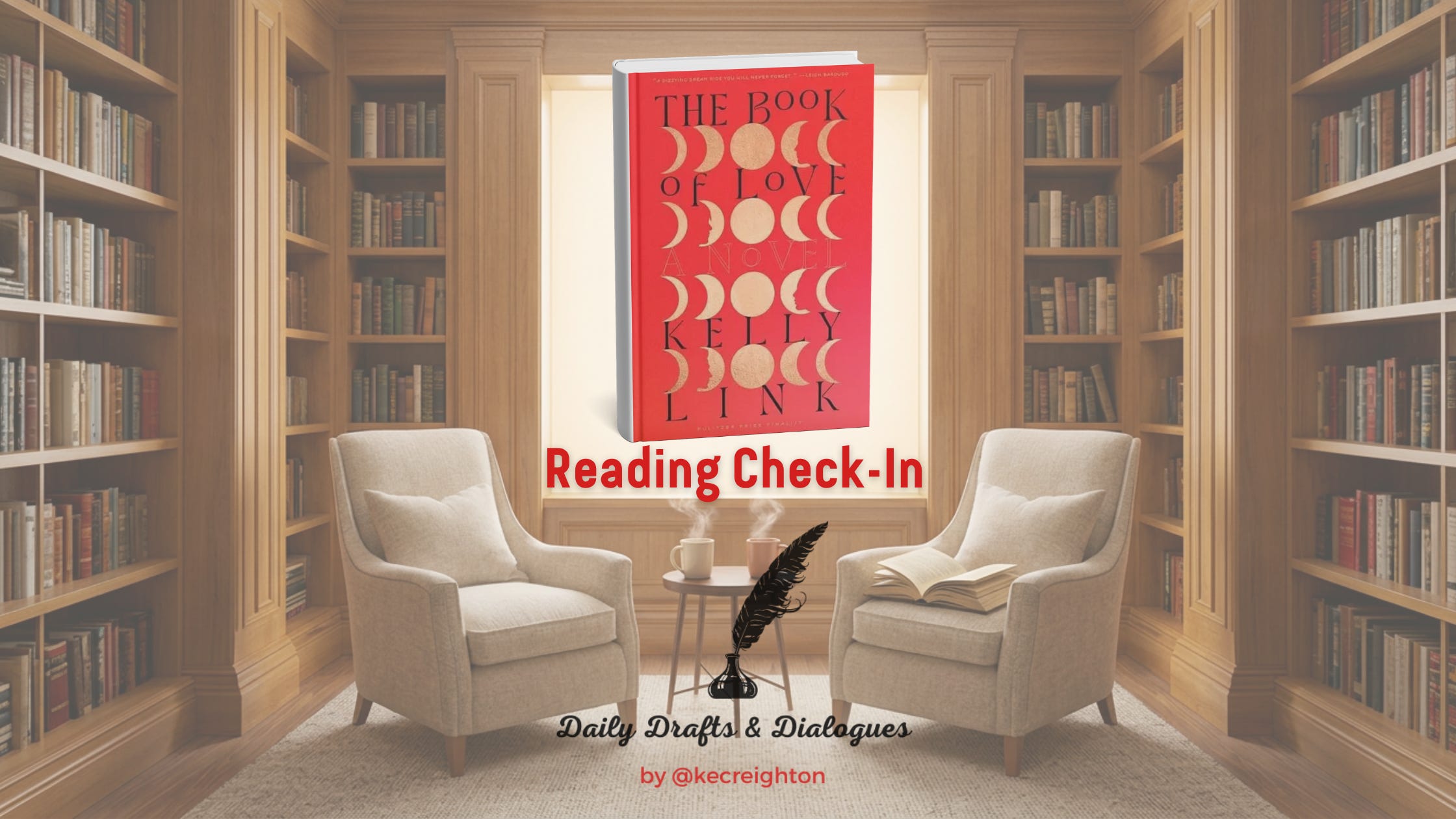
To kick off our book club’s fifth and final week exploring The Stories We Carry in September, we’re reading The Book of Love by Kelly Link.
According to Storygraph, The Book of Love is for a reader who “enjoys atmospheric, slow-burn tales where surreal magic intersects with the raw emotional complexities of growing up and grief.” Which is what makes it an interesting BONUS pick for this month, as we haven’t discussed magical elements or grief and their role in storytelling that much yet.
The Book of Love is an immersive, genre-bending contemporary fantasy that beautifully illustrates how the stories we carry shape our sense of self and human survival. Set in the seaside town of Lovesend, Massachusetts, the novel begins when three teenagers (Laura, Daniel, and Mo) abruptly materialize in their high school music classroom late one night. Covered in dirt and extremely disoriented, they’re greeted by their music teacher, Mr. Anabin, who, to their immense stupefaction, informs them that they have actually been dead for nearly a year.
To fully reclaim their lives among the living, the trio, along with a mysterious fourth soul named Bowie, must agree to a magical bargain, and are then tasked with mastering supernatural challenges, all while a powerful spell alters the townspeople’s memories to make them believe the teenagers were merely studying abroad in Ireland instead of missing for the past year.
This novel ties together the concepts we’ve been discussing about The Stories We Carry this month, as each resurrected teenager must navigate the heavy, invisible, and buried stories of their pasts, including everything from their profound grief and unspoken truths to the fractious family dynamics they carry. Though they are strictly forbidden from revealing the truth of their missing year to anyone.
The stakes for each character begin to escalate when their sudden return upsets a millennia-old supernatural balance, drawing powerful, centuries-old beings down upon Lovesend with their own chaotic agendas. Among these entities is a cruel and flashy moon goddess named Malo Mogge, whose arrival blurs the boundaries between life, death, and ancient magic. As the supernatural chaos grows, the teenagers are forced to grapple with their trauma, untangle their unfinished or complicated relationships, and uncover the lingering mystery of how they died in order to save their community from total devastation.
Ultimately, this chaotic clash of realms and stories sheds light on what it takes to create stories that truly last. By structuring the narrative around personal mythologies, with chapters framed as ancient testaments like ‘The Book of Laura’ and ‘The Book of Daniel’, the novel explores how narratives endure through time and survive the transition between life and death and life again. And the ancient magical beings bring centuries-old feuds across dimensions, proving that the emotional weight of history and the stories we carry and tell persist no matter how much time passes.
The novel also demonstrates that even when magic alters reality or erases memories, some core emotional truths of human experience cannot be overwritten or forgotten from our stories. And by focusing on deep-seated human connections like friendship, romance, and family bonds, The Book of Love emphasizes that the only stories that truly last are those rooted in sincere emotional honesty, resilience, and love.
As we read The Book of Love, let’s pay attention to how each character tells or hides the stories they carry, what they have in common and where they differ, and how this allows us to explore Stories That Last.

💭Initial Reflections on The Book of Love
This book is so unique and readable. It’s as heartfelt and mysterious as it is funny and is definitely a story that’s easy to get lost in once you pick it up as it has many layers to unpack. But the base narrative of the novel, which includes vivid descriptions and witty dialogue between characters, is so readable and relatable that you might forget you’re following a magical mystery about teenagers altogether.
The first 200 pages of The Book of Love build an eerie yet inviting foundation for the rest of the novel that is all about how stories, the people who tell them, and the forms they take, can often dictate reality. Instead of jumping straight into an action-packed quest to solve the novel’s mysteries, the opening focuses on the weird, uncomfortable friction between ordinary teenage life and the supernatural or unknown, as well as the terror that arises when one doesn’t know the full story of their life, or death, as it were. The first mystery introduced in the novel kicks off when three dead teenagers (Laura, Daniel, and Mo) along with a mysterious fourth soul named Bowie, abruptly pop back into existence in their high school music room, where their music teacher, Mr. Anabin greets them and Bogomil, a shape-shifting entity, writes a rule on the blackboard: ‘2 RETURN / 2 REMAIN’.
The first major narrative the teens encounter is the incomplete story told by their music teacher, Mr. Anabin. Acting as a reluctant guide, he is the one who drops the bombshell that they have been dead for eleven months. However, his story is frustratingly full of holes. He also gives them the rules of their magical trial, demanding they learn a spell and uncover the truth of their own demise, though he deliberately holds back the full story behind their deaths and what happened to them and refuses to explain the cosmic mechanics of why they were chosen, who is pulling the strings, or how they actually died, leaving the teenagers to navigate their resurrections, and magic, without knowing the full story.
But the tension in the novel shifts from Mr. Anabin’s cryptic narrative to the narrative the town is forced to believe regarding the teens’ disappearance. Mr. Anabin informs them next that a town-wide spell is currently altering everyone’s memories, making them believe a fake cover story in which the teens were actually studying abroad in Ireland for the last year and not dead or missing. This artificial narrative creates immediate, heartbreaking friction as the resurrected teens have to navigate their way through daily conversations and play along with the fake script written for them, for townspeople and loved ones who have absolutely no clue about the truth of the past eleven months. It also works to highlight the painful reality that while the teenagers were stuck in a mysterious supernatural limbo, the town’s collective story, and their families’ stories, kept moving forward without them.
Beneath this public deception, the novel’s structure also plays with the idea that truth changes depending on who is sharing their story, rotating perspectives through biblical-style personal mythologies or narratives. With chapters titled ‘The Book of Laura’, ‘The Book of Daniel’, and ‘The Book of Susannah’, the novel shows how much individual memory and storytelling shapes the broader magical, fictional world the reader is encountering. These chapters dive into the messy, highly personal stories the characters carry about their secrets, their longings and regrets, and their complicated relationships. And it establishes that before they can even figure out the story behind how they died, they must work to untangle the deeply personal half-written and half-lived histories they left behind.
We then see a more literal version, or meta-narrative version, of the stories we carry via the narratives of Mo, who comes back to find that his grandmother passed away from a heart attack while he was gone. Because she was a famous romance novelist, her entire legacy is made of the literal, published stories she left behind, in which Laura finds connection and solace, though Mo processes his grief of her loss through the stark reality of her absence in the home they shared.
As readers get deeper into the novel, the scale of the storytelling elements and slow-burn narratives suffusing the novel become more complex, as the evolving messy adolescent dramas begin to integrate with the ancient, cosmic myths being introduced and gradually expanded upon and unraveled. The arrival of centuries-old beings, like the cruel moon goddess Malo Mogge and her immortal servant Thomas, signal that this small Massachusetts town is more than a backdrop for teen sagas, but for a much older mythology as well. These entities bring grudges they’ve been holding for centuries, complicated magical rules, and divine histories that cross dimensions. And their presence slowly begins to reveal that the teenagers aren’t just fighting for their own stories and survival, but that they’ve been dropped right into the middle of an enduring supernatural epic.
Ultimately, all the overlapping narratives in The Book of Love reveal what it takes to create stories that truly last. By weaving together those stories its characters carry literally and figuratively (Mr. Anabin’s tales, the false cover story the town is forced to believe, the characters’ personal narratives, Mo’s grandmother’s romance novels, and the ancient myths) the novel exemplifies the complex emotional weight of history and how the human stories that it consists of persist no matter how much time passes, or how it passes. It also emphasizes that even when magic alters reality or erases memories, the core emotional truth of human experience cannot be overwritten, and that the only stories that truly endure are those rooted in genuine honesty, resilience, and love.
Note: I think readers who enjoy books by Fredrik Backman, Gail Honeyman, Kevin Wilson, or Shelby Van Pelt will enjoy this one.
As I read, I keep asking myself questions like:
No, seriously, HOW did they die, and will it make me bawl my eyes out?
How would I feel about the individual characters’ narratives if they were older?
What is Mr. Anabin hiding and why?
Does the ‘2 RETURN / 2 REMAIN’ message mean something other than what we are led to believe it means at the beginning of the novel?
Are their narratives essentially what keeps them alive?
How would this novel make me feel if it didn’t have magic in it?
💬Notable Quotes and Passages from the First Half of the Novel
“‘...What’s the point of magic if you can’t use it to make the world a better place?...’” (p.41)
“The route to What Hast Thou Ground? took Susannah through two neighborhood parks, past four statues and one frieze. Susannah’s favorite was the frieze. She’d done a whole project in fifth grade on its subject, Leonta Carter, and it hadn’t even felt like homework. Maybe that was because Leonta Carter wasn’t actually real. She was a character in Ashana’s Heart, one of Mo’s grandmother’s books. Of all the statues in Lovesend, she was the only one who was entirely imaginary. Which meant Susannah had only gotten a C, even though she’d work pretty hard. Apparently you were supposed to pick a real historical figure.” (p.97)
“For years, all she’d had of her father were photographs. Stories Ruth told. The time he taught Laura and Susannah to swim and Laura’s sunburn afterward was so bad she’d run a fever of 101. The time Susannah was five and had drunk two glasses of Baileys, thinking it was chocolate milk, and then thrown up in his underwear drawer where she’d gone looking for the Reese’s Peanut Butter Cups he’d always kept hidden there. The time he’d kissed their hamster on the mouth because they’d begged him to, and it had bitten him on the lip. And now here he was again, restored to her. To her and Susannah. As if he, too, had been in Ireland.” (p.136)
✨ When Bowie turns into moths and continues to shapeshift.
✨ Mo’s grandmother’s correspondence on page 158.
✨ When we learn more about Sussanah’s history with Bogomil.
“There was only, eternally, Malo Mogge. For Thomas, it had been this way for more than three hundred years. He did not feel pity for Malo Mogge, but at times he understood how she had become the thing she was. Time pressed in on you from all sides and there was no door you could go through to escape what you became.” (p.173)
“Of course what happened instead was she died. Which was admittedly a setback. And Mr Anabin was slightly less pathetic than she’d always assumed. That was probably a useful lesson. Always be nice to people, especially when it doesn’t cost you anything. Really, it doesn’t cost you anything to be nice.” (p.202)
🗣️Book Discussion Questions
The novel structures individual character arcs through biblical-style sections like ‘The Book of Laura’ and ‘The Book of Daniel’. As a writer, how does this framing device alter your perception of each character’s voice and subjective memory? How does it help build a narrative about the invisible stories we carry within our personal histories and what we eventually decide to write?
The characters return to find their absence has been overwritten by a magical ‘study abroad in Ireland’ cover story, forcing them to perform a lie for their loved ones. From a craft perspective, how does this clash between a forced public script and an unspoken traumatic reality build tension throughout the novel? How can we writers use artificial or public-facing narratives to reveal a character’s deeper, hidden truths?
When we look at stories that last, how does incorporating physical, fictional texts (like those of Mo’s grandmother) within a novel change the way we handle a character’s legacy or character arc? How can an artist’s public work serve as a mirror or a barrier for the characters trying to remember who they truly are or were?
In the first 200 pages, the narrative moves from intimate, messy adolescent drama to an ancient, multi-dimensional epic with the arrival of entities like Malo Mogge. How does the novel balance the small, hyper-local stories of a small town with centuries-old cosmic mythologies without losing sight of its real-world and human anchors? What craft techniques keep the emotional stakes of each character deeply human when the global or supernatural stakes become stronger?
The fourth soul, Bowie, returns without a physical form or a clear memory of their past identity, leaving them temporarily blank. As a writer, what are the unique challenges and opportunities of developing a character who lacks a personal history? How does Bowie’s journey demonstrate that the core emotional truth of human experience can survive even when a character’s memories have been completely erased?
👇 Drop your thoughts, reading progress updates, and favorite quotes from the book below! Or join our Buddy Read in Storygraph to share your thoughts there based on where you are in the book. I can’t wait to see what everyone thinks of this book so far! 👇
📝 Bonus Writing Prompts for Drafts
This is for the active writers, journalers, and literary artists in our community. If this book has your creative or analytical wheels spinning, consider completing one or both of these writing prompts.
Creative Prompt
Imagine a character who wakes up in the middle of the night in a familiar childhood space, where they find a chilling and ominous message scrawled across the wall, much like the ‘2 RETURN / 2 REMAIN’ rule that shatters the lives of Laura, Daniel, Mo, and Bowie. Then write a scene where your character must immediately re-enter their ordinary routine. Have them sit down to eat breakfast with their family or answer work emails or work in their garden, for example, all while carrying the crushing weight of their new cosmic countdown. Focus on the ways your character’s supernatural circumstances confront their mundane domestic life, and how this incites their evolving existential dread. And show, via their mannerisms and body language and dialogue, how they truly feel inside about engaging in things like small talk and daily work tasks or chores as their sanity and concept of reality slowly begin to crack.
Reflective Journaling Prompt
If your personal history, hidden longings, and heaviest emotional baggage were bound into an ancient, multi-dimensional testament titled ‘The Book of [Your Name]’, what messy, half-lived chapters would define and fill its pages? Map out the invisible stories and myths you currently carry into your creative life, identifying which parts of your history feel like a forced public script you are tired of performing and which parts feel like they carry the authentic truths of who you are. Consider how the ghost of your past choices still dictates your reality today, and question whether the core essence of your resilience and who and what you love would still guide your instincts even if magic erased every literal memory of the path that brought you to where you are today.
Share what you write in the Drafters Workshop Chat.
💬 Let’s Dialogue
Writers and readers can have varied creative lifestyles and approaches to what they read and write. Let’s discuss them!
If a town-wide spell forced you to play along with a fake script, to essentially perform for others and your family, about where you’ve been for a year, what would be the hardest lie for you to look them in the eye and say?
When Mr. Anabin tells the teens they are dead, he holds back most of the details. How do you write a conversation where one person is desperate for answers and the other refuses to give them?
When centuries-old beings like the moon goddess Malo Mogge drop into a normal town, their voices sound completely different from other characters’ voices. What is your favorite trick to make a character sound ancient or powerful?
Bowie starts out with no memories and no identity. How do you give a character a voice when they literally don’t even know who they are yet?
How can you use a character’s old letters, journals, or books to let them ‘speak’ from beyond the grave? And can books talk back, metaphorically speaking?
Share your responses in the Dialoguers chat or leave a comment.
See all our September Book Club Picks with optional and customizable reading schedules.

Whether you join a chat, one of our Buddy Reads in Storygraph, or lay it all out in the comments, I look forward to hearing more about your thoughts on our book club picks this month!
If you enjoyed this post, please like and share it so others can enjoy it and read with us too. Thank you and happy reading!
Continue Exploring September’s Theme, The Stories We Carry
This Week: Stories That Last
Writing Prompts for Stories That Last
Drafting Diaries: The Stories We Carry
Week 4 Popular Posts: The Stories We Tell Others
Writing Prompts About The Stories We Tell Others
The ‘Death of the Author’ in the Age of AI
Week 3 Popular Posts: The Stories We Tell Ourselves
Can you write great work without challenging your own beliefs?
The Story of My Flaws Sounds Like Death Metal
Historical Fiction that Challenges the Stories We Tell Ourselves
Week 2 Popular Posts: Memory and Storytelling
Writing Prompts About Memory and Storytelling
The Art of Autofiction: Memory, Markets, and the Modern Confessional
Week 1 Popular Posts: The Books That Changed Us
Writing Prompts About Books That Changed Us
What My Favorite Books Say About Me
20 Banned Books That Have Changed Us
Go Deeper with Daily Drafters Exclusives
This month: The Stories We Carry Writing Collection

This collection offers a month of guided writing exercises, mini workshops, and creative writing experiments designed to take you beyond a single prompt and into a deeper creative practice. It gives you the creative spark and space you need to explore memory, identity, inheritance, perspective, voice, and the stories we tell ourselves and others. It will also encourage you to consider how those stories shape the work we create and the creative lives we lead.
Inside this collection, you’ll find 30 original writing prompts (designed as mini writing workshops) across five sections with focused themes, craft-focused exercises, curated reading suggestions, reflective questions, and three optional month-long writing challenges designed to help you develop your ideas, explore your personal material and stories, and build a consistent writing practice.
You can follow the prompts in order, choose the exercises that speak to you, or return to a section whenever you need a new way to explore your writing craft. As a paid subscriber, you will also be able to come back to the collection throughout the month or any other time you feel like exploring The Stories We Carry in the future.