
Reading Notes: The Cemetery of Untold Stories
Here are some reflections, notes, and discussion questions for this week’s book club pick, with bonus writing and dialogue prompts. Keep reading, then join our book club discussions!

August Theme: The Creative Life
Big Question: How do we build a creative life that works for us?
Week 3: The Messy Middle
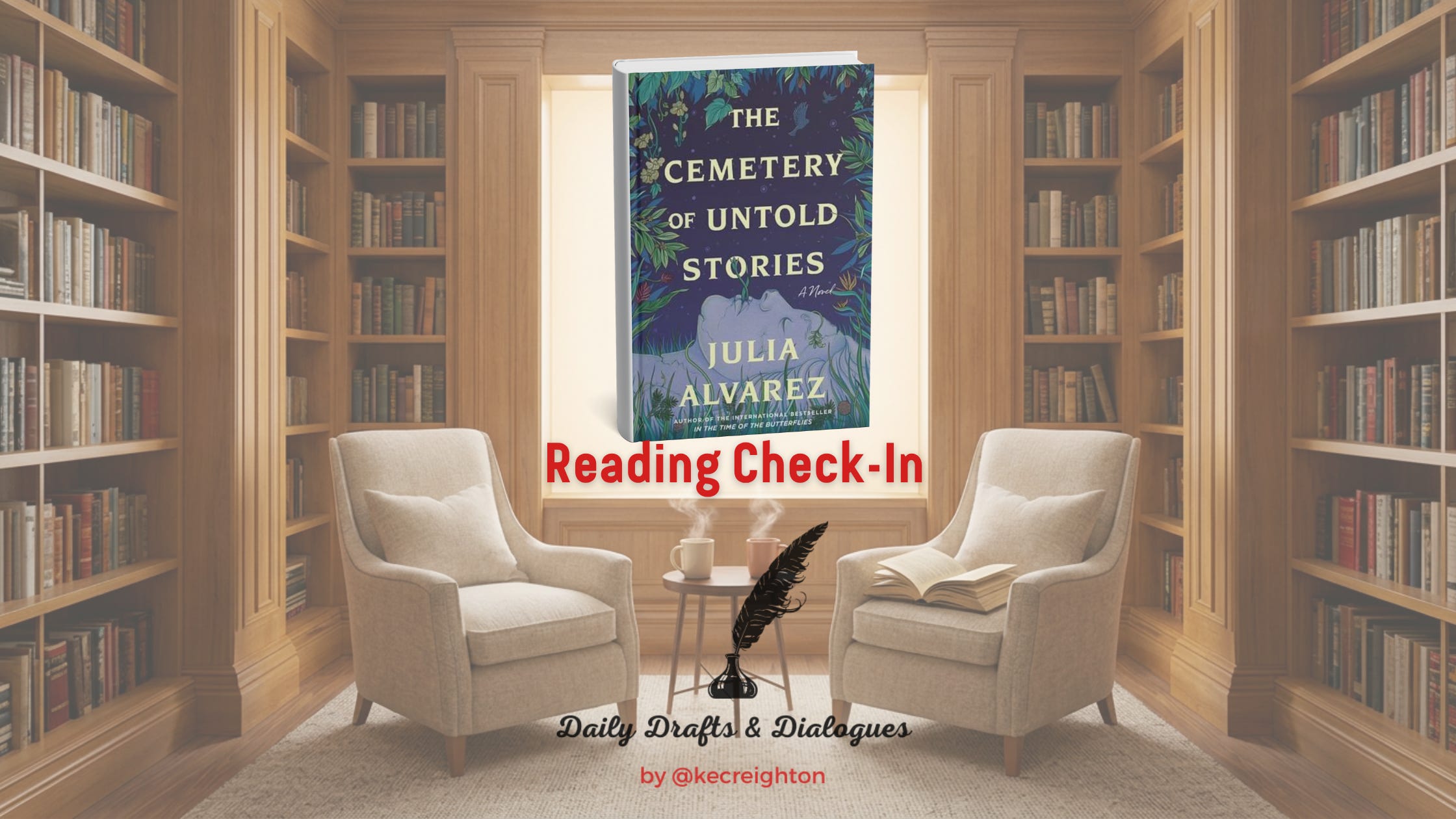
This week we’re reading our third book club pick in August together: The Cemetery of Untold Stories (2024) by Julia Alvarez.
According to Storygraph, this book is a work of magical realism for “a reader who enjoys lyrical, reflective stories that blend elements of magic with deep explorations of history and the art of storytelling” and “Readers of Isabel Allende’s Violeta and Barbara Kingsolver’s Demon Copperhead will devour Alvarez’s extraordinary new novel about beauty and authenticity, and will be reminded that the stories of our lives are never truly finished, even at the end.” Which made it an ideal selection for the week we’re discussing ‘the messy middle’ on Daily Drafts & Dialogues.
In The Cemetery of Untold Stories, aging Dominican-American writer Alma Cruz inherits a plot of land in her native Dominican Republic. To find peace and avoid creative obsession, she uses the land as a literal graveyard to bury her unfinished manuscripts, rejected drafts, and haunting character ideas.
In many ways this novel serves as a profound metaphor/allegory/conceit for the ‘messy middle’ of the creative life, illustrating that the artistic journey is rarely linear and often paved with half-baked ideas, abandoned drafts, and projects that lose momentum…but still take on a life of their own. And by treating a plot of land as a graveyard for her unfinished manuscripts, the protagonist, Alma, embodies the burden of choice every writer inevitably faces, which entails the small griefs of deciding which narratives to nurture and which to lay to rest.
However, instead of staying buried, these literary fragments develop their own agency and refuse to cooperate with the protagonist author’s original vision, highlighting the exact moment in the creative process where an artist loses their sense of creative control and must learn to tolerate chaos and ambiguity and doubt.
Ultimately, this novel dismantles the myth of clean narrative closures, suggesting that the true vitality of art exists within this crowded, vocal, and unpredictable middle space of storytelling. The novel reframes creative debris or fragments not as signs of failure, but as an essential, living testament to a writer’s lifelong struggle with creative expression. It shows that even when an artist attempts to walk away from incomplete work, the stories themselves retain an everlasting life, proving that the creative impulse we have, and the stories it births, are never truly finished or neatly wrapped up, though we may want to contend that they are or can be.
As we read this novel, let’s reflect on where and how ‘the messy middle’ shows up for the protagonist and her stories, and what this reveals about the creative life and writer’s life, then come together to share our reflections in the chat or Buddy Read in Storygraph.

💭Initial Reflections on The Cemetery of Untold Stories
I am enraptured by the concept that stories have a life of their own, which this novel brings to light and forces the reader to reckon with in both fun and profound ways.
As writers, we like to believe that we ‘own’ story ideas, our ideas about a character, etc., but we don’t. Not really. At least, not in the ways we like to believe we do. In fact, it’s often the complete opposite, and the stories and their characters ‘own’ us and often drive us to create things we never thought possible, as they must ultimately be recognized and told and revealed to the world in ways only they can demand, not the other way around. And the harder we try to avoid this truth and either control or neglect a narrative that needs to be told in the way it demands to be told, the more our creative ideas haunt us and others.
In the first half of The Cemetery of Untold Stories, aging author Alma Cruz moves to the Dominican Republic to clear her creative conscience by disposing of her unfinished drafts. While she burns most of her failed manuscripts, she finds herself unable to destroy two specific projects, which include a deeply personal narrative about her father, Dr. Manuel Cruz, and a historical draft about Bienvenida Inocencia, the erased wife of dictator Rafael Trujillo. Instead of burning them, she buries these two intact manuscripts in her makeshift graveyard. Rather than keeping her written secrets and accounts, however, the buried pages spark a magical awakening and the characters refuse to stay buried and begin speaking directly to the illiterate groundskeeper, Filomena, who sits by the graves to listen to their unspooling lives and narratives as we learn about her life, as well.
This setup perfectly addresses anxieties related to the creative ‘messy middle’ by showing that an artist is rarely, if ever, able to execute a clean break from their unfinished ideas and drafts, no matter the lengths they go to in order to do so. Which ironically makes this novel incredibly relatable despite its magical realism elements. The first half of the book also reveals that the middle of one’s creative life is a living, unpredictable space where unfinished ideas will aggressively demand to be heard eventually, even if the author herself has given up on them or is desperately trying to move on from them.
In the first 115 pages of The Cemetery of Untold Stories, the tension between Alma’s conscious boundary-setting and Filomena’s patient listening also serves as a powerful allegory for the conflicting forces that often arise during the creative ‘messy middle.’ That tension creators experience when they consider whether to hold onto a story or let go of it.
Recognizing the limits of her own mortality, Alma chooses to physically bury her manuscripts as a deliberate act of letting go, a profound choice she makes to prioritize her own peace over the relentless, all-consuming obsession of the creative process. She walks away from the plot of land in which her drafts are buried because she wants to free herself from the heavy burden of carrying stories that may never find a perfect resolution that she’s happy with, as well as stories she no longer wants to hold onto. And this captures a crucial crossroad writers encounter during their own creative lives all the time— the moment they must decide whether to keep working on a stalled project or to intentionally set it aside to protect their own well-being, or to pass it on to someone else.
Conversely, the illiterate groundskeeper, Filomena, embodies the radical, ego-free listening required to hold space for the stories Alma has consciously released, at Alma’s request. Where Alma steps back to claim her own peace, Filomena steps forward to approach the emerging, fragmented voices of Bienvenida and Manuel with deep empathy and open curiosity. And because she cannot read, she holds no editorial biases and feels no pressure to shape their complex histories and voices into a neat, commercialized narrative like Alma did previously. Filomena’s presence represents, then, the essential mid-project shift an artist must usually undergo when a work assumes its own agency, when they must decide whether to relinquish absolute control and allow the ideas they’re writing about to breathe independently or not.
By contrasting Alma’s necessary (and literal) boundary-setting with Filomena’s open curiosity, the first half of the novel demonstrates the ways in which navigating the ‘messy middle’ requires a delicate balance between knowing when to step back for your own creative and personal survival and when and how to listen to where the work wants to go on its own.
So far, I am intrigued by where this novel is going and can’t wait to see more of what Alma’s characters decide to do when they take matters into their own hands.
As I read, I keep asking myself questions like:
How do I know when a character or story starts taking on a life of their own? Is it a feeling or something I observe?
What lengths have I gone to in the past to avoid or ‘bury’ a creative project I was working on, and why?
How will Alma and Filomena change by the end of the novel? Will their perspectives swap or merge?
Will this novel have a tragic or incomplete ending?
What are the other lessons this novel reveals about living a creative life?
What does this novel say about the nature of storytelling and how stories outlive us?
Stay tuned for Friday’s post, which will include my final thoughts on the book and any other relevant reading notes I have from the week, along with reminders for upcoming book club picks and additional reading recommendations.
Favorite Quotes and Passages from the Book
“The real deal was this one story that would not be hurried. The story possessed her.” (p.3)
“A writer needs to be grounded or the force that through the green fuse drives the flower is going to incinerate it.” (p.4)
“The idiom always sounded off. Didn’t anything worthwhile involve work?” (p.7)
“Her friend seemed to treat her life like drafts of a novel. This plot isn’t working. Okay, no problem. Let’s take out the marriage and rearrange the sequence, see what happens. Some troubling confusion between art and life.” (p.7-8)
“One thing is hearing a story, another is writing it down.” (p.8)
“What Alma was finding harder to accept was that aging also happens in the creative life.” (p.16)
“But how to exorcise a story that had never been told?” (p.23)
“Alma forged ahead, a habit developed over years of writing. When a manuscript wasn’t going anywhere, you stayed with it. You loved it into being. It worked, until it didn’t.” (p.27)
“If a story is never told, where does it go?” (p.43)
✨ When Brava and Alma discuss whether a work needs to be published in order to be told and have life on page 46.
“Now that she’s given up writing, the world is a clutter of chaotic details— stories, stories, so many stories, and Alma has nowhere to put them except in the ground.” (p.47)
“That isn’t the point, Pepito explains. These stories are about real passions in people’s hearts. They tell of all that is possible.” (p.85)
“Way back, Filomena destroyed Perla’s peace of mind. The story has been buried so deep, it should have rotted into oblivion. But like Lazarus in La Biblia, it keeps coming back to life, a ghost that is not a ghost, but her own living breathing betrayer of…” (p.96)
🗣️Book Discussion Questions
These discussion questions were pulled directly from the back of the book.
The characters who are ‘buried’ in Alma’s cemetery reveal parts of their lives that their ‘creator’ didn’t know about. What do you think that says about the role of a novelist and the limitations of a storyteller?
Consider these two lines from the novel: “We don’t get free until we write our stories down” and “Some stories don’t want to be told. Let them go.” Can both statements be true? How so?
Alma’s pen name is Scheherazade, inspired by the character in One Thousand and One Nights. How is Alma’s story similar to and different from that legendary storyteller?
Do you think Alma was ever able to ‘escape’ her characters? Do you think the creative life is ever over? Can we ever bury the past?
A maxim of creative writing workshops is that all stories are about trouble: “Only trouble is interesting.” Do you agree with this statement? How does it relate to the stories that are told, or not told, in this novel?
👇 Drop your thoughts, reading progress updates, and favorite quotes from the book below! Or join our Buddy Read in Storygraph to share your thoughts there based on where you are in the book. I can’t wait to see what everyone thinks of this book so far! 👇
📝 Optional Writing Prompts for Drafts
This is for the active writers, designers, journalers, and artists in our community. If this book has your creative wheels spinning, consider completing one or both of these writing prompts.
Creative Writing Prompt
Write a scene where your main character enters a literal graveyard of their own abandoned ideas. Have them find one specific, half-finished object or tool they left behind weeks, months, even years ago, that is related to that idea (e.g. a pen, a manuscript, a typewriter, a piece of memorabilia, etc.). Describe the sensory shock of touching it again, then write the exact dialogue that passes between the character and this unfinished or abandoned thing. Also consider what prompted them to revisit it again.
Reflective Journaling Prompt
List three creative projects or stories you have abandoned over the past year or two. Next to each, write down what keeping those projects unfinished or stories ‘untold’ protects you from experiencing. Then reflect on how leaving a piece of work incomplete can serve as a shield against judgment, failure, success… or perhaps something else?
Share what you write in the Drafters Workshop Chat.
💬 Let’s Dialogue
Writers and readers can have varied creative lifestyles and approaches. Let’s discuss them!
When a draft or project stalls, what is your immediate coping mechanism? Do you over-research, abandon it for a new idea, force your way through, or do something else?
What is the most extreme thing you’ve done during ‘the messy middle’ of a creative project?
How do you mourn the loss of your perfect, unwritten vision once the messy reality of the actual work takes over?
Does your creative doubt usually manifest as a technical critique of the work, or as a personal attack on your identity as a creator?
Is doubt a normal part of the creative process or a sign something isn’t working?
Share your responses in the Dialoguers chat or leave a comment.
Not able to read this book with us this month? No worries! We have other options to choose from. See our other August Book Club picks here.

Whether you join a chat, one of our Buddy Reads in Storygraph, or lay it all out in the comments, I look forward to hearing more about your thoughts on our book club picks this month!
If you enjoyed this post, please like and share it so others can enjoy it and read with us too. Thank you and happy reading!
Continue Exploring August’s Theme, The Creative Life
This Week: The Messy Middle
Writing Prompts for Navigating ‘The Messy Middle’
Is doubt a normal part of the creative process or a sign something isn’t working?
ICYM Week 2: Creative Habits
Writing Prompts for Building the Creative Habits You Want
Immersive Storytelling Mode and the ArXiv
Should writers have quantifiable creative habits?
Reading Notes: The Unabridged Journals of Sylvia Plath
The Habits That Help Me and My Creative Life Most
Striking the Right Balance with Quantifiable Creative Habits
Popular Posts from Week 1: Making Space
A Day Alive in the Lakeside Library
How to Make Space and Time for Your Creative Life
The Creative Life as Play and Work
Consider going more in depth with this month’s theme with The Creative Life Writing Collection

Every prompt, draft, and dialogue begins a conversation, but some of those conversations deserve more of our time and attention.
If today’s post sparked an idea or practice you want to explore further, The Creative Life Writing Collection offers a guided month of prompts, craft exploration and techniques, reflection, and customized reading recommendations for writers who want to go deeper.
And if you want to explore past themes, paid subscribers also have access to the full archive, including previous writing prompts, discussions, and reading lists, as well as full access to the community chat and Daily Drafters Exclusives writing collections.
I found your description of the novel much more intriguing than Storygraphs, and really might seek it out now. But haven’t read the book yet I won’t be able to comment on book group 😢