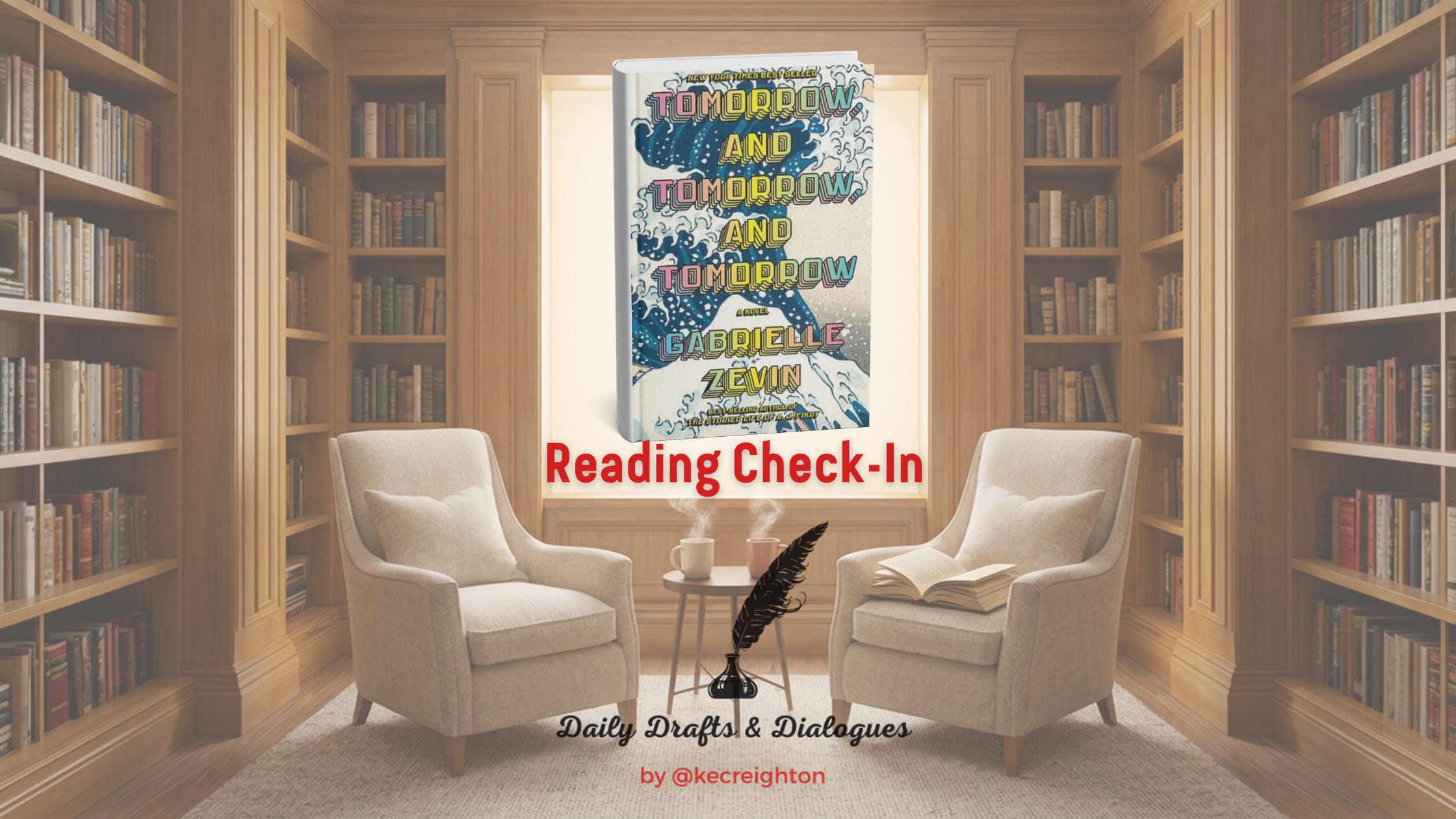
Reading Notes: Tomorrow, and Tomorrow, and Tomorrow
Here are some reflections, notes, and discussion questions for this week’s book club pick, with bonus writing and dialogue prompts. Keep reading, then tell me what you think!
August Theme: The Creative Life
Big Question: How do we build a creative life that works for us?
Week 1: Making Space
This week, we’re reading our first ever pick with our BRAND-NEW book club!
We’re reading Tomorrow, and Tomorrow, and Tomorrow by Gabrielle Zevin, a novel that tracks and explores the complex, decades-long creative bond between Sam Masur and Sadie Green.
In the novel, Sam and Sadie first meet as children in a hospital game room and instantly bond over a video game. They have a falling out but reunite six years later as college students, deciding to work together to design a video game they call Ichigo, which ends up rocketing them to fame.
Over the next three decades, their intense platonic relationship undergoes painful rifts, creative disagreements, professional rivalries, and personal tragedies. Yet they still always seem to find their way back to each other, as their relationship is anchored by the virtual worlds they build.
The novel treats video game design as a demanding, sacred art form that requires intense vulnerability. Throughout the novel, Zevin shows that making space for a creative life means accepting failure, messy collaboration, and the reality that artistic visions often clash with commercial ambitions. Sam and Sadie discover that true creative partners are rarer than romantic lovers, and that protecting their work requires managing egos, resentment, and the fear of being truly seen by another person.
As we read this novel, let’s reflect on how artistic partnerships and creative lives thrive on vulnerability, and what happens when professional ambition and individual egos begin to strain a shared lifelong vision. Then share our thoughts in the Buddy Read on Storygraph.
💭Initial Reflections on Tomorrow, and Tomorrow, and Tomorrow
I’m only about halfway into the novel at this point, but I am really enjoying it so far. Overall, I appreciate how the author lets me learn about video game design and the designs the characters are creating without feeling overwhelmed by industry jargon. And the more I read, the more invested I become in Sadie and Sam’s partnership, which gets to the heart of this week’s discussion.
Typically, creativity is thought of as a solitary endeavor, but through Sadie and Sam’s partnership in this novel, we see how essential collaboration can be to a meaningful and successful creative life, depending on what your idea of ‘success’ is. Though we also see many of the challenges that come with their creative collaboration, especially when it comes to their personal views on artistic integrity and what drives them to create once they move past developing and designing their ideas together.
Sam and Sadie seem to view video games through different lenses at this point in the novel, creating a push-and-pull between their need for commercial success and pure artistic integrity. Sam, who grew up poor and endured severe physical trauma at a young age, views financial and popular success as a necessary shield against the harsh realities of the world. For him, blockbuster games mean financial security, survival, and mainstream validation, leading him to lean into more accessible mechanics and a broader public appeal. Sadie, coming from a more privileged background, tries to guard her artistic creations against commercial compromise, viewing video games as a high art form capable of expressing profound personal grief and more complex social themes.
This ideological divide between the two causes deep friction, especially during the creation of their games following Ichigo. Sadie pours her heartbreak and creative ambition into a dark, challenging, and avant-garde project that subverts traditional gaming tropes. But Sam, recognizing that the game is too niche for the mass market, pushes for more conventional gameplay elements to ensure its commercial viability. Their clash highlights a core truth about the creative life: art requires absolute vulnerability and creativity, but sustaining a certain level of success requires a certain amount of compromise with the popular market.
Ultimately, I hope their partnership is able to thrive because of their creative tensions, and that they’re able to combine Sam’s market instincts with Sadie’s artistic intuition. But we shall see…
So far, I am also really enjoying how key the underlying concept of storytelling is throughout this novel. Though the characters in this novel are building video games, I still feel connected to the creative struggles they’re going through as a writer. They, like me and other writers, also deal with issues related to story arcs, character arcs, crafting techniques, creative adaptability, public scrutiny, inspiration, influence, collaboration, etc.
As I read, I keep asking myself questions like:
Does friendship come first in a successful creative partnership, or do similar creative interests?
How might it be possible to foster such a relationship in my own creative life?
Should financial factors be weighed when designing my creative life?
How much do the worlds I create influence my creative life and identity, and vice versa?
I can’t wait to see where the rest of this story goes.
Stay tuned for Friday’s post, which will include my final thoughts on the book and any other relevant reading notes I have from the week, along with reminders for upcoming book club picks and additional reading recommendations.
Favorite Quotes and Passages from the Book
“To play requires trust and love.” (p.21)
“The format for the [video game design] class was not unlike a creative writing class.”(p.25)
✨The concepts behind the games (EmilyBlaster and Solution) Sadie built herself before she partnered with Sam were pretty epic and poetic in their own unique ways. (Part 1, Chapter 3)
✨When Dov (Sadie’s teacher and sometimes lover) tells Sadie, “You aren’t just a gamer when you play anymore. You’re a builder of worlds, and if you’re a builder of worlds, your feelings are not as important as what your gamers are feeling. You must imagine them at all times. There is no artist more empathetic than the game designer.” (p.44)
✨When Sam says in an interview: “The alternative to appropriation is a world where white European people make art about white European people, with only white European references in it. Swap African or Asian or Latin or whatever culture you want for European. A world where everyone is blind and deaf to any culture or experience that is not their own. I hate that world, don’t you? I’m terrified of that world, and I don’t want to live in that world, and as a mixed-race person, I literally don’t exist in it.” (p.78)
✨When Sam’s mother Anna tells him: “And this is the truth of any game— it can only exist at the moment that it is being played. (p.82)
“He wanted the pre-verbal Ichigo to feel authentic, to have details that came from life. Marx saw Ichigo as a homecoming story, but also a language story. How do we communicate in a world when we don’t have language.”(p.90-1)
“There is no purity in art. The process of how you arrive at something doesn’t matter at all.” (p.98)
“We are all living, at most, half of a life…” (p.142)
🗣️Book Discussion Questions
Sam and Sadie build virtual worlds together but often struggle to communicate in the real world. In what ways does their art serve as a bridge, and a barrier, to their actual relationship?
Marx takes on the role of the producer, managing the business so Sam and Sadie can create. In a creative life, how essential is having a ‘non-creative’ support system?
Artistic jealousy plays a massive role in this novel. Is professional jealousy a destructive force for these characters, or does it serve as a necessary engine for their growth?
What are the pros and cons of artistic collaboration, as explored and weighed throughout this novel?
Have you ever collaborated with someone else on a creative project similar to the scope of their projects in the novel? If so, what did the experience teach you? And was it similar to Sadie and Sam’s experience?
👇 Drop your thoughts, reading progress updates, and favorite quotes from the book below! Or join our Buddy Read in Storygraph to share your thoughts there based on where you are in the book. I can’t wait to see what everyone thinks of this book so far! 👇
📝 Optional Writing Prompts for Drafts
This is for the active writers, designers, journalers, and artists in our community. If this book has your creative wheels spinning, consider completing one or both of these writing prompts.
Creative Writing Prompt
Describe the first level of a video game you would want to play that doesn’t exist right now using descriptive sensory details. OR share the title of a video game you would want to see developed within the next few years.
Reflective Journaling Prompt
Write about one of your favorite games from childhood. It can be a video game or some other type of game you liked to play. As you write, try your best to describe why exactly you enjoyed the game so much. Was it because of who you played it with, or where you played it? Because it was easy or difficult to play? Etc.
Share what you write in this week’s Drafters Workshop Chat.
💬 Let’s Dialogue
Writers and readers often see collaboration differently, so let’s unpack it together in the comments and chats as we continue to read this book together this week.
As a reader, are you more drawn to stories about solitary, brooding artists, or do you prefer the high-stakes drama of a creative team?
Writers and creators, have you ever collaborated on a project? What was the hardest part about letting someone else alter your initial vision?
What is one real-world creative duo (in music, film, or literature) whose partnership has always fascinated you or inspired you?
What is the most important quality you look for in a prospective creative collaborator?
Share your responses in the Dialoguers chat or leave a comment.
Not able to read this book with us this month? No worries! We have other options to choose from. See our other August Book Club picks here.
Whether you join a chat, one of our Buddy Reads in Storygraph, or lay it all out in the comments, I look forward to hearing more about your thoughts on our book club picks this month!
If you enjoyed this post, please like and share it so others can enjoy it too. Thank you and happy reading!
Continue Exploring The Creative Life (August Series)
This week’s Posts: Making Space
Writing Prompts for Making Space in Your Creative Life
A Day Alive in the Lakeside Library
Do writers need to protect creative time like an appointment?
Consider going more in depth with this month’s theme with The Creative Life Writing Collection
Every prompt, draft, and dialogue begins a conversation, but some of those conversations deserve more of our time and attention.
If today’s post sparked an idea or practice you want to explore further, The Creative Life Writing Collection offers a guided month of prompts, craft exploration and techniques, reflection, and customized reading recommendations for writers who want to go deeper.
And if you want to explore past themes, paid subscribers also have access to the full archive, including previous writing prompts, discussions, and reading lists, as well as full access to the community chat and Daily Drafters Exclusives writing collections.