
The mostly true hidden story…
Today’s flash fiction revealed some hidden truths behind the nature of storytelling and language itself and was pretty fun to write. Check it out, then join this week’s Drafters Workshop to discuss!

July Theme: Creative Courage
Big Question: What does it take to begin, risk, and share what you create?
Week 3: Sharing the Work
What I wrote below is based on the following creative writing prompt included in Saturday’s Writing Prompts That Encourage You to Share Your Work post.
Prompt: The Hidden Manuscript
Write a story about someone discovering another person’s secret writing.
Why did I choose it?
I lost my mother at a young age, which left me with many unanswered questions about who she was and wanted to be, especially because her death was sudden and unexpected. So, I suppose a lot of my writing is influenced by that, and that a part of me chose this prompt to see if it would allow me to explore that experience in some minor way, even if only on a surface level. My mother wasn’t a writer and never kept journals, that I know of anyway. But what if she was, and what if she had? What would I have uncovered, and what would it have told me about her?
Another part of me likely chose this prompt because I find the concept of discovering secret writing compelling, as it prompts readers to ask themselves who they can trust and why alongside the main character. It also invites both parties to investigate written documents and their authenticity, meaning, and genesis, which I find fascinating. And it opens the door for a variety of different plots to enter, depending on what type of writing is discovered, where, and by whom. A secret letter will likely lead readers in a different direction than a secret manifesto. An unsent letter can lead places a secret book manuscript could not. And so on.
What follows is where my creativity led me this week when answering this prompt. Yet who knows what my response to this same prompt would be a few weeks or months from now? I might just hang on to it to find out. But for now, this is where I landed…
My Response: The mostly true hidden story…
dropped off boxes from moms office closet hayley said u want the journals
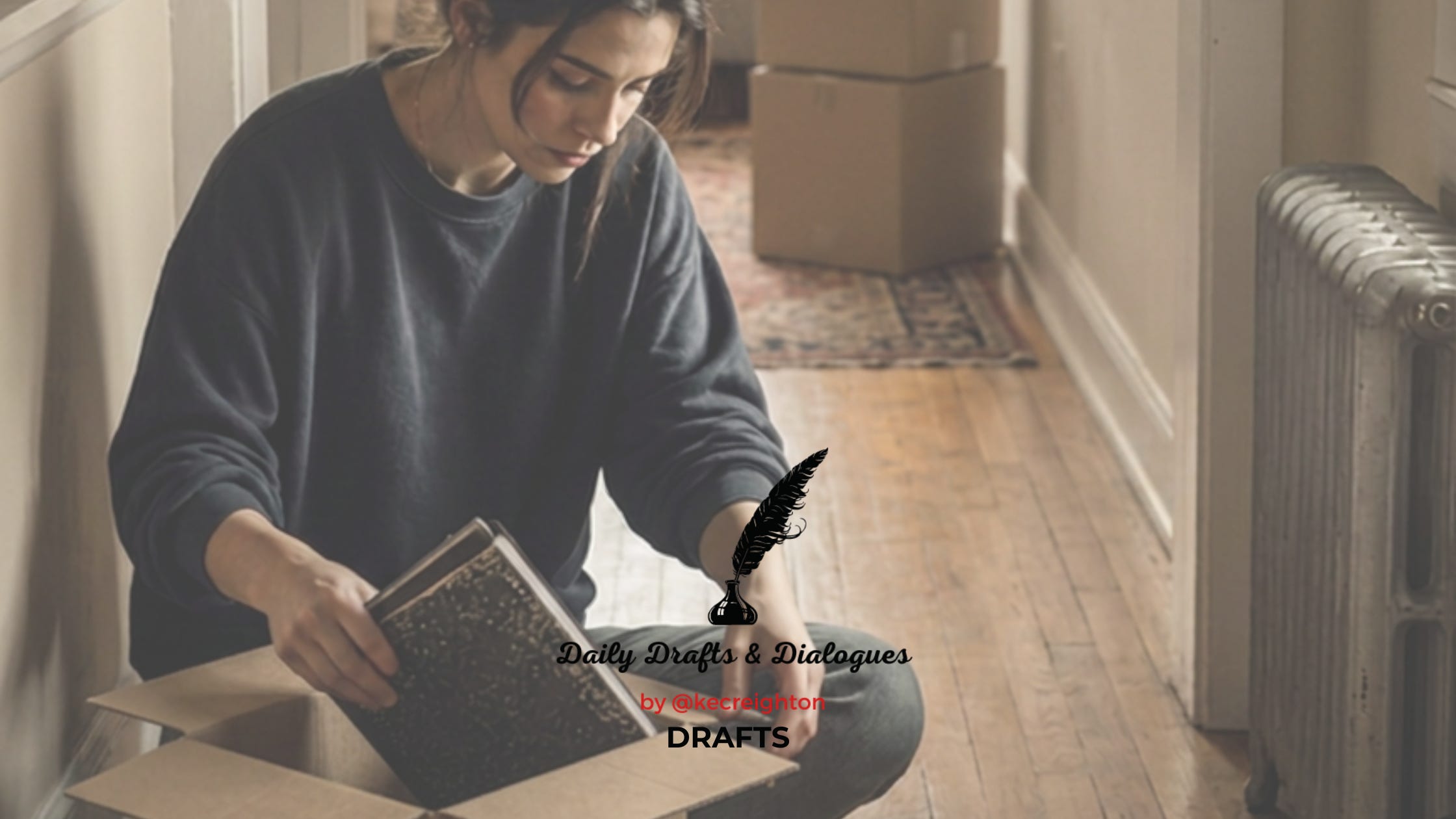
Of course she did. Of course, my new sweet-yet-naive-and-completely-clueless sister-in-law had said I wanted the musty old boxes full of composition notebooks currently taking up the only navigable space at the edge of my living room. Because, for some inexplicable reason, ever since my mother had died, she has been hell bent on reallocating practically everything my mother had so much as breathed on to me, and my teeny tiny studio apartment.
And oh, how I wish I could have ignored their obtuse dimensions and moldy stench, for at least one more day. I had to be at work in less than an hour and was supposed to meet Kaia at the taco cart on the way to hear about the ‘trauma-dumping’ date she had last night. And I, well… needed to keep myself as busy as possible and do anything and everything that prevented me from thinking about or excavating my mom’s old words.
But the harder I tried to ignore them, like the lack of punctuation in my brother’s texts, the more space they seemed to occupy in my mind. I just couldn’t resist their magnetic pull.
Mid glam up routine, I couldn’t take it anymore. I put down my concealer tube and blush brush and charged back into the living room intent on ripping open the first box I saw. Which I did. Though it ended up being much easier than I had anticipated because its moist top edges folded against my hands as I pulled them back, tearing them off completely.
And there it was, my mother’s handwriting, scrawled inside the boxes on the journal covers staring up at me, marking time. Though based on its neater and more precise curves and points, I could also tell it was her handwriting from before she had me and probably ran out of time for pretty penmanship, or writing in journals for that matter. From a time when she was younger than I am now.
The one on my left read: Summer 2000. The one on the right: Winter 2000.
I was born in the spring of 2001, so I grabbed the latter. A surreal feeling washed over me when I picked it up and held it in my hands, realizing she had held it before too, but without knowing when the last time she did was. Based on the condition of the box it was in, it could have been years.
My finger was on the top corner of its cover, ready to pull it back when my phone buzzed on the glass top of the side table, making me jump and drop the journal.
When I bent to pick it up, I saw my mother’s face illuminating on my phone in my periphery and sucked in a shallow breath.
With shaky hands, I picked up the phone, wondering whether to accept or reject the call.
My voice cracked when I answered on the fourth or fifth ring.
“H-hel-lo?”
“Hey honey. Just wanted to see if we’re still on for dinner tomorrow?”
A small wave of relief washed over me.
“Dad?”
“Who else would it be?” He chuckled, but when I didn’t respond right away he followed up with, “You okay peanut?”
I drew a long breath.
“Yeah, I guess. It’s just mom’s picture came up when—”
“Oh, dang it. I did it again. So sorry honey. I left her phone out, meaning to take it to the phone place to return it or recycle it or whatever your brother keeps telling me to do with it and keep mistaking it for mine instead. We have all the same contacts and they look the exact same, I swear.”
I let out a small laugh, now fully relieved my mother wasn’t calling me from beyond the grave the second I decided to go snooping through her old journals.
“So, we still on for tomorrow?”
“Yeah. But you should come to my place before so we can look at these journals Hayley had Finn drop off this morning while I was at yoga.”
“What journals?”
“The ones from mom’s office closet. I think they’re from when she was younger, but I don’t know for sure what’s in them.”
There was an awkward pause then, “I didn’t know your mother kept journals.”
“Well, apparently she did. I have three boxes full of them here in the pathway to my living room to prove it.”
I nudged one with my foot, as if he could see me making my case.
“Hmmm. Okay, well sure, we’ll look at them tomorrow then. I’ll be by at six-thirty.”
“Sounds good.”
I was about to say goodbye and hang up when he said, “Hey Peanut, do me a favor.”
“Yeah dad?”
“Wait until I get there tomorrow to open them, okay?”
“Sure, no problem. I’m headed to work in a few anyway.”
But as I bent my head to hang up the phone, I caught a glimpse of the first page of the journal that had fallen, which was now splayed open.
In bold capital letters, it read: MY SECRET LIFE AS AN ASSASSIN: A DOCUDRAMA
And underneath those bold letters: The mostly true story behind how I survived and playacted my way through hostages and hits to be home in time for dinner.
My Reflection
Working on this prompt was fun and more thought-provoking than I thought it would be when I first started writing, as I seriously couldn’t get the phrase “mostly true story” out of my head and how I would feel if I came across it in a loved one’s written material after they passed. Which also allowed me to appreciate the adverb ‘mostly’ more, and how adverbs might be used effectively in fiction when we’re constantly told to avoid them like the plague. But that is a topic to get into some other time.
I also like the cliffhanger of this piece, as it offers a great place to start later, which made me remember that most beginnings to stories come at the end of other stories. So writing this piece uncovered a hidden trick for me: If I’m struggling to find a story’s beginning, perhaps I should find where the story that came before it ended first.
And, of course, I liked the uncertainty the piece’s cliffhanger brings, as it provides an open-ended question that I, the writer, may or may not be able to answer in full when I carry on writing the story, which would make writing the remainder of this piece fun and engaging. And that reminds me of something Robert Frost wrote once: “No tears in the writer, no tears in the reader. No surprise in the writer, no surprise in the reader.”
Ultimately, I didn’t uncover anything too personal about my mother’s passing or how I feel about it, but writing this piece was still cathartic and enjoyable in other ways, as it helped me rediscover some hidden truths behind the nature of storytelling and language itself and the myriad of reasons behind why someone may or may not choose to share their writing. And that made writing this worth it.
How about you? What did this prompt or flash fiction piece surface for you?
Leave a comment or join this week’s Drafters Workshop chat so we can discuss it or your own writing related to Saturday’s Writing Prompts That Encourage You to Share Your Work.
Whether you join the chat to share your responses to this week’s prompts, ask questions, workshop an excerpt of something else you’ve written, or simply want to encourage others, we’d love to see you there as we explore what it means to share our creative work with others this week.

Continue Exploring July’s Creative Courage Theme
This Week: Sharing the Work
Writing Prompts That Encourage You to Share Your Work
ICYM Week 2: Taking Creative Risks
Taking Creative Risks: Writing Prompts to Build Creative Courage
Should writers prioritize creative risks or readers’ expectations?
20 Books That Prove Creative Risks Are Worth Taking
Balancing Artistic Vision and Creative Risks with Readers’ Expectations
Stories I’ve Read Recently That Made Me See Something Differently
Popular Posts from Week 1: Beginning Before You Feel Ready
Beginning Before You Feel Ready: Writing Prompts
Why Beginning Feels So Difficult, But Doesn’t Have to Be
Books That Made Me Want to Write and Take Creative Risks
Consider going more in depth with this month’s theme with July’s Creative Courage Writing Collection.
The writing collection is designed to help you explore creative courage from different angles: discovering your voice, strengthening your craft, experimenting with new approaches, and reflecting on the writer you are becoming.
The free Drafts writing prompts posts that will be published every Saturday this month will explore the outward side of creative courage—beginning, risking, and sharing— and should complement this collection quite well, which invites you to go much deeper into the internal work of creativity with 30 guided writing prompts and craft exercises, reflections, as well as three options for guided monthly writing challenges for those who want to go even further than that.