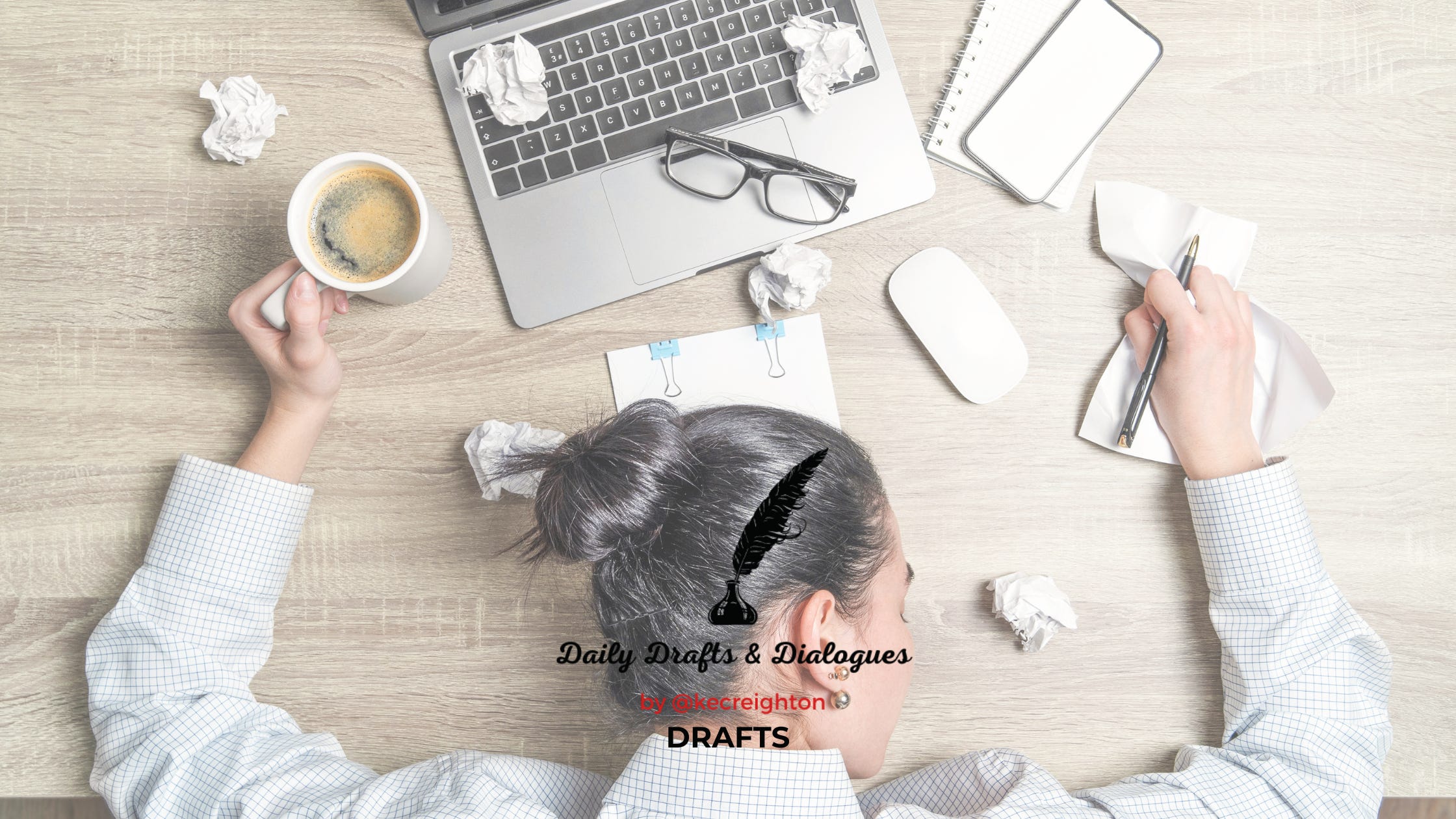
What I Do When I’m in ‘The Messy Middle’
Today’s post allowed me to take a beat and reflect on what I do whenever I find myself in ‘the messy middle.’ Read on, then join the chat to share how you handle the same situation so we can discuss.
August Theme: The Creative Life
Big Question: How do we build a creative life that works for us?
Week 3: The Messy Middle
What I wrote below is based on the following reflective writing prompt included in Saturday’s Writing Prompts for Navigating ‘The Messy Middle’ post.
Prompt: When the Work Isn’t Going Well
How do you respond when your work isn’t going well, especially when you’re in the middle of a project?
Why did I choose it?
I chose this prompt because I want to explore what I actually do when I find myself in ‘the messy middle,’ as I don’t usually think about it. One of the things I have always loved about writing is how it forces you to slow down and gather your thoughts and feelings so that you can express them in an honest and coherent way. So, I guess I have always seen ‘the messy middle’ as the fun part of writing, where I get to sort through ideas and words and figure out how I want to bring them all together, kind of like I’m building a puzzle of words, to depict a picture I want to share with others.
While some writing projects take longer than others, which can cause some stress at times, all in all I would like to think that I respond to that stress with genuine curiosity and a problem-solving yet artistic type of mentality. Though that necessitates I have time to write what I want to write, and that I’m fairly well rested, if I’m entirely honest.
Basically, in today’s post, I want to reflect on whether my assumptions about how I respond to ‘the messy middle’ are true, and whether I truly see the stress it can cause as a creative challenge to overcome, or as something else…
My Response: What I Do When I’m in ‘The Messy Middle’
I would like to say that I have a distinct strategy for handling ‘the messy middle’ of a draft, but alas I do not, mainly because each draft has its own creative requirements and lifeblood. Though I am hoping this week’s focus on this topic (The Messy Middle) will help me come up with something more tangible to do, or at least allow me to become more aware of what I’m already doing, to navigate the messy middle of a draft, so substantial doubt never creeps in to have the last word.
If I’m being honest, when I’m in the middle of a draft and things aren’t ‘going well,’ I stop whatever I’m doing or writing as soon as possible, then ‘take it from the top.’ So, if we’re following the dialogue drafted in Monday’s post, Is doubt a normal part of the creative process or a sign something isn’t working?, I tend to lean more toward the perspective that doubts are a sign that something needs to change ASAP… for better and worse.
But I’m not sure I would say this is the ‘best strategy,’ as I have a feeling that it might be deeply rooted in my perfectionism, which can be my worst enemy and is something I’m constantly working on.
So… back to what I do when I find myself in ‘the messy middle’...
First, I’ll go back to the beginning of the chapter or paragraph I’m writing to see if whatever isn’t working is something minor that can be adjusted or fixed. If not, I’ll go back another page, chapter, or paragraph before the section that doesn’t seem to be working to see where I lost the thread of my original idea or voice. And believe it or not, this tactic usually fixes a majority of the issues I encounter when the flow of my writing isn’t going well— probably like 80-90% of the time.
But, if for whatever reason, going back only a little bit in the project doesn’t seem to be working and I’m still unable to locate where I started to lose the thread of whatever I’m writing, I’ll go way back to the very beginning of the writing project to see what the main thesis or idea or voice at the outset was. Then I’ll work through each line or paragraph to locate and make note of exactly where and how and why the original thread got lost.
From there, I’ll then ask myself if what I originally wrote needs to be adjusted or changed rather than the latter part of the project, where I ended up stuck, or if the opposite is true and I can simply readjust the portion that got me stuck to align better with the main thesis or voice I was using at the beginning of the project.
Most of the time all I need to do is change a sentence or two and voilà the issue is fixed. Precisely what sentences I need to change, why, and how, can take quite a bit of time and effort to sort out, however.
It’s actually exceedingly rare that I lose the thread of what I’m writing so much that I need to scrap an entire project and start over with a blank document, though that has happened to me a handful of times.
More than that, I’ve discovered that going back over what I wrote can help me get back into the rhythm and momentum of a project that I needed to close and come back to later. Yet I do need to be careful not to start intensely revising a piece that is still incomplete when I go back to read through it. Rather, the read through is only intended to get me back into the flow of whatever I’m writing so that I can continue its original thread.
This seems so normal and routine to me at this point in my writing career that I often do it without thinking, so I’m not sure if it’s something that will help others in the same way that it helps me or not. And I’m still unsure whether it’s a response to stress or a habit, if it’s both, or if it’s neither.
I’ll admit, when I first started writing, eons ago now, I hated losing the thread of my writing and bemoaned how long it took to go back and find it again. Yet I also learned that starting a project over from the very beginning is often much harder and more time-consuming and soul-crushing in the long run, for me anyway.
For me, it’s much easier to go back a little in your draft so that you can remind yourself why you’re writing what you’re writing in the first place, and locate your original thread again, than it is to abandon it or charge ahead writing something that will be confused or irrelevant to what you started writing anyway just to have to revise it heavily later.
One of my writing mottos: Smooth, thorough writing hides the heavy labor behind it.
Join the Conversation
What’s your response to the question I answered in today’s post, or any of the other prompts in this week’s Writing Prompts for Navigating ‘The Messy Middle’ post?
Leave a comment or join the Drafters Workshop chat or Dialoguers chat, where we’ll be discussing how to build and sustain the creative lives we truly want throughout August.
Whether you leave a comment or join one of the chats to share your responses, ask questions, or connect with other writers and support their work, we can’t wait to see what you contribute!
Please don’t forget to like and share this post with your network so others can see it too. Thanks in advance. I hope to see you in the comments or chat threads soon!
Continue Exploring August’s Theme, The Creative Life
This Week: The Messy Middle
Writing Prompts for Navigating ‘The Messy Middle’
Is doubt a normal part of the creative process or a sign something isn’t working?
Reading Notes: The Cemetery of Untold Stories
Popular Posts from Week 2: Creative Habits
Immersive Storytelling Mode and the ArXiv
Reading Notes: The Unabridged Journals of Sylvia Plath
The Habits That Help Me and My Creative Life Most
Striking the Right Balance with Quantifiable Creative Habits
Popular Posts from Week 1: Making Space
A Day Alive in the Lakeside Library
How to Make Space and Time for Your Creative Life
The Creative Life as Play and Work
Consider going more in depth with this month’s theme with The Creative Life Writing Collection
Every prompt, draft, and dialogue begins a conversation, but some of those conversations deserve more of our time and attention.
If today’s post sparked an idea or practice you want to explore further, The Creative Life Writing Collection offers a guided month of prompts, craft exploration and techniques, reflection, and customized reading recommendations for writers who want to go deeper.
And if you want to explore past themes, paid subscribers also have access to the full archive, including previous writing prompts, discussions, and reading lists, as well as full access to the community chat and Daily Drafters Exclusives writing collections.