
Book Review: Days of Love and Rage
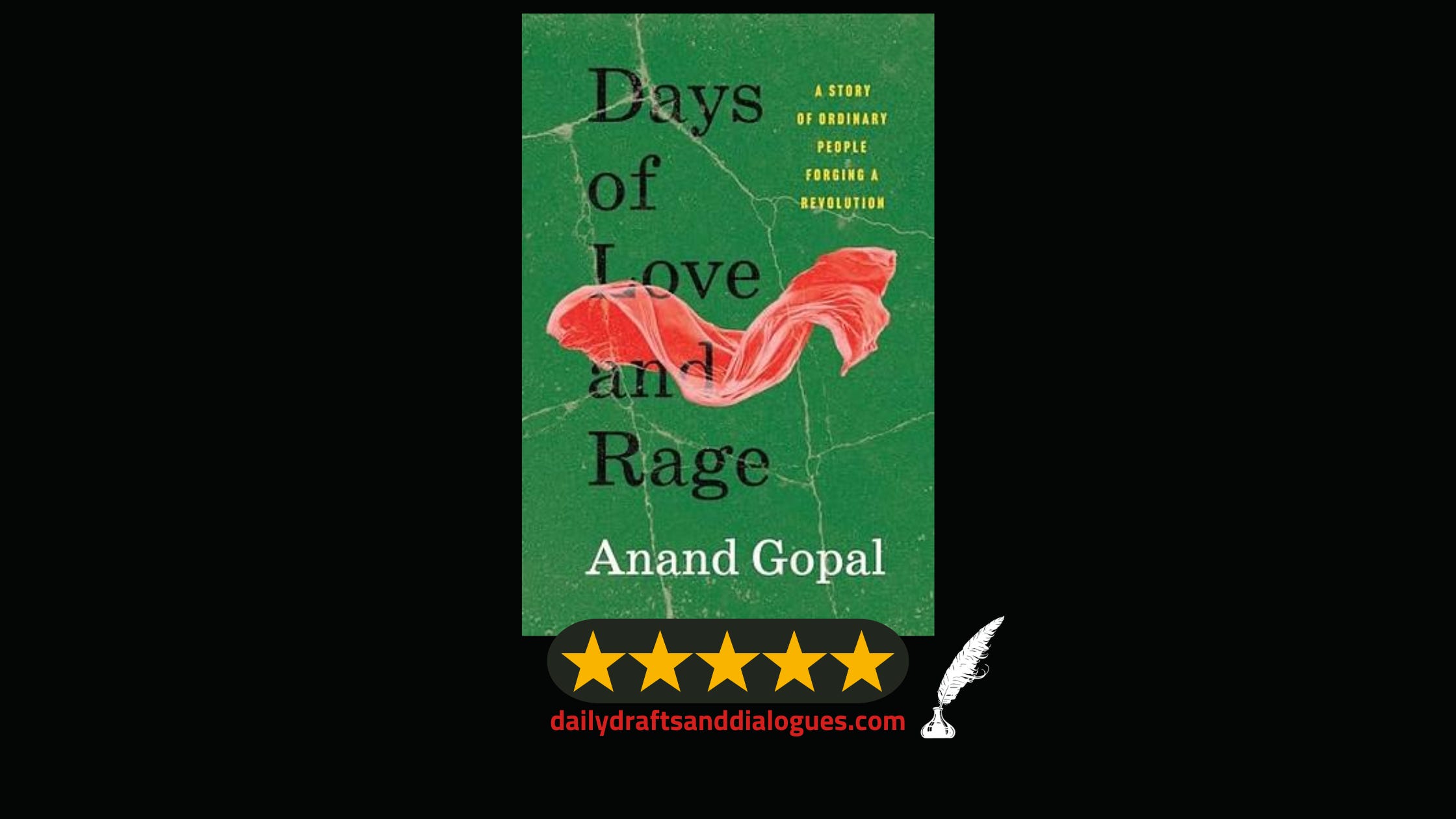
Here is my final review of Days of Love and Rage by Anand Gopal. Leave a comment if you’ve read it, plan to read it, or have any book recs to share. And join today’s dialogue!

SCROLL TO THE BOTTOM TO SEE TODAY’S WRITING PROMPT
Days of Love and Rage: A Story of Ordinary People Forging a Revolution by Anand Gopal is a striking example of collective journalism with thousands of newspaper and magazine clippings and personal diary entries and letters and video footage and social media posts and activity along with eight years’ worth of original research and two thousand interviews and a half dozen on-the-ground research assistants behind it. It is so thorough and comprehensive that I had to divide my book review for it into two posts. Here are my notes on the first half of the book.
Halfway through Book Three (and the entire book), the spirit of the revolution in Manbij, Syria in 2013 starts to shift away from the Revolutionary Council (not yet two years old) toward a faction of revolutionaries who try to oust the Council for their mishandling of the city’s bread supply and rampant corruption and greed, called the Revolutionary Youth Movement (RYM). And one of the key players behind this faction is none other than Abdul Hadi, who is enraged at how the elitist Council doesn’t seem to care about justice for the poor and uneducated, which leaves him susceptible to the influence of a few ISIS soldiers who come to town and inevitably turn his world and how RYM operates upside down, leading them to believe that religious morality is better than liberal morality.
After the regime’s incessant raiding, skyrocketing bread prices, and the inroads ISIS is able to make due to Abdul Hadi’s help, the Revolutionary Council is ousted from power within eighteen months after ousting Assad’s forces from the city and the Islamic State begins ruling Manbij, installing Repentance Centers and Sharia law, which ultimately leads to such horrific conditions that members of the revolution must leave the city or be executed, along with thousands of other innocent people who are slaughtered and terrorized for years until the Syrian Democratic Forces (SDF) come in, backed by foreigners and remote interests, until they are ultimately ousted by Syrian rebel forces again in 2024, whose future is still pending.
Gopal continues to follow the narratives of six critical and ‘ordinary’ individuals (see my notes on the first half of this book for notes on them) in the latter half of the book for nuanced accounts of what happened during the beginning stages of the revolution in Manbij (2011-2024), which is still ongoing, while never sacrificing the political and cultural history of Syria and Manbij and their people’s complex narratives of love and rage. Through their intimate and complex personal narratives, this revolution is a little closer to being understood on a profoundly human level, on their collective terms.
Many with similar stories to Mina Saba, Ibrahim Kasem, and Hasan Nefi, will never see their homes in Manbij again as they once knew them. Others, like Abel Os, are walking scars of the price and rewards of resistance to future generations across Manbij. And those who were unable to overcome their vulnerabilities to let in a more profound sense of hope for a collective future, like Abdul Hadi, will have to live with the extreme consequences of their betrayals and miscalculations. While those like Oday al-Hema will live on in collective memory and spirit, as their bodies will likely never be recovered.
One of the most intense parts of this book is when Gopal gives his first-person account of searching for Oday al-Hema, who was captured and tortured by ISIS in Manbij and went missing after SDF forces took over the city. Gopal spends years tracking down family members, friends, previous cell mates, and dangerous ISIS leaders in refugee camps to eventually learn of Oday’s tragic, unclear fate, sharing Oday’s words and poetry simultaneously, ultimately juxtaposing Oday’s path with his friend Abdul Hadi’s path. Where one man was able to live with the despair and hope of what revolution requires, and willing to sacrifice everything for it, the other was not.
“There was a persistence to Oday’s hope, and that of his comrades, through the ups and downs, that we don’t normally associate with emotion. Hope, for him, was not simply a feeling, like love or rage or any other passion, but a disposition, a trait of character.”
“Abdul Hadi could not live with his vulnerability. He was enslaved by it, and it led him, in ways he could have never imagined, to moral disaster.”
In addition to each of the six personal narratives Gopal offers in this book, I will remember the major lesson the Revolutionary Council of Manbij hopefully learned by now: The perceptions and realities of economic equality and general stability, which usually go hand-in-hand with the cost of bread, can and will influence a revolution, more than anything else. Above all else, people need to eat, and so do their children.
I still think this might be one of the best nonfiction books I end up reading this year and think readers who enjoy deep historical dives with personal narratives and stakes will want to read it.
Here is one of the most memorable passages from the second half of the book:
“Was it all worth it? I [Gopal] came to Manbij because I wanted to know: Would it have been better for people never to have stepped onto the rain-slicked streets that April afternoon in 2011 and demand freedom? Should they have kept quiet, choosing a desolate peace over the horrors that followed? … Looking at everything that’s been lost, was it not now perfectly reasonable to give in to despair? And if not, how was one supposed to resist that temptation?
“This isn’t merely a question for Syrians. In an epoch of crumbling institutions and rising oceans, it’s one we all confront. To persist in the shadow of great loss demands a certain kind of hopefulness— and that, ultimately, is why I’d come: to investigate the limits and possibilities of hope in a damaged world.”
Today’s Dialogue
What do you think hope looks like in today’s ‘damaged world’?
What do you know about the revolution in Syria, and what do you want to know?
Have you read this book yet, or plan to read it soon?
© This work is not available for artificial intelligence (AI) training. All Rights Reserved by K.E. Creighton; Creighton’s Compositions LLC.
Community Notes

CURRENTLY READING
Yesteryear by Caro Claire Burke
Week 1 (June 1-7) — Part I and Part II Chapters 1- 11
Week 2 (June 8- 14) — Part II Chapters 12- 27
Week 3 (June 15- 21) — Part II Chapters 28- 42
Week 4 (June 22- 30) — Finish Book
A public chat thread will be shared on Substack to discuss the entire book at the end of the month. Until then, join our Buddy Read in Storygraph to chat about the book as you read it at your own pace.
JULY BOOK: TBD
A poll will be posted in Storygraph for this book selection soon! Join the club so you’re ready to cast your vote when it goes live.
