

SCROLL TO THE BOTTOM TO SEE TODAY’S WRITING PROMPT
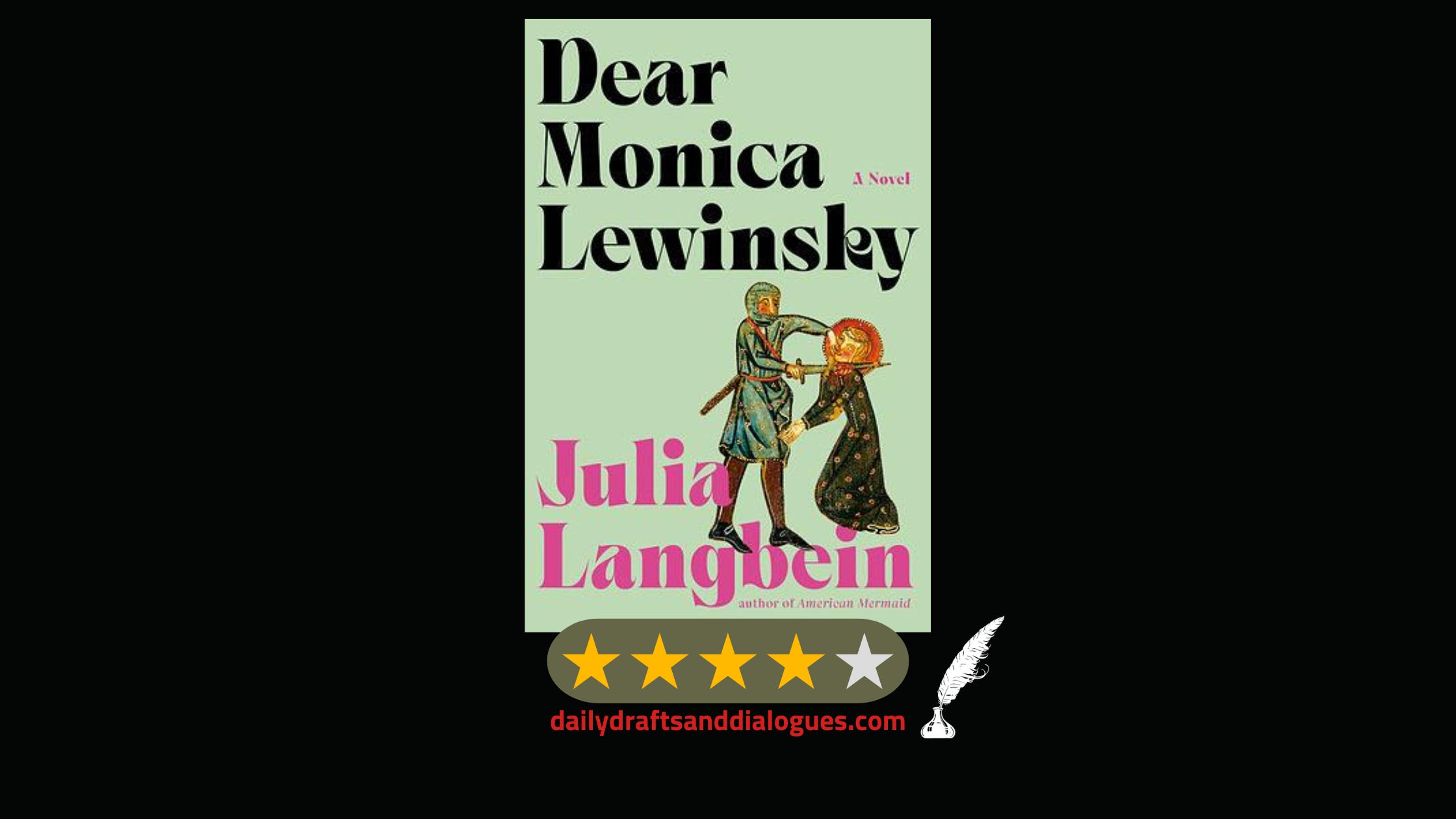
Dear Monica Lewinsky by Julia Langbein is one of those books that pulled me in with its wit and candor right away, almost making me forget that it promised a poignant story about a young woman growing up in the late 90s during the Clinton-Lewinsky scandal. It had me laughing out loud and thinking deeply at the same time, which is a rare treat.
At the beginning of the novel, forty-something Jean Dornan receives an email from David Harwell, a professor she had an affair with during a study-abroad program in France when she was nineteen, who was in his forties at the time. The email invites her to his retirement ceremony and prompts Jean to seek out and reread her journals from that time in her life, leading her to realize that their affair took place during the exact same summer as the infamous Clinton-Lewinsky scandal—a parallel she completely missed when it was happening because she had been too caught up in David and her desire for him.
This realization sends Jean into an emotional spiral as she’s forced to reckon with her newfound empathy for what Monica (who was also young and only in her early 20s at the time) went through, and how her own affair derailed her life. At the beginning of her emotional spiral, she finds herself in a church basement and conjures the ghost of Monica Lewinsky, who ends up acting like a ghost-from-Christmas-past, guiding Jean as she unpacks the power dynamics of her youth, and the guilt and shame her affair with David caused, so that she can view her younger self with a more realistic and compassionate lens.
The majority of the book includes flashbacks centered around how Jean’s desire for David developed over the summer of 1998 as they stayed in a castle owned by an eccentric prince and visited and studied churches and their cultural and architectural histories with a small group of students and one other professor. In these flashbacks, readers see virgin Jean struggle with her budding desire for a married man who is kind and attentive as she is still trying to figure out who she is and what she really wants out of life. As they visit churches full of history and complex architecture across France, she is constantly comparing herself to the other students and doing what she can to get David to notice her (who is more than willing to oblige) as she learns about the history of the women upon whose sacrificed bodies many of the churches were built, who were all vilified and martyred for other men’s desires, as well as their own— all while hearing about what is going on with Monica Lewinsky over periodic radio and television broadcasts.
The brief chapters covering the women saints and how they reached sainthood parallel the storylines of Monica and Jean, who are all continually shamed and punished for their desires, or lack of desires. By placing these women martyrs alongside Lewinsky, the novel inevitably challenges readers to consider why society only reserves sainthood or reverence for women who suffer for their chastity, while simultaneously punishing women like Lewinsky who assert their sexuality or transgress patriarchal boundaries. Through this novel, Lewinsky is reframed from a subject of tabloid ridicule into a modern-day martyr, as a woman who survived mass humiliation and came to embody resilience and grace, all while she helps Jean learn to forgive herself for her past desires as well.
This novel ultimately forces readers to reevaluate how young women are continually vilified, punished, and scapegoated for illicit affairs and missteps with older men, and forced to forgo their promising futures, while the older men (David Harwell and Bill Clinton) in these affairs emerge unscathed and protected by their power and status. At the same time, however, this novel never victimizes the women who participate in these affairs or depicts them as weak, and never depicts the men as creepy predators either— and it is because of this that it is able to successfully capture the complexities of how young women are meant to feel ashamed and get punished for their desires, while men (especially those in positions of authority or power) do not. Instead, it depicts how the older men in these affairs can carry on in their personal and professional lives as if nothing happened, while the young women must be the ones who change jobs and struggle with their intimate relationships and feel guilt and shame.
Most of all, I appreciated the humor in this novel. It made a difficult topic easier to explore on an intellectual and emotional level without ever outright demeaning anyone or losing the main purpose of the novel’s plot, although I can see how and where such humor could ruffle a few devout Christian feathers. I also thought the humor in this novel helped capture Jean’s struggles in an engaging and approachable way and ensured Monica’s apparition was relatable and funny but also reasonable and emotionally intelligent.
Yet I did finish the book wishing I had received more of Monica’s personal backstory for more context and empathy, as it seemed as if it was assumed readers would know the details of everything she experienced. I was also left wishing I had a better understanding of what Jean experienced during the decades between the affair and the email she received from David, as I felt much of that was glossed over.
Overall, I would recommend this novel to Xennials (older Millennials) who would like to revisit where they were during the Clinton-Lewinsky scandal, and the effect it had on them, as well as those who like to laugh and think as they learn a little more about saints and religious history.
Today’s Dialogue
If you had a notable person from history help you revisit a past period in your life, who would it be, and what time in your life would you want to revisit?
Have you read this book yet, or plan to read it soon?
© This work is not available for artificial intelligence (AI) training. All Rights Reserved by K.E. Creighton; Creighton’s Compositions LLC.
Community Notes
Check out Book Club For Weirdos’ Free Reflection Deck for Readers Who Like Stories That Stain the Brain
— a 52-card reflection deck filled with questions designed to help readers think more deeply about the stories that stay with them. This deck will help you read deeper and weirder and explore unanswered questions about characters and books that have stayed with you, and so much more!
EGALITARIAN BOOK CLUB
The POLL for July’s selection is up in Storygraph and closes in 3 days.

The options are:
Prophet Song by Paul Lynch
Poverty, By America by Matthew Desmond
The Edge of Space-Time: Particles, Poetry, and the Cosmic Dream Boogie by Chanda Prescod-Weinstein
Japanese Gothic by Sunyi Dean
