
Book Review: Fahrenheit 451
Here’s my review of Fahrenheit 451 by Ray Bradbury. Leave a comment if you’ve read it, plan to read it, or have any similar book recs to share. And don’t miss today’s writing prompt.

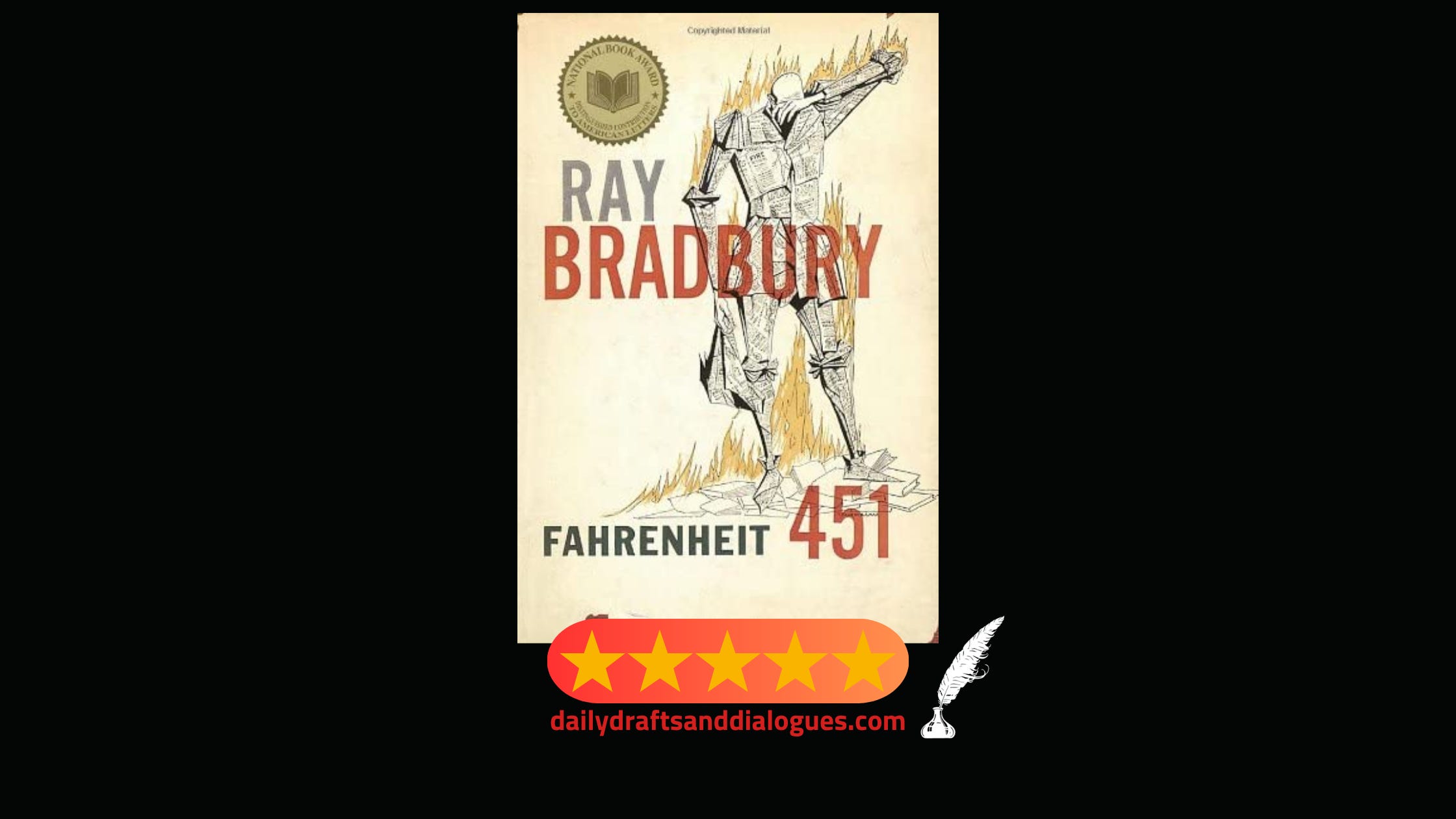
Fahrenheit 451 by Ray Bradbury is one of those novels that will resonate with me for a long time, as it will for many others, as it simultaneously inflames reflection, curiosity, empathy, and horror. It might also prove more prescient now than it did when it was first published in 1953, as society continues to grapple with how certain people and groups in power leverage technology like AI to obfuscate reality to subdue the masses and torch the power of books (even if not the literal books themselves), reminding me how Ray Bradbury himself once said: “You don’t have to burn books to destroy a culture. Just get people to stop reading them.”
[Warning: There are a few plot spoilers in the rest of this review.]
At the beginning of the novel we’re introduced to Guy Montag, a fireman whose job it is to burn books in a society with fireproof houses that views books as dangerous weapons but mindless always-on noisy screen-centered entertainment that induces mass conformity as central to their happiness. From the first dozen or so pages, readers will be able to intuit that Montag is different from his wife and fellow firemen somehow, especially his boss Captain Beatty, though it’s not clear exactly how… until he meets and interacts with Clarisse McClellan, a 17-year-old girl who lives next door and ignites the curiosity he always had but tamped down until they start talking. Once they start talking about nature, happiness, and book burning, Montag starts reflecting on his own life and actions more too, then starts seeing the world and his actions within it in different ways.
After Montag interacts with Clarisse, his character starts shifting more starkly toward nonconformity, especially after he witnesses an elderly woman burn herself alive along with her home library rather than live without its books. It is then that Montag starts explicitly questioning the value of books: “There must be something in books, something we can’t imagine, to make a woman stay in a burning house; there must be something there. You don’t stay for nothing.” To which his wife, Mildred, replies with annoyance and frustration, as he is interrupting her ‘happy’ everyday life and routine full of mindless entertainment and noise. And to which Captain Beatty responds with quotes from books, though he twists their meaning to try and demonstrate how dangerous, contradictory, confusing, and nonsensical books are, and how they ultimately lead to ‘insanity.’ Beatty says, “A book is a loaded gun in the house next door. Burn it. Take the shot from the weapon. Breach man’s mind. Who knows who might be the target of the well-read man?” But Montag can’t shake his growing curiosity.
As the novel unfolds we learn that Montag had been curious about books and their significance for at least a year once we discover that he’s been hiding some books inside his own house and that he’s been hanging onto a small piece of paper with contact information for a former English professor he met in a park the previous year. He then reconnects with the English professor, Faber, who acts as Montag’s new mentor, helping Montag understand the significance and value of books in a dystopic world, though Faber claims that he is himself a coward. Faber does, however, empower Montag to rebel against censorship and aids Montag’s awakening, highlighting the importance of deep thought over superficial entertainment. And from that point on, Montag journeys down a new and uncertain path, which is as dangerous as it is exhilarating.
There are plenty of themes to highlight and discuss in this novel, which include censorship, technology, and mass media, and how they all work together to promote pervasive apathy (which is misconstrued as happiness in the novel) to dehumanize and control the population, promoting and instituting artificial relationships and superficial ‘knowledge’ over deeper human connections and understanding. The novel also highlights the power of literature and intellectual freedom and how essential books (as well as the memory of what they hold) are to the survival of humanity.
Montag’s journey represents the uncomfortable yet enlightening shift from being a passive tool of the state to an active participant in preserving knowledge and fighting against a system that works to control people. There are also tons of images and symbols for lit nerds to unpack, which include fire (destruction/purification), the hearth and salamander (home/firemen), the phoenix (rebirth), the sieve and sand (mind/knowledge), and mirrors (self-awareness).
More than anything, I enjoyed following the unraveling mystery of why books were being burned and who was working for and against such state-mandated efforts alongside Montag. While this novel is chock full of similes, metaphors, irony, imagery, literary motifs, paradoxes, symbolism, etc., I appreciated how it was still relatable (especially in 2026) and easy to follow, which also makes it an excellent novel for any school classroom to devour, digest, then discuss. Fahrenheit 451 is officially now one of my favorite classic novels of all time.
Here are a few additional notable quotes from the novel:
“We need not to be let alone. We need to be really bothered once in a while. How long is it since you were really bothered? About something important, about something real?”
“‘The books are to remind us what asses and fools we are. They’re Caeser’s praetorian guard, whispering as the parade roars down the avenue, “Remember, Caeser, thou art mortal.” Most of us can’t rush around, talking to everyone, know all the cities of the world, we haven’t time, money or that many friends. The things you’re looking for, Montag, are in the world, but the only way the average chap will ever see ninety-nine per cent of them is in a book. Don’t ask for guarantees. And don’t look to be saved in any one thing, person, machine, or library. Do your own bit of saving, and if you drown, at least die knowing you were headed for shore.’”
“With school turning out more runners, jumpers, racers, tinkerers, grabbers, snatchers, fliers, and swimmers instead of examiners, critics, knowers, and imaginative creators, the word ‘intellectual,’ of course, became the swear word it deserved to be.”
“The good writers touch life often. The mediocre ones run a quick hand over her. The bad ones rape her and leave her for the flies.”
“But you can’t make people listen. They have to come round in their own time, wondering what happened and why the world blew up around them.”
“‘If you don’t want a man unhappy politically, don’t give him two sides to a question to worry him; give him one. Better yet, give him none. Let him forget there is such a thing as war. If the government is inefficient, top-heavy, and tax-mad, better it be all those than that people worry over it. Peace, Montag. Give the people contests they win by remembering the words to more popular songs or the names of state capitals or how much corn Iowa grew last year. Cram them full of noncombustible data, chock them so damned full of ‘facts’ they feel stuffed, but absolutely ‘brilliant’ with information. Then they’ll feel they’re thinking, they’ll get a sense of motion without moving. And they’ll be happy, because facts of that sort don’t change.’”
“‘I don’t talk things, sir. I talk the meaning of things.’”
“See the world. It’s more fantastic than any dream made or paid for in factories. Ask for no guarantees, ask for no security.”
Have you read this book yet, or plan to read it soon? Leave a comment to start a discussion or tell us what we should read next. And don’t forget to subscribe to receive future book reviews in your inbox, along with other engaging posts.
© This work is not available for artificial intelligence (AI) training. All Rights Reserved by K.E. Creighton; Creighton’s Compositions LLC.
Want to express your appreciation for this post and writing prompt?
My writing and I are fueled by loyal readers, caffeine, and kind words, so I appreciate any support you can offer that keeps me writing. Thank you so much!
Today’s Writing Prompt
Writing Prompt: Burning
Write a scene in which someone is burning something. Or write about the last time you burned something and why.
Writing Tip
Use the first-person perspective to make what you write more personal and intense.


