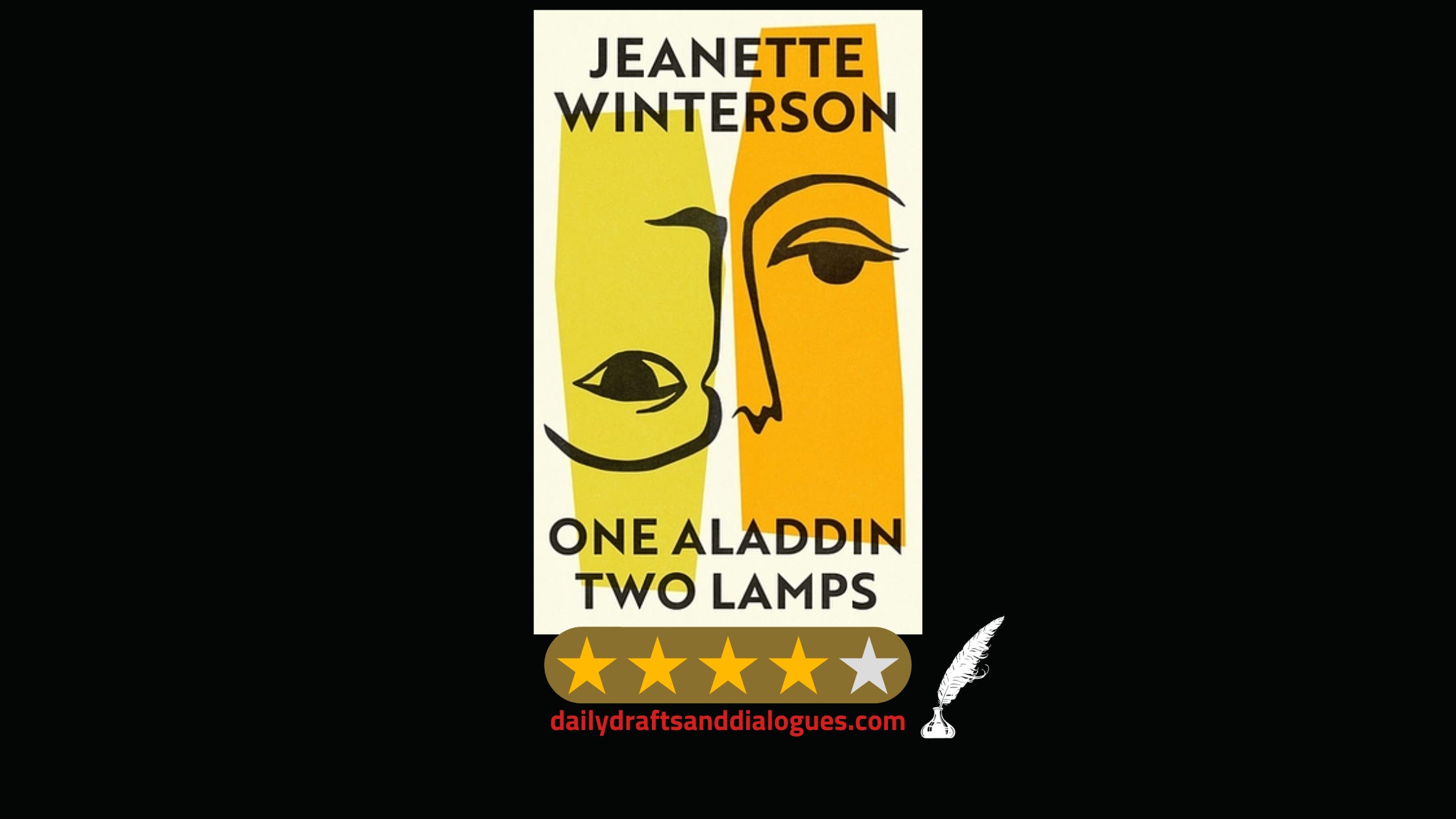
Book Review: One Aladdin Two Lamps
Here’s my review of One Aladdin Two Lamps by Jeanette Winterson. Leave a comment if you’ve read it, plan to read it, or have any book recs to share. And don’t miss today’s writing prompt.
One Aladdin Two Lamps by Jeanette Winterson is a unique book I enjoyed reading, as it’s primarily centered around the power of storytelling and how storytelling is essential to the human condition and living (sometimes quite literally), as well as humans’ future on this planet. It is a good book for lit. geeks, bookworms, natural storytellers, those who enjoy dabbling in light philosophy, and those seeking something a little different to read.
Through an ongoing discussion of One Thousand and One Nights that is mainly focused on how it’s being narrated, by and to whom it’s being narrated, and why it’s being narrated, Winterson explores the power of storytelling. She explores how stories make up who we are, what we learn, what we want, what we’re able to imagine, and even what we do— on both macro and micro levels, as well as more cosmic levels.
With her ongoing discussion of One Thousand and One Nights in the book, Winterson mingles bits of her own personal stories with stories about how Charles Darwin’s theories popularized eugenics (a dangerous story), the history of algebra and computer science (an interesting story many don’t know, but should), shape-shifting’s links to psychology and identity (and how those stories can aid or impede the patriarchy), and many others, illustrating how stories (even and especially those typically assumed as ‘fact’) both allow us to connect to and understand and imagine things greater than ourselves… but only when we explore them on a much deeper and more intimate level first. And how do we do this? By reading and studying literature and telling stories.
“I can change the story because I am the story.”
“The facts are the facts. They stay as they are. The story is the thing that moves. Stories matter. And if deconstructing the heart of a story will alter its beginnings, think how this might apply to how we understand the world.”
“Stories are there to change what is into what if? What if I’m not crazy? What if I’m not trapped? What if things were different? Then what?” (Emphasis added.)
“People ask me, what is the point of reading literature? By literature I mean those works of the imagination that are more than page-turners to pass the time and be tossed away. Once read and twice forgotten. Literature allows complexity, but complexity doesn’t mean obscurity. Literature doesn’t mean boring. What we are hoping for – well, what I am hoping for – is a piece of work with the power to captivate us on many levels. Yes, we want the story. Yes, we want a relationship with the characters. Yes, we want to enter this new – maybe strange – world. And then we want something to happen, by which I mean something to happen to us. This new, maybe strange, world will pose questions, will prompt memories, will cause us to reflect on our own world. And matters of the heart. We always end up there. Literature is an invention. But it’s an invention that asks us to distinguish between reality and illusion. The easy answers on the surface are often illusions. They don’t go deep enough. The rules we live by are provisional and changing – things will never ‘always be this way’. Things have never ‘always been done this way’.” (Emphasis added.)
“As we read the Nights, those questions keep coming in – is this real? Is this an illusion? The right answer can save your life.”
“Ultimately though, each must answer for herself. The same question will not be answered by you in the same way as it will be answered by me. This is why literature is so valuable. Reading deeply is not time wasted. Reading is time set apart to get closer to ourselves. Alienation is the modern disease. Where do we belong? Where should our loyalties lie? This is really a deeper question about who we are. Belonging to yourself only happens when there is a way to dwell on – or do I mean dwell in? – the bigger questions. And it’s never over. Not till we die. And maybe not even then. Who knows?”
“The reason I am an evangelist for literature is that steady, regular, engagement with deep thought, with lit-up language, with vivid worlds, encourages us to go inwards, not outwards. Inwards is where we discover and create resources that belong to us. Resources that are intrinsic not external. I have a private library inside me that I can visit anytime. This is because I have stocked it over many years. In there are stories, characters, lines, words, ideas, comfort, challenge, memories, and even if I never saw a book again, no one can take away what I have. They can’t find it. It’s not outside. It is inside.”
“The stories we tell ourselves, and others – and I mean here our personal stories, as well as our national stories – are not the truth, the whole truth, and nothing but the truth. That is because the subjective part of the story can’t be removed. Humans are subjective by nature. We are not just telling the story. We are part of the story we tell.”
Most of the book reads like the passages highlighted from the book above, with Winterson reminding readers about the mechanics and power of storytelling and literature, offering example after example of Classic literature and Western-centric literature to drive home certain perspectives. And I did get enamored by these passages, underlining dozens of them, at the start of the book. After a certain point in the book, however, the book starts feeling more preachy than illustrative, in my opinion, and the focus on One Thousand and One Nights and its illustrative value to the book’s overall message becomes lost and buried.
I also wish there were more examples of recent literature and how it will and should fit into our understanding of the modern world explored in the book, especially since the book leaves us contemplating how we’re going to explore the future of the world and AI via storytelling now.
Because I am a true believer in the value of storytelling and how it can help us better navigate our world, I will recommend this book to others, especially bookworms and language lovers like me. However, I do feel it would have had more of an impact on me as a reader had it either been a true personalized manifesto or memoir about the power of storytelling OR a more thorough literary critique regarding the timelessness of One Thousand and One Nights.
Subscribe to receive future book reviews in your inbox, along with other engaging posts. And don’t forget to leave a comment with your own book recommendations.
© This work is not available for artificial intelligence (AI) training. All Rights Reserved by K.E. Creighton; Creighton’s Compositions LLC.
Want to express your appreciation for this post and writing prompt?
My writing and I are fueled by loyal readers, caffeine, and kind words, so I appreciate any support you can offer that keeps me writing. Thank you so much!
Today’s Writing Prompt
Writing Prompt: Once upon a time…
Write flash fiction, or a journal entry, that begins with: “Once upon a time...”
Writing Tip:
The most important thing to consider when working on this prompt is that you are telling a story, whether you are writing something based on real life or something that is completely made up.


