

SCROLL TO THE BOTTOM TO SEE TODAY’S WRITING PROMPT
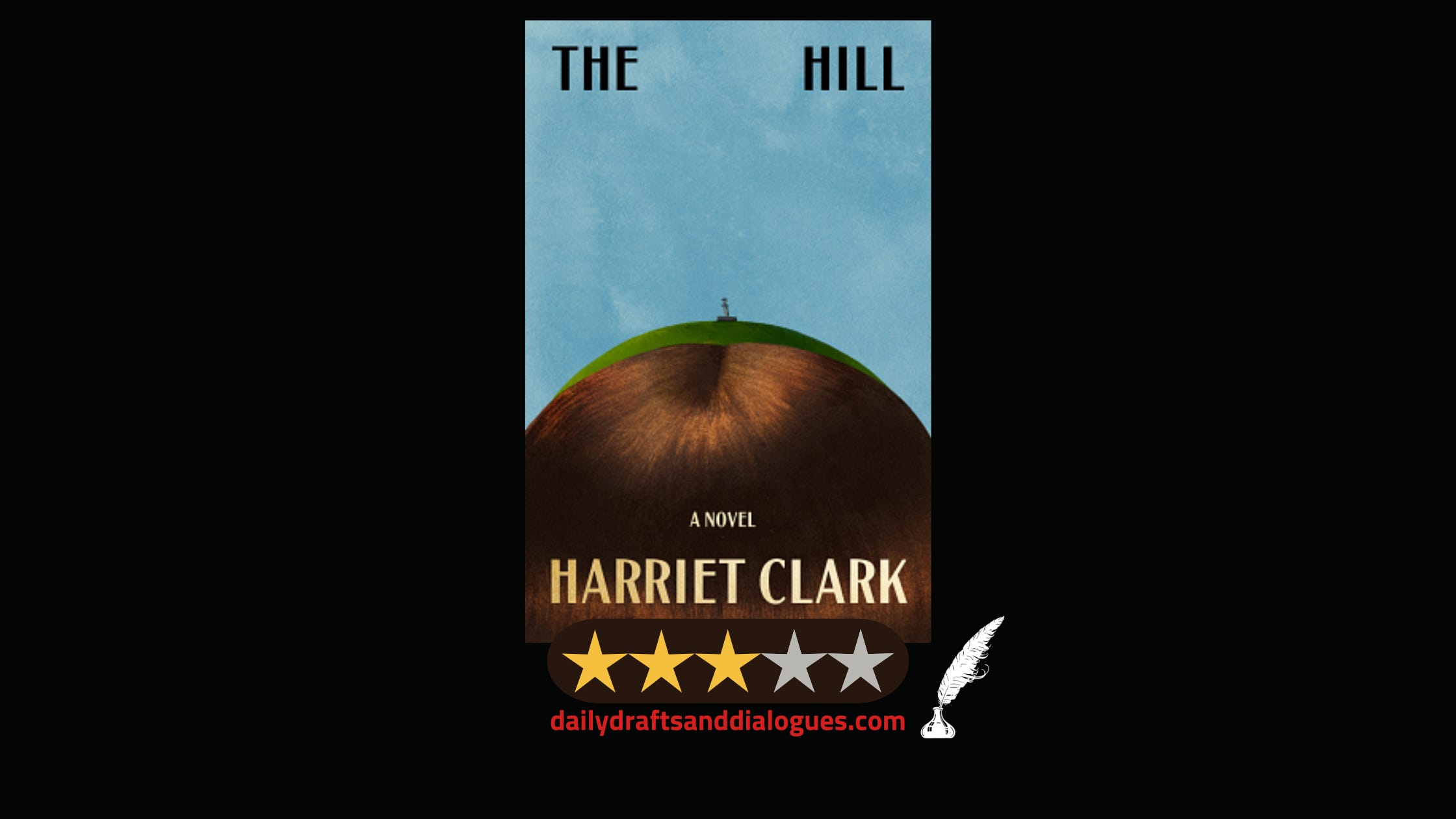
The Hill by Harriet Clark is a coming-of-age novel that offers readers a steady stream of captivating prose that mimics its plot, stuck between the known and unknown. Readers in a more introspective mood will enjoy it, as well as readers who enjoy novels that force them to slow down and witness the intricacies of everyday life in another world rather than experience it at a hurried pace, which is unique for a coming-of-age story, and also what other readers may not enjoy about it.
The premise of the novel is revealed within its first pages: “To stay or to go, that is a question. But on the hill it wasn’t a question. Anyone who could leave left.” And the remainder of the novel is about young Suzanna grappling with her relationship to the hill, or Hillcrest, her mother who is incarcerated there, and her grandmother with whom she lives, who refuses to visit the prison, as she comes of age. Through dry humor and stories created, remembered, retold, and embellished, Suzanna grows up, reluctant to abandon her mother and start her own life, despite her grandmother’s and other adults’ best efforts, as she learns bits and pieces about their histories.
Without fail, Suzanna visits her mother every Saturday at Hillcrest until she comes of age, claiming she is as loyal as a dog, despite the death of the elderly around her, despite her grandmother’s disapproval and death, despite looming eviction, despite getting ready to graduate high school. And she seems to find comfort in the various places that seem to mirror the prison in the novel, as well— the museum with guards and artifacts stuck in time and place where she interns, and the apartments full of death and noise and lack of privacy that she frequents. Which makes sense for a girl who grows up visiting her mother in a prison. Where others see freedom stifled, Suzanna seems to see predictability and solace.
Over the course of the novel, Suzanna’s narrative and perspective matures with her as she learns more about what her mother did to end up in prison, what her grandmother did to end up in New York, and how their stories intersect and diverge with the one she is reluctant to begin writing for herself. As her grandmother encourages her to write her own story and leave her mother behind, Suzanna’s grandmother still needs her nearby, constantly and reluctantly offering her guidance on how to live as she dies, though not without mixed messages and morals. And as her mother lives her own life in prison, busying herself training service dogs and appreciating mundane experiences others on the outside take for granted, Suzanna experiences what predictable patterns and places look like. So, the irony is hard to miss when Suzanna ultimately discovers more of herself and who she wants to be inside the prison’s walls than outside of them.
I enjoyed the introspective, straightforward prose in this novel the most. However, not much happens over the course of the novel and I did find myself periodically tuning out, until I encountered the next batch of disarming or interesting prose. Essentially, the novel ends where it begins. “Call this the call to adventure or call it what it was: choosing the life I had, which strikes me still as wise a choice as any.”
I also never found myself rooting for the main character or empathizing with her all that much, never ultimately caring whether she stayed or went or became incarcerated herself… which could have been the point? Though it still never felt like she made a choice in the end but that choices were made for her, that her path was decided for her. Even the runaway train ride at the end of the novel was decided for her, as it passed the prison without her taking action or deciding anything on her own, just as her missing her mother at the end was not her doing. So did she ‘come of age’?
I also felt like I was left in the lurch regarding Suzanna’s mother’s and grandmother’s supposed radical past actions and histories. While we got glimmers of what they did, who they were, and where they came from, their stories still seemed incomplete. Sure, this could have been intentional, as how the stories of their pasts were relayed reflect most children’s experiences when they hear about their forebears’ pasts. Yet in the context of the novel being responsible for revealing and reflecting on the consequences of their supposed radical pasts, it led to flatter characters, and a flatter story arc in certain aspects, I am afraid. Though many readers may not care about this.
Overall, I would recommend this novel to literary fiction readers who enjoy introspective prose with a hint of dry wit and literary symmetry that moves at a steady pace.
Here are some notable passages from the novel:
“A fact, well-known, that vows get tested. You promise you’ll come to a particular hill at a particular time, promise you’ll do it again and again, all your life. Then no driver on hand, and just like that, you don’t. The hill, the climb, the women waiting. The longer I stayed away the more it seemed I’d made the prison up or only imagined my time there. So that as weeks became months, the hill became something else—between real and unreal, at the edge of being forgotten or disbelieved. And my mother became something else too—more occasional and farther away.”
“This had not occurred to me and it pleased me to remember that there was in fact a place like the one I dreamed of for myself. Not a place that necessarily existed but that other people had imagined long before me and for their own reasons.”
“A great effort, it turns out, to stay where you are. No sooner do you let a sleepwalking stranger move into your home than news comes that you still have to leave.”
“A nostalgic choice, my mother called the museum. The most familiar option in the list of options I’d been given. But being in the gem room did not feel like going back in time. It felt, if anything, like a break from time.”
“‘... It wasn’t good, I thought, to treat the living like the dead.’”
“There were times still when the prison was extraordinary to me but my mother and I were ordinary to each other and if I left, we wouldn’t be.”
“Now the train window served this purpose: a lens so familiar I could imagine traveling with it into the unfamiliar. … Nothing was more familiar than the views from these windows, though the faster we went the more the views changed, scenes from an old life as seen from a new one.”
“Again the road rose, rose and stretched onward, and this was just how the world worked: it made you keep going, made you keep circling round.”
Today’s Dialogue
What is a coming-of-age story you think everyone should read?
Have you read this book yet, or plan to read it soon?
© This work is not available for artificial intelligence (AI) training. All Rights Reserved by K.E. Creighton; Creighton’s Compositions LLC.
Community Notes

CURRENTLY READING
Yesteryear by Caro Claire Burke
Week 1 (June 1-7) — Part I and Part II Chapters 1- 11
Week 2 (June 8- 14) — Part II Chapters 12- 27
Week 3 (June 15- 21) — Part II Chapters 28- 42
Week 4 (June 22- 30) — Finish Book
June 30th: Discuss entire book in Substack chat thread
JULY SELECTION
Poverty, By America by Matthew Desmond
Recommended Reading Schedule:
Week 1 (July 1-5 )— Prologue- Chapter 1
Week 2 (July 6-12)— Chapters 2-4
Week 3 (July 13- 19)— Chapters 5-7
Week 4 (July 20-31) — Finish Book
July 31st: Discuss entire book in Substack chat thread
