

SCROLL TO THE BOTTOM TO SEE TODAY’S WRITING PROMPT
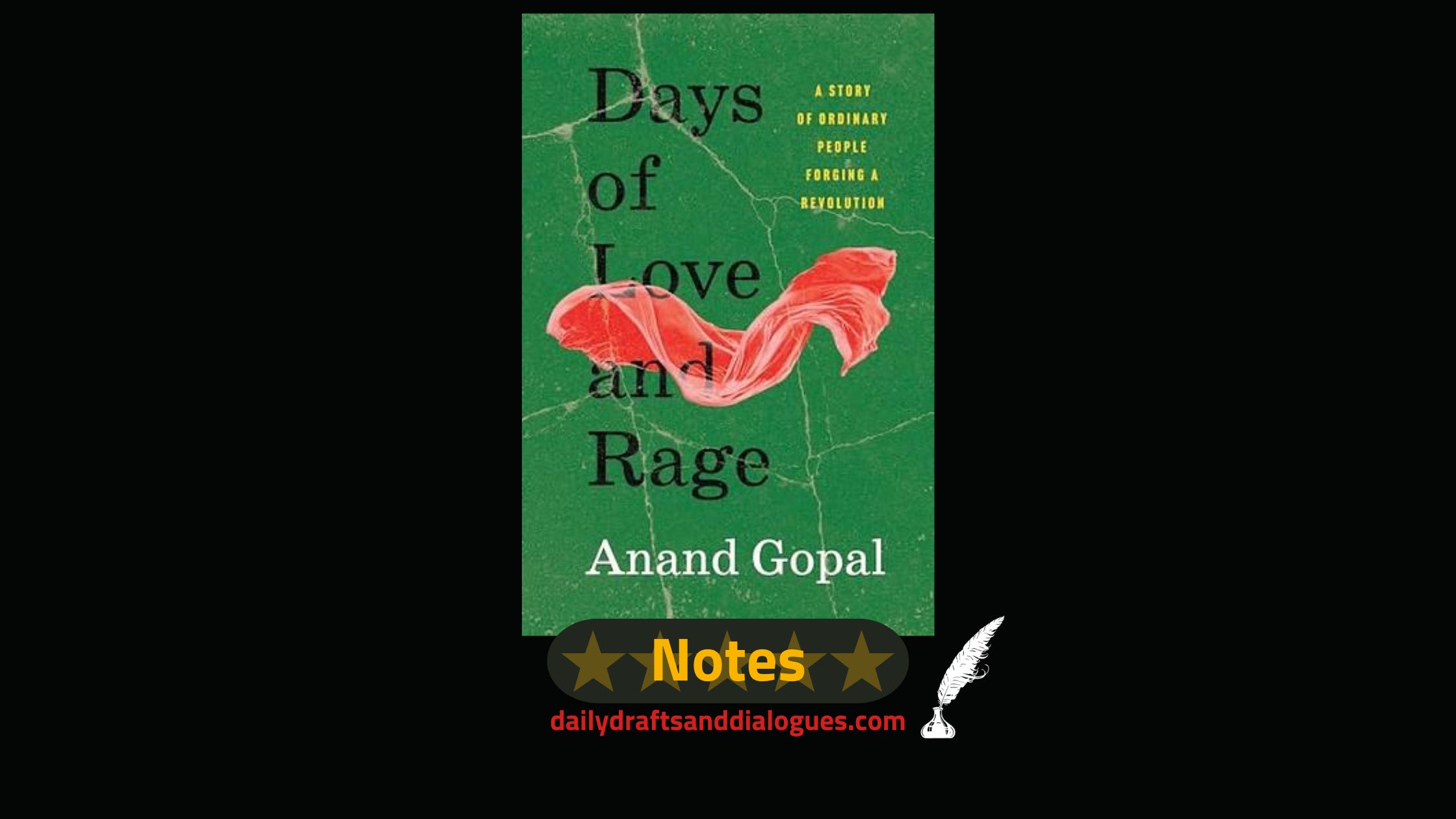
Days of Love and Rage: A Story of Ordinary People Forging a Revolution by Anand Gopal is around 500 pages long with about 100 pages worth of notes and is as emotionally rich as it is informationally rich, so I decided to split my review up into two posts. This first post will cover my notes on the first part of the book, and the second post will include my final review of the book with notes on the last half of the book.
Gopal has been a finalist for the Pulitzer Prize multiple times for his work in journalism, as well as his work on No Good Men Among the Living: America, the Taliban, and the War Through Afghan Eyes, which is no surprise. He has a talent for deep, investigative work that reaches the true heart of things, and people, as I am learning while reading Days of Love and Rage. Through his amassing of thousands of newspaper and magazine clippings and personal diary entries and letters and video footage, along with eight years’ worth of original research and two thousand interviews, Gopal is able to offer true insight and a behind-the scenes look at the conflict in Syria through the eyes of a small group of rebels and revolutionaries whose lives and paths intersect in notable and unexpected ways.
Book One of five in Days of Love and Rage opens with complex nostalgia as readers are introduced to Ibrahim Kasem, who lives in a tiny village outside Manbij, Syria, near the Euphrates, where he wants to stay with his family and enjoy the land, until government forces come in and seize property and build a dam, flooding the village and killing or displacing nearly everyone. His personal account is weaved in with centuries and decades of outside government and international political and cultural influences on the region, offering readers a nuanced and up-close perspective of how love of home can grow alongside rage and resentment for generations, as the first book does focus on 1963 through 2010.
Next, readers are introduced to Hasan Nefi, a veteran poet and dissident from Manbij who ends up spending 15 years in prison enduring bouts of unimaginable torture, only to end up as a major figure in the revolutionary movement in Manbij and its coordinated resistance once released. The excerpts of his days in prison were strikingly similar to what I read about Alexei Navalny’s detainment in various Russian prisons in Navalny’s memoir, Patriot. (Readers: Beware of graphic and violent episodes shared throughout the book.) Yet his growth as an individual and intellectual throughout the revolution is remarkable.
Then readers are introduced to Abdul Qader Oseb (aka Abel Os), who falls into financial and legal troubles and learns karate when he takes over his family’s merchant cart in Manbij while being subjected to the harsh economic consequences of Bashar al-Assad’s (and his father’s) governance. Through his perspective, readers will see a nuanced look at how desperate economic situations affect vibrant people who are simply interested in charting a path for themselves in life, and how those situations lead them to wander, ultimately revealing how such desperate situations can lead to desperate outcomes with little to no options for survival. His plight is perhaps one of the most relatable ones halfway through the book.
Readers are then introduced to Oday al-Hema, a youth who falls in love while getting caught up in underground encounters that lead to his initiation of, and involvement in, some of the first protests outside mosques in Manbij, which lead to more and more protests. Through his perspective, readers will see how the passions and convictions of youth for what is right and wrong can fuel a revolutionary spirit that can persevere.
And then readers meet Mina Saba, a mother, wife, and teacher who is central to the women who lead protests that influence many other resistance groups throughout the revolution, who eventually secures women’s involvement in the People’s Assembly in Manbij, all while upholding her shawi values of loyalty, family, hospitality, and above all, honor. She brings a practical and human touch to the revolution, inspired by the philosophies of Martin Luther King Jr. and Ghandi, never wavering in her conviction that women’s voices are necessary in the revolution and that there can be no real revolution without women. Her plight is also incredibly relatable to me, for obvious reasons, and I was content to learn that Gopal did not forget the influences of women in this work.
Then Abdul Hadi is introduced, a friend betrayed by Oday who plays soccer until he can’t escape the pull of the brewing revolution any longer, whose revolutionary spirit is only refueled when he is released from the unbearable conditions of incarceration due to Oday’s betrayal. Through his perspective and relationship with Oday, readers see the complex disagreements behind how revolutionaries sort through the intellectual and emotional determinations of what spearheading a revolution should look like, and the emotional tolls it takes on close relationships.
Eventually, all these individual narratives and personal histories that are commingled with poignant details of the political and cultural history of Syria (especially the city of Manbij) kick off Book Three: The Republic (January 2012- January 2014), of which I am only about halfway through. Yet so far, it is intense and memorable, as it covers the brutal and complex nature of building a republic run by citizens once state forces are ousted from Manbij, not the entire country. Readers will encounter how enemies and former torturers can become strategic allies, how complicated it is to fight for democracy to survive when families who can’t afford bread and are being regularly bombed by the state are barely surviving, and how complicated it is to secure weapons and political support as different revolutionary groups split and form their own coalitions and initiatives that cross domestic and international borders.
It is in these first few chapters of Book Three that readers will be forced to reflect on and reckon with their own concepts of freedom, what it means, and how it should be secured, as prominent revolutionary members work to secure it. Truly, the book is worth reading for these reflections and real-life conversations on what freedom means to ordinary citizens alone.
Overall, I am fully invested in this book and how it offers a strict human lens to civil war without neglecting historical accounts or personal nuance and conflict within those accounts— a true fusing of love and rage. I see it being one of my top nonfiction reads of the year, and so far, I think readers who enjoy deep historical dives with personal narratives and stakes will want to read this book.
Here is one of the most memorable passages from the first half of the book:
“Every political system, whether one of popular consent or of tyranny, is built on innumerable acts of faith— the faith that traffic lights will work, prescribed medicines will heal, evening news tells the truth, enemies are who the authorities say they are. Revolution reflects, if anything, a profound crisis of faith. It ushers in a new mode of understanding, where old solidities crumble, the preordained is exposed as a contrivance, misfortune as injustice. The world, once unitary and complete, has splintered into distinct realms: the kingdom of make-believe and the kingdom of truth. Inhabitants of that second realm find themselves facing the tantalizing possibility that life isn’t merely given, it’s made.” (p.169)
Stay tuned for the second half of the book review for Days of Love and Rage, which will be posted in a few days. [Edit: You can now read the full book review here. ]
Today’s Dialogue
How would you define freedom?
What do you think a successful revolution requires?
Have you read this book yet, or plan to read it soon?
© This work is not available for artificial intelligence (AI) training. All Rights Reserved by K.E. Creighton; Creighton’s Compositions LLC.
Want to express your appreciation for this post or make a one-time donation? This keeps things going around here :) Thank you so much!
Community Notes
Check out the updated homepage for Daily Drafts & Dialogues, now divided into sections that you can read and subscribe to individually.
Just customize your subscriber email notifications for this publication in your Substack account to control which posts reach your inbox moving forward, and which ones don’t. This way you will only receive emails for the posts you can’t miss, while still being able to access all other posts when you visit the website on your own.
Daily Drafts & Dialogues publication sections now include:
Book Reviews
Creative Writing (Tip: Creative Writing posts include writing based on writing prompts shared in previous Daily Drafts & Dialogues posts, in case you want to receive occasional writing prompts this way.)
Essays & Reflections
Writing Prompts
Daily Drafters Exclusive Posts
I hope this update makes your reading experience much better, but let me know if you have any questions or concerns.
ICYMI: A roundup of all the writing prompts published on Daily Drafts & Dialogues in May, and the new Summer Writing challenge, just dropped—all your writing inspiration for June in one place!
Free Subscribers, you can access this post with a 30-day free trial. Or enter to win lifetime access to all Daily Drafts & Dialogues posts.

CURRENTLY READING
Yesteryear by Caro Claire Burke
Week 1 (June 1-7) — Part I and Part II Chapters 1- 11
Week 2 (June 8- 14) — Part II Chapters 12- 27
Week 3 (June 15- 21) — Part II Chapters 28- 42
Week 4 (June 22- 30) — Finish Book
A public chat thread will be shared on Substack to discuss the entire book at the end of the month. Until then, join our Buddy Read in Storygraph to chat about the book as you read it at your own pace. And read my initial thoughts on the book, here.
JULY BOOK: TBD
A poll will be posted in Storygraph for this book selection soon! Join the club so you’re ready to cast your vote when it goes live.
