
Notes on the Efficacy of Hyperbole
This may not be the *Absolute Greatest take on hyperboles EVER written!* but is probably still worth reading and discussing. So please read it and join this dialogue, then see today’s writing prompt.


When we’re learning how to write essays, or any other form of nonfiction, we’re instructed to stay away from hyperboles, those grandiose figures of speech that exaggerate intense feelings or states of being. And we’re usually instructed to do so because using hyperboles tends to undermine credibility, trust, and can distort the factual accuracy of what is being written then read. Hyperboles (supposedly) tend to make readers roll their eyes, in other words, especially when they’re used excessively.
But in today’s world it seems imperative to question that assumption— that hyperboles weaken the trustworthiness of nonfiction— to some degree, because there are hyperboles everywhere we look. In fact, it’s nearly impossible to escape them, and our current political and public discourse seems to rely on them more than ever before.
The current occupant of the White House says that he will do things like make the “biggest trade deal ever made” and that he and his administration have accomplished more in two years “than almost any administration in the history of our country” and that the US will have “the most secure border” and that US crime or economic crises are at “levels that nobody’s ever seen before” and constantly uses words and phrases like ‘tremendous’ and ‘best ever’ and ‘total disaster’, just to name a few (and don’t even get me started on his use of capital letters). He even coined this as a deliberate tactic in his book Art of the Deal, which he calls “truthful hyperbole.” And while some have said his love of hyperbole might backfire eventually, it hasn’t yet. Quite the opposite, actually.
Since 2016, more and more public-facing individuals and traditional media outlets are throwing around hyperboles like confetti. They just can’t seem to get enough of them. And one can only wonder then assume why that is as they simultaneously recount the current White House occupant’s meteoric rise, which is closely tied to thousands of hyperbolic social media posts and dozens of rambling hyperbolic campaign— What would you even call them… talks? — and how those things are not mere coincidence. The timelines and date stamps on social media posts and campaign talks since 2016 seem to match the steady rise in hyperbole in public discourse.
As a result, it is now commonplace to see headlines that talk about political and legal opponents ‘slamming’ and ‘condemning’ one another, or how rates and prices are ‘skyrocketing’, and how so many things happening are ‘unprecedented’ and ‘groundbreaking’ or ‘devastating’ and ‘shocking.’ And that nearly every headline screams ‘Breaking News’ now, compared to a decade or so ago.
Sure, journalists have used hyperbole in their headlines before, and always will, to grab attention. But there has been a seismic uptick in their hyperbolic usage over the past decade. And they tend to stick with the same hyperboles time and time again. Seriously, count how many times you see some synonym or conjugation of ‘slam’ and ‘skyrocket’ and ‘groundbreaking’ and ‘shocking’ in the next week or so. You’ll see what I mean, though chances are you’ve already noticed this trend in hyperbole usage in one way or another.
All of this, of course, begs the question of what this uptick in hyperbole usage is doing, and has already done, to erode audiences’ and citizens’ trust, not only for their government officials inside the US but those they’re engaging with internationally. Not only in public spheres, but in private spheres. And not only in person, but online.
There are two main reasons writers are taught to avoid hyperboles when writing nonfiction, particularly in public-facing documents and formal speeches. They obscure the meaning and integrity of what is being said and discussed, which eventually leads to sensationalism fatigue. And sensationalism fatigue is what causes readers to become apathetic or check out from what they are reading or listening to since they can no longer extract real information or meaning from what they’re reading or listening to anymore. And this, my friends, is where we’re at… the phase where most people are opting out of engaging in political discourse or reading the news altogether because they’re experiencing sensationalism fatigue.
Odds are good that you’re probably nodding your head in agreement at this point. But if you’re not, I want to discuss your thoughts too. Leave a polite comment, so we can explore this more, as this post is only a draft of my thoughts on this topic after all.
One additional note before I sign off today, since I do also value the power of literature and literary devices in general: Don’t you find it interesting to consider, after reading the above, how hyperbole in literature is typically used most effectively in satire and to illustrate over-the-top characters and ridiculous thoughts of characters in fictional worlds? Which also makes me wonder how and if hyperbole in fiction can or should be used to subsume its current power in political discourse, and whether using hyperbole more in fiction will help most people better recognize it when they encounter it in the ‘real world’ — or would the opposite be true? Just some food for thought…
What are your thoughts on this topic? Leave a comment to join this dialogue, and don’t forget to share this post with others so they can join this dialogue too. Thanks for keeping this dialogue going!
© This work is not available for artificial intelligence (AI) training. All Rights Reserved by K.E. Creighton; Creighton’s Compositions LLC.
Want to express your appreciation for this post and writing prompt?
My writing and I are fueled by loyal readers, caffeine, and kind words, so I appreciate any support you can offer that keeps me writing. Thank you so much!
Today’s Writing Prompt
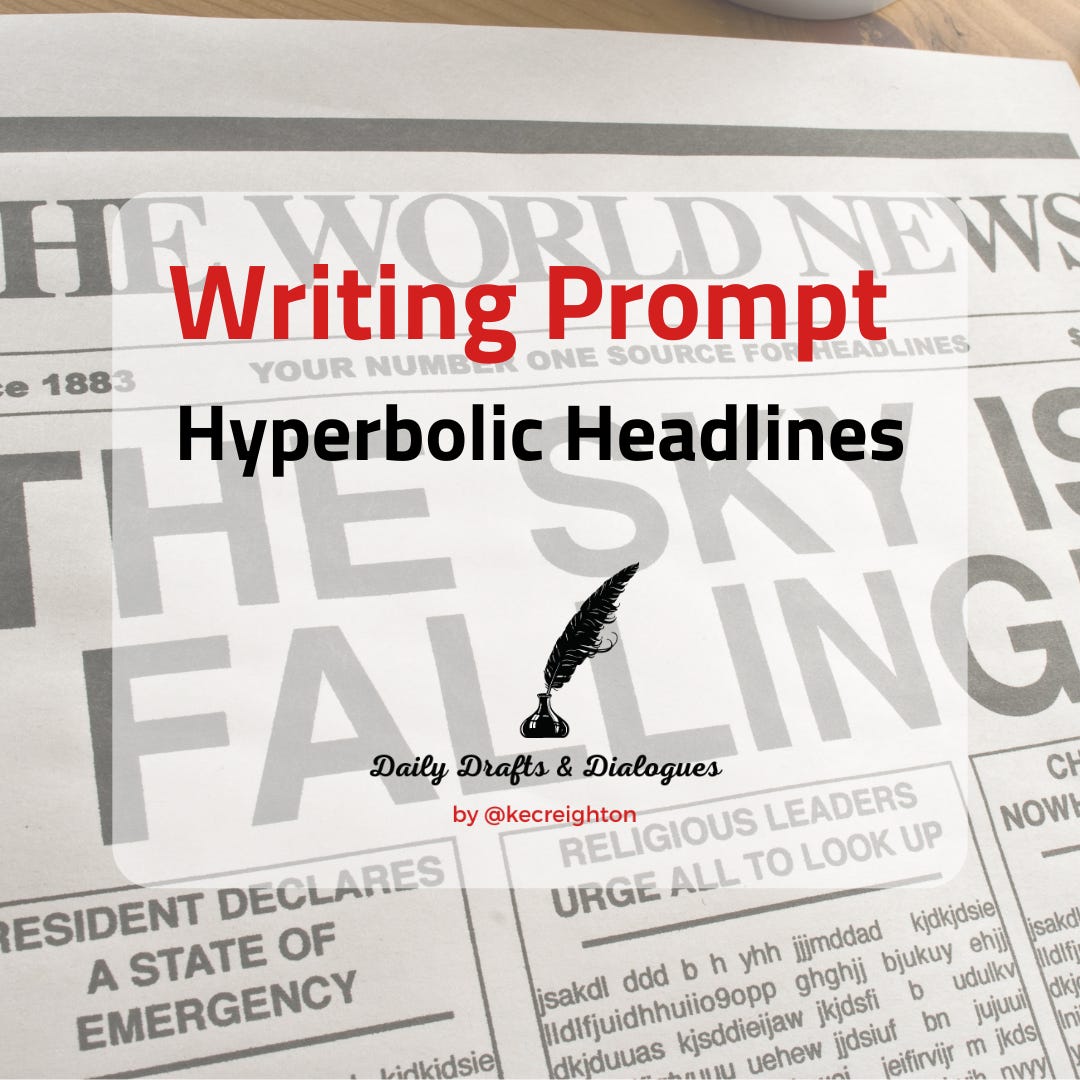
Writing Prompt: Hyperbolic Headlines
Write fifteen to twenty hyperbolic headlines that resemble real headlines you’ve seen in the media recently, then rewrite them so they’re less hyperbolic.
Writing Tip
Scroll through your news feeds for inspiration. Or take a few days to collect example headlines so you can come back to this writing prompt later.


