

September Theme: The Stories We Carry
Big Question: Why do certain stories stay with us?
Week 3: The Stories We Tell Ourselves
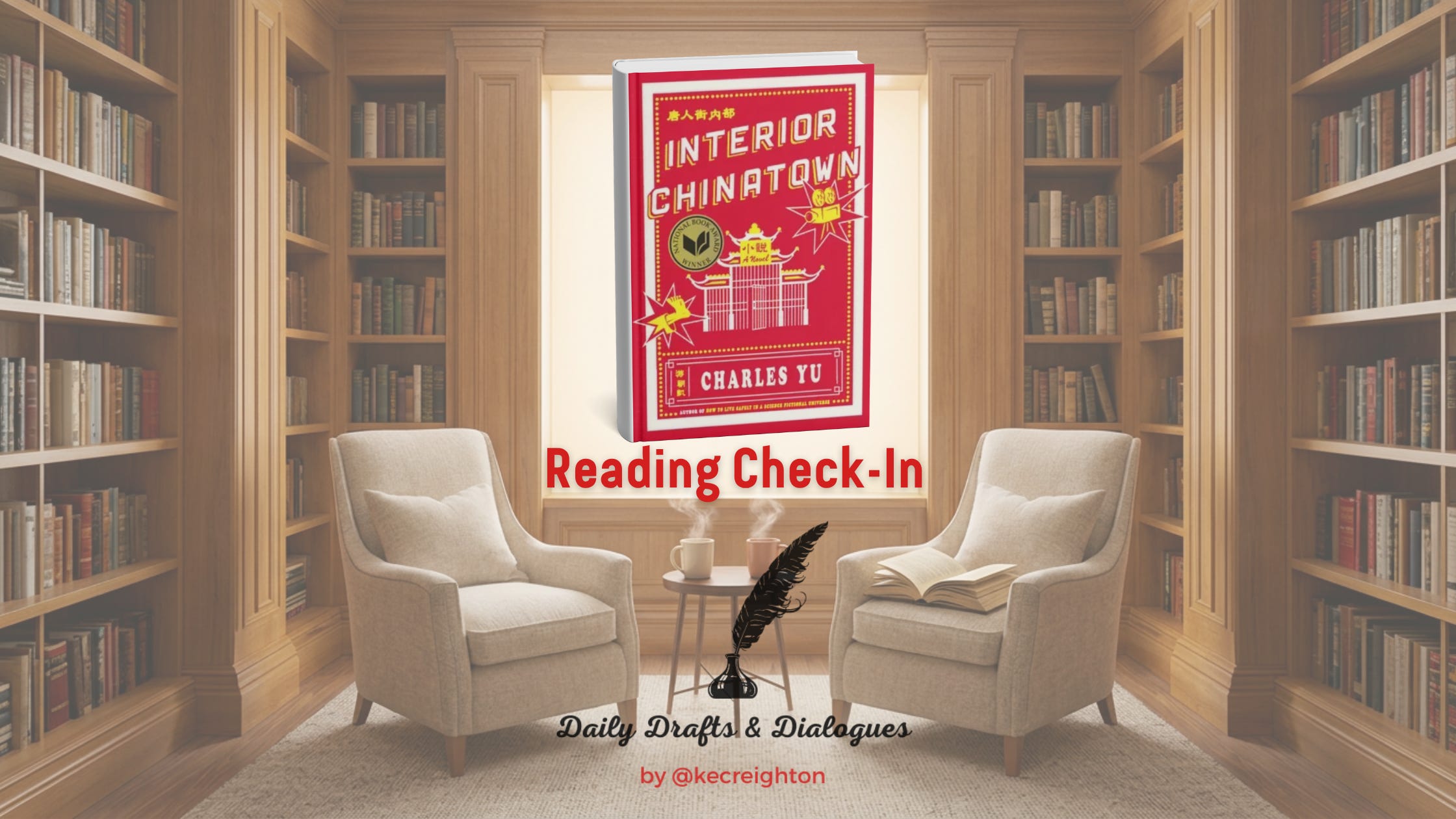
To kick off our book club’s third week exploring The Stories We Carry in September, we’re reading Interior Chinatown by Charles Yu.
According to Storygraph, Interior Chinatown is for a reader who “enjoys clever, experimental storytelling that uses humor and pop culture to dismantle societal stereotypes and explore the complexities of identity.” Which is what makes it an ideal selection to read for the week we’re exploring The Stories We Tell Ourselves, especially those stories we tell ourselves about who we are, where we come from, and where we’re going.
Interior Chinatown, which won the 2020 National Book Award for Fiction, explores the rigid scripts society writes for Asian Americans in a uniquely crafted satirical screenplay that bounces between backstories and the story of a mostly fixed television set and the story of its actors playing their allocated parts.
Through the life of Willis Wu, a perpetual background actor trapped in a formulaic television procedural set in Chinatown, the book examines the identities and stories we construct for ourselves and who we are by illustrating how individuals come to adopt and internalize limiting cultural roles.
Willis views his entire existence through the lens of a generic Hollywood set, where his identity is reduced to flat archetypes like ‘Generic Asian Man’ or ‘Delivery Guy’. His ultimate, deeply internalized ambition in the earlier chapters of the book, however, is to graduate to ‘Kung Fu Guy’, a pursuit that exposes the tragedy and self-sacrifice that some of the stories we tell ourselves carry. Willis initially believes this martial-arts caricature represents the peak of personal achievement and identity but has yet to realize that it is actually just another restrictive box created by the Western gaze, showing how easily we can mistake a slightly larger stereotype for true freedom and or ‘success’.
The first half of the book also unpacks the generational myths and physical spaces that shape Willis’s worldview and narrative. Chinatown is presented not just as a geographic neighborhood, but as a psychological stage constructed to keep its residents functioning as exotic backdrops to the main characters. Within this space, Willis’s aging parents embody the often dramatized yet heartfelt and heartbreaking immigrant narrative, as well. They are people who accepted their assigned placement as background extras in the American story, sacrificing their own fully realized inner lives and histories in the hope that their children might eventually inherit a better script for the so-called American Dream.
The Wu family dynamic is heavily dictated by inherited narratives of filial piety, standard success, and the silent pressure to fit into a pre-established mold or formulaic American narrative. But as this narrative charts a path forward, the early portions of the novel also lay the groundwork for Willis to seize an opportunity to break free from these generational and societal expectations and stories. And Willis eventually begins to look beyond his immediate environment and the strict formatting of the screenplay that dictates his sense of identity and daily movements, signaling a desire to change his future trajectory and write his own script once he meets Karen Lee and falls in love.
By reflecting on the lives of his parents and his own stagnant career, Willis starts to question the validity of the ‘Black and White’ Hollywood script and worldview that positions minority lives as merely peripheral to a dominant cultural narrative even in Chinatown. Without mentioning any spoilers, the first half of the book allows readers to examine the ways forward progress within the confines of traditional cultural narratives may require a person to recognize when, where, and why they are performing certain character roles. And that it is this sense of self-awareness that will ultimately allow them to reclaim ownership of their own story.
As we read Interior Chinatown, let’s explore the ways in which we typecast ourselves, and others, into roles that are ill-fitting and ultimately inauthentic, and how this influences the stories we carry and tell ourselves.
💭Initial Reflections on Interior Chinatown
Charles Yu balances the formulaic absurdity of network procedural television with the deeply painful realities of marginalization in this novel, making it unique and hard to put down, and as heartfelt as it is heartbreakingly funny.
By using a screenplay format complete with stage directions, parentheticals, and casting descriptions, the narrative forces the reader to look closely at and through the superficial lenses in which the characters, and the real people behind them, are being perceived. It also manages to make the reader laugh out loud at the ridiculous, overused stereotypes and tropes of the fictional cop show Black and White while simultaneously delivering a gut punch regarding how those stereotypes and tropes diminish human dignity and individuality in real life. In essence, it is a fine example of satire worth reading and studying, as it ultimately allows readers to see how useful a tool satire can be when navigating deep cultural injustices and the normalization of racism.
The narrative’s satirical impact is amplified by Yu’s intentional use of the second-person point of view (‘you’), which serves a dual psychological purpose throughout the screenplay-novel. On one level, addressing Willis Wu as ‘you’ mirrors the rigid, detached nature of a screenplay’s stage directions, highlighting how Willis has internalized his role so deeply that he views his own life from the outside and from someone else’s perspective. On another level, this point of view acts as an intimate literary device that immediately forces the reader into the claustrophobic, complex reality of being typecast as a ‘Generic Asian Man’ themselves. Rather than allowing the reader to remain a passive observer of Willis’s life, the second-person point of view demands that they inherit his anxieties, feel the sting of his normalized invisibility, and navigate the exhaustion of performing a caricature designed for the Westernized and American gaze.
The weight of the book’s first half lies in how it captures the daily grind of the Golden Palace restaurant in Chinatown, which acts as the stage for the fictional Hollywood set and background work for the novel and Willis’s character. Willis and his peers are stuck in a relentless loop, described explicitly via script directions where they transition seamlessly from waitstaff to background ambiance, hoping to break into more prominent roles in Black and White.
For example, when a scene for Black and White is shot, the white lead takes center stage, while characters like Willis are actively blocked to remain out of focus and in the background of the main narrative. This humorously written yet agonizing contrast highlights how the characters’ lives at Golden Palace are structured around someone else’s close-up, even over one of their literal dead bodies, as the main-character cops in the procedural are supposedly attempting to solve Dead Asian Guy’s murder.
Landing the role of the ‘Dead Asian Guy’ even represents a coveted milestone for background actors in the Golden Palace restaurant as it offers guaranteed screen time, even though the character in the role is himself reduced to a literal prop without speaking (or breathing) parts. Again, this dynamic illustrates how the characters’ lives are constantly sidelined to serve as mere background ambiance for the Black and White police procedural or the American Dream of success.
Within the first half of the novel, we also learn more about Willis’s relationship with his father, ‘Old Asian Man’, who was once the impressive Sifu but has had his role in the main narrative reduced by the passing of time and the entertainment industry to a background prop without a proper name. So, the humor of the script’s rigid typecasting gives way to immense heartache during scenes where Willis watches his father’s progression from a respected martial artist to a forgotten, frail extra without a proper name, highlighting how America’s cultural scripts discard aging immigrants once their immediate utility as ‘Kung Fu Guy’ fades, or once their exotic novelty fades.
Willis’s mother, Dorothy, designated as ‘Old Asian Woman’, shares a similar parallel, gendered confinement within this restrictive industry’s story arc. In her youth, she was immediately objectified and cast as the ‘China Doll’ or the ‘Geisha’, her identity flattened into a highly sexualized, exotic female backdrop designed to add a layer of foreign intrigue to a scene, but nothing more. And as the years have passed, her character arc has been reduced to a repetitive loop of tragic maternal suffering, which Willis sums up by noting that her script requirements are merely to ‘weep, and die’ and ‘weep and die’. This increased erasure of her individuality underscores how the Western gaze and typecasting strips Asian women of their nuance, offering them only a narrow path that transitions from a hyper-sexualized youthful prop to an invisible, grieving elder.
The arrival of ‘Older Brother’ further complicates this psychological space of tropes and actor roles, as well, introducing a standard of perfection that haunts Willis’s own journey and pursuit to be cast as ‘Kung Fu Guy’. In the beginning, ‘Older Brother’ represents the ideal immigrant son, who seemingly mastered the system, mastered the script, and executed every role perfectly. Yet, as the novel ultimately reveals, the ‘perfect’ performance within a rigged system inevitably requires an exhausting suppression of one’s authentic identity, trapping an individual in a cage of high expectations and narrow possibilities for future roles.
The tone of the novel begins to shift as Willis Wu builds a relationship with Karen Lee, an actress on the rise who infuses the set of Black and White with a rare level of sharp self-awareness. And the introduction of her character allows the narrative to pivot seamlessly from biting Hollywood parody to more tender, authentic human connection. When they share more intimate, off-camera scenes together, the strict formatting of the screenplay in the novel mellows, offering a poignant glimpse into what happens when two background characters step out of the corners of the spotlight to imagine a genuine life completely independent of the roles they’ve been given to play.
Unlike Willis, who has deeply internalized his background status, however, Karen clearly recognizes that the roles they are offered are merely artificial constructs designed to satisfy a white audience’s expectations. And this tension becomes even more pronounced via Karen’s background as a quarter-Taiwanese woman whose physical features allow her to pass as multiple ethnicities, including Brazilian, Filipina, Mediterranean, or Eurasian, demonstrating a different kind of racial and cultural objectification when she’s frequently cast as ‘Ethnically Ambiguous Woman Number One’.
While Willis initially envies Karen’s fluid ‘passing’ as a privilege, the novel subverts that assumption when Karen directly corrects his idealized view, pointing out that her fluid casting doesn’t grant her true liberation or individuality but simply allows her to be claimed and objectified by a wider variety of audiences. And by emphasizing her ethnic malleability, the novel underscores how the entertainment landscape, full of tropes and stereotypes, values minorities only as decorative, interchangeable blank slates rather than fully realized human beings.
Mainly, the first half of the novel uses the literal and fictional set of Chinatown to explore the literal and fictional boundaries of assimilation and all the stories affiliated with it on both macro and micro levels. Whether Willis is trying to master the precise pitch of a ‘Generic Asian Accent’ to please a white director or trying to calculate exactly how many lines he needs to get noticed or become ‘Kung Fu Guy’, the novel reveals the deep psychological and emotional toll of being typecast into a role. It also underscores the profound truth that trying to fit into a story that wasn’t really written for you will always require cutting away the most genuine parts of who you are.
As I read, I keep asking myself questions like:
How much of my own identity is a script I inherited from my family, my culture, or the media, rather than a narrative I actually wrote for myself?
What are the invisible background roles that society expects me to play based on how I look, where I come from, or how I speak?
Am I chasing a version of success similar to Willis’s fixation on becoming ‘Kung Fu Guy’ that is actually just a bigger, shinier trap designed by someone else?
How do we honor the sacrifices of our parents and the quiet, background lives they lived without letting their generational trauma dictate our entire future trajectory and the roles we play?
What does an authentic life look like when we finally choose to step completely out of the frame, stop performing for an audience’s approval, and speak in our own voice?
💬Notable Quotes and Passages from the First Half of the Novel
“But the old parts are always underneath. Layers upon layers, accumulating. Which was the problem. No one in Chinatown able to separate the past from the present, always seeing in him (and in each other, in yourselves), all of his former incarnations, the characters he’d played in your minds long after the parts had ended.” (p.20)
“A performer may be taken in by his own act, convinced at the moment that the impression of reality which he fosters is the one and only reality. In such cases we have a sense in which the performer comes to be his own audience; he comes to be the performer and observer of the same show. — Erving Goffman” (p.31)
“There’s just something about Asians that makes reality a little too real, overcomplicates the clarity, the duality, the clean elegance of BLACK and WHITE, the proven template and so the decision is made not in some overarching conspiracy to exclude Asians but because it’s just easier to keep it how we have it.” (p.39)
“They’re going to shoot him. You have to say something. But how can you? You don’t have any lines.” (p.43)
“You’re here, supposedly, in a new land full of opportunity, but somehow have gotten trapped in a pretend version of the old country.” (p.58)
“Old Asian Man looks at you, a look of disappointment flickering across his features with each accented word. You play this part, talking like a foreigner. The son who was born here, raised here, a stranger to his own dad for what. For this. So he could be part of this, part of the American show, black and white, no part for yellow. The son who got As in every subject, including English, now making a living as Generic Asian Man.” (p.91)
“You’ve worked too hard to show them something they might not understand. You need to keep it together. You can’t get fired now. You make your face into a mask–dead in the eyes. Not a person. Not a real one anyway. A type. Generic. It’s a form of protection. Keep yourself inside this costume, this role. You lay it on a little thicker with the accent, break up your grammar a bit more.” (p.92)
“No. But you’re going along with it. Look where we are. Look what you made yourself into. Working your way up the system doesn’t mean you beat the system. It strengthens it. It’s what the system depends on.” (p.95)
“And you think: no. It won’t be somewhere else. It will be here, again, in Chinatown, next year, same place. To be yellow in America. A special guest star, forever the guest.” (p.119)
“Some people think it isn’t the worst thing in the world to die. Because if you never die— if you play the same role too long— you start to get confused. Forget who you really are.” (p.130)
“In this place? This is no place for a romance. This is a place for the police to find dead bodies. This is a place where day and night are interchangeable, where we don’t know who we are allowed to be, from one day to the next. How do we have a love story in a place like this?” (p.155)
🗣️Book Discussion Questions
Willis Wu’s ultimate ambition in the first half of the book is to become ‘Kung Fu Guy’. Why do you think he views this highly stereotypical caricature as the pinnacle of achievement? In what ways do we mistake a slightly larger, flashier stereotype for true personal freedom in our own lives?
The novel features the coveted but tragic role of the ‘Dead Asian Guy’, which background actors compete for just to get guaranteed screen time. What does this dark, comedic element say about the desperate human desire to be seen, even if it means letting our identities be completely flattened or objectified?
Willis’s parents, ‘Old Asian Man’ and ‘Old Asian Woman’, lived through eras where they were cast as the glamorous ‘Sifu’ and the exotic ‘China Doll’, only to be discarded as invisible, frail extras as they aged. How do their histories shape the structural expectations Willis faces? How do we balance honoring our parents’ sacrifices without letting their generational trauma write our own futures?
The Golden Palace restaurant acts as both a literal workplace and a ‘psychological Chinatown’ constructed by the Western gaze and stereotypes. How does this environment trap the characters in a relentless loop? How do the physical and cultural spaces we grow up in dictate the invisible boundaries we set for ourselves, and the stories we tell ourselves?
Karen Lee’s character is cast as ‘Ethnically Ambiguous Woman Number One’ because she can pass as multiple ethnicities. While Willis envies this as a form of privilege, Karen points out that it just allows her to be claimed by a wider variety of audiences. How does her character subvert Willis’s ideas about ‘fitting in’, and what does it reveal about how society can sometimes see minorities as interchangeable blank slates?
The book uses a screenplay format, where characters are defined by stage directions, parentheticals, and casting descriptions. As the characters start to question their roles off-camera, how does this formatting begin to crack and change? What does the book suggest it actually takes to step out of the background of someone else’s story and reclaim ownership of your own story?
👇 Drop your thoughts, reading progress updates, and favorite quotes from the book below! Or join our Buddy Read in Storygraph to share your thoughts there based on where you are in the book. I can’t wait to see what everyone thinks of this book so far! 👇
📝 Bonus Writing Prompts for Drafts
This is for the active writers, journalers, and literary artists in our community. If this book has your creative wheels spinning, consider completing one or both of these writing prompts.
Creative Prompt
Write a short scene about a routine part of your day (like buying a coffee, riding the bus, or sitting in a meeting) using the screenplay format of Interior Chinatown. Treat your environment as a Hollywood set and yourself as a character with a designated archetype title rather than your real name. Example: Tired Office Worker Number Two. Include stage directions, lighting descriptions, and parentheticals that expose the gap between the flat, predictable role you are expected to play for the public and the complex thoughts running through your head.
Reflective Journaling Prompt
In the first half of the novel, Willis Wu dedicates his energy to chasing the role of ‘Kung Fu Guy’, believing it represents the absolute peak of success, only to realize it is just a larger, more prominent stereotype. Reflect on a goal, job title, or status symbol you have chased (or are currently chasing) in your own life. Then ask yourself: Did this goal originate from your own genuine desires, or was it a script handed to you by your family, culture, or societal expectations? And if you achieve it, will it grant you true personal freedom, or is it simply a shinier, more acceptable box designed by someone else?
Share what you write in the Drafters Workshop Chat.
💬 Let’s Dialogue
Writers and readers can have varied creative lifestyles and approaches. Let’s discuss them!
What’s your default role? If an everyday director cast you based purely on your appearance or job, what would your generic character name be?
Would you play the ‘Dead Asian Guy’? Have you ever accepted an invisible or humiliating role just to get a foot in the door?
How do we rewrite our parents’ scripts? How do we honor the massive sacrifices of the generation before us without adopting their old survival traps and trauma?
Is it better to blend in or stand out? Is being an ‘ethnic chameleon’ a genuine privilege, or is it just a different way of being typecast?
What is a ‘Kung Fu Guy’ role? What major status symbol are people around you chasing that might actually just be a shinier trap?
When do you stop performing your given or adopted roles? Who is the person in your life with whom you can completely drop the social script and just be your authentic self?
Share your responses in the Dialoguers chat or leave a comment.
Not able to read this book with us this month? No worries! We have other options to choose from. See our other September Book Club Picks here.

Whether you join a chat, one of our Buddy Reads in Storygraph, or lay it all out in the comments, I look forward to hearing more about your thoughts on our book club picks this month!
If you enjoyed this post, please like and share it so others can enjoy it and read with us too. Thank you and happy reading!
Continue Exploring September’s Theme, The Stories We Carry
This Week: The Stories We Tell Ourselves
Writing Prompts that Navigate the Stories We Tell Ourselves
Can you write great work without challenging your own beliefs?
Week 2: Memory and Storytelling
Writing Prompts About Memory and Storytelling
The Art of Autofiction: Memory, Markets, and the Modern Confessional
Week 1: The Books That Changed Us
Writing Prompts About Books That Changed Us
Can a book genuinely change who we are?
What My Favorite Books Say About Me
The Anatomy of Books That Have Changed Us
20 Banned Books That Have Changed Us
Go Deeper with Daily Drafters Exclusives
This month: The Stories We Carry Writing Collection

This collection offers a month of guided writing exercises, mini workshops, and creative writing experiments designed to take you beyond a single prompt and into a deeper creative practice. It gives you the creative spark and space you need to explore memory, identity, inheritance, perspective, voice, and the stories we tell ourselves and others. It will also encourage you to consider how those stories shape the work we create and the creative lives we lead.
Inside this collection, you’ll find 30 original writing prompts (designed as mini writing workshops) across five sections with focused themes, craft-focused exercises, curated reading suggestions, reflective questions, and three optional month-long writing challenges designed to help you develop your ideas, explore your personal material and stories, and build a consistent writing practice.
You can follow the prompts in order, choose the exercises that speak to you, or return to a section whenever you need a new way to explore your writing craft. As a paid subscriber, you will also be able to come back to the collection throughout the month or any other time you feel like exploring The Stories We Carry in the future.