

September Theme: The Stories We Carry
Big Question: Why do certain stories stay with us?
Week 1: The Books That Changed Us
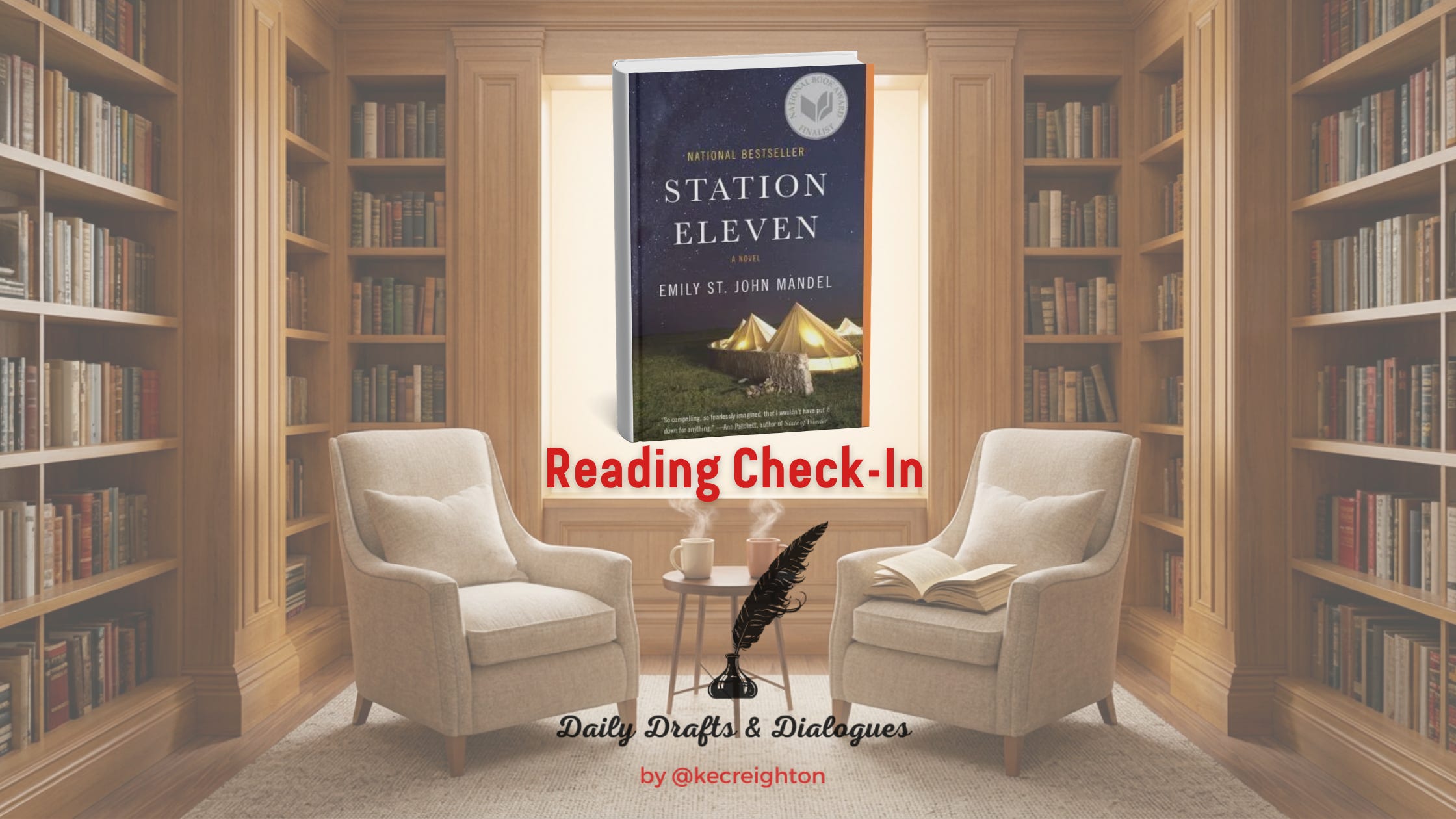
To kick off our book club’s first week exploring The Stories We Carry in September, we’re reading Station Eleven by Emily St. John Mandel.
According to Storygraph, Station Eleven is for “a reader who appreciates stories that explore the enduring power of art and human connection even in the bleakest of circumstances.” Which is what makes it ideal for our first book this month. This novel not only touches on the stories and books that have changed us, but the stories that we can’t seem to let go of no matter what happens to us.
Mandel’s post-apocalyptic novel explores the fragility of human civilization through the lens of a devastating pandemic known as the Georgia Flu, which eradicates most of the global population. Rather than focusing on the violent mechanics of societal collapse, however, the opening half of the novel weaves together two distinct eras connected to the heart attack famous actor Arthur Leander has during a production of King Lear in Toronto that occurs just hours before the world starts to unravel.
The novel then shifts between the chaotic final days of the old pre-pandemic world and the quiet, haunting reality of the new post-pandemic one twenty years later. At its core, the first half of the novel functions as a somewhat nostalgic examination of the literal and figurative ‘stories we carry’ via the art, pages, plays, music, memories, and fragile physical artifacts characters cling to for identity and ‘sufficient survival’ as modern society vanishes.
The primary vehicle for the stories the characters carry in the post-flu landscape in the novel is the Traveling Symphony, a nomadic troupe of musicians and actors who navigate the smaller outposts of the Great Lakes region. Performing classical music and staging Shakespearean plays, their caravans move under a guiding manifesto: “Because survival is insufficient.”
Through the character of Kirsten Raymonde, a young woman who was an eight-year-old child actress on stage with Arthur Leander when he died, the novel establishes that art and storytelling are vital necessities for keeping the human spirit alive. Also, by carrying centuries-old scripts into a world without electricity or internet, the Symphony ensures that survivors do not lose their connection to a collective human experience or their shared memories.
These shared narratives are also distilled into physical talismans that characters fiercely protect as they move through the ruins. Kirsten carries a rare, self-published comic book titled Dr. Eleven, given to her by Arthur just before the collapse. Created by Arthur’s first wife, Miranda Carroll, the comic tells the story of a lonely physicist living on a fading space station. For Kirsten, these fragile, illustrated pages are a vital anchor to the world before it collapsed, demonstrating how a single piece of storytelling can become a lifeline. Alongside a glass paperweight she also carries with her, these items represent the heavy weight of meaning and memory that survivors choose to transport across a broken landscape of time and place.
As the Traveling Symphony journeys between the smaller outposts of the Great Lakes region in the first half of the novel, their peaceful mission is abruptly shattered when they arrive in the town of St. Deborah by the Water. Here, they encounter the Prophet, a charismatic and menacing cult leader who rules the settlement through religious terror and demands total submission to his warped worldview. The narrative shifts at this point in the novel from a nostalgic study of survival into a tense psychological thriller as the Symphony flees the Prophet’s territory, only for members of the troupe to mysteriously vanish one by one from the dark roads. By introducing this looming threat, the first half of Station Eleven positions the Prophet and what he preaches and represents as a dangerous perversion of the stories they carry, setting up a high-stakes conflict over whether humanity’s future will be defined by the beauty of shared art or the violence of absolute control.
As we read Station Eleven, let’s ask ourselves what stories these characters carry with them, why, and how they influence what they do, as well as how they connect to the overarching plot of the novel.

💭Initial Reflections on Station Eleven
This book starts with an unforgettable scene that left me hooked literally and metafictionally. And it’s been so easy to get absorbed in it, especially because it ticks a lot of boxes for what I typically enjoy reading. It includes a dystopian setting with a nostalgic bent, stories about stories, mysteries, danger, and a multi-character narrative structure with multiple timelines. Chances are also high that I will enjoy a novel that incorporates Shakespeare’s work into it, like this one does. Just as chances are high that I will enjoy a novel like this one that focuses on storytelling and its value to humans beyond the page.
So, no, it’s not too surprising that I’m enjoying this novel as much as I am, and that so many others have before me. What is surprising, or at least worth taking a moment to document and notice, however, are the various types of stories this novel includes, so that we can try to unpack some of them and the significance they bring to the overall work.
The first half of Station Eleven is constructed through the internal stories, texts, and cultural references that its characters preserve and engage with. Rather than focusing on a singular, chronological plotline, the novel introduces a variety of fictional and historical storytelling mediums, each serving a specific structural and thematic purpose. Collectively, these micro-narratives illustrate how human beings depend on structured and unstructured storytelling to survive all sorts of trauma, archive the memory of a dying world, and establish a common language for a fragile new civilization. And in doing so, Mandel highlights the profound weight of the stories we carry, illustrating that it is often the specific texts and books and stories that changed us in our formative years that dictate who we become after everything else is stripped away.
The grandest of these internal narratives belongs to the theatrical works of William Shakespeare, specifically his tragedy King Lear. The novel opens in Toronto with a pre-collapse production of the play where the legendary actor Arthur Leander suffers a fatal heart attack on stage, mirroring the imminent collapse of the modern world. Twenty years later, the plays of Shakespeare become the primary repertoire for the Traveling Symphony, a nomadic troupe of actors and musicians who navigate the ruins of the Great Lakes region. Staging centuries-old scripts in settlements without electricity or technology serves a vital societal function and even mirrors Shakespearean times in a lot of ways. By performing stories about timeless human conflicts that focus on grief, betrayal, madness, reconciliation, etc. the troupe ensures that the post-apocalyptic world does not lose touch with a broader, ancestral understanding of human emotion and history, carrying forward a dramatic heritage that shapes the moral compass of a new generation by linking it to the older ones via storytelling.
Dr. Eleven, a rare, self-published comic book project created by Arthur’s first wife, Miranda Carroll, also makes its appearance in the first half of the novel. Telling the story of a melancholic physicist stranded on a fading space station, this fictional graphic novel acts as a vital psychological refuge for an adult Kirsten Raymonde, who carries a copy with her through the apocalypse. The comic serves a distinct narrative purpose from the shared public space of Shakespeare, however, as it represents the deeply intimate, personal stories that individuals use to process private grief, especially for its author. For Kirsten, the comic’s stylized pages are also the ultimate example of a book that changed her, serving as an emotional anchor to her lost childhood and fading memories. Her relationship with the comic illustrates how a piece of pure imagination can transform into a literal lifeline when reality becomes too devastating to bear, highlighting how deeply a single book can alter a person’s psychological survival. At the same time, it mimics the real post-apocalyptic world she is literally trying to navigate and functions as a roadmap in a lot of ways.
In stark contrast to the noble preservation of theater and fiction, the novel introduces Dear V., a scandalous book compiling the private letters written by Arthur Leander to his childhood friend, Victoria. Published shortly before the pandemic hit, these letters expose intimate details about Arthur’s infidelities, failed marriages, and desperate reflections on his fading youth, which Kirsten’s mother forbade her to read. This internal story represents the complicated, often messy nature of modern historical archives. For survivors like Kirsten, who eventually finds a copy of the text in an abandoned house, Dear V. is not a piece of gossip, but a vital historical artifact that contextualizes the mysterious man she once knew when she was a child. And the text alters her understanding of the past, underscoring the idea that written testimonies carry a transformative power, turning private human flaws into permanent narratives that change how survivors view the world before it collapsed.
The thematic archive expands further through the transcripts of the interviews Kirsten gives to François Diallo, the librarian and publisher of the New Petoskey News. Woven into the text as an ongoing, written interview fifteen years post-collapse, this narrative layer acts as a more formal record of memory and trauma. Through Kirsten’s stark, fragmented recollections of her earliest years on the road, the interview represents the deliberate, often painful act of turning personal trauma into historical memory. Diallo’s project shows that journalism and oral history remain vital tools in the new world, providing survivors with an opportunity to externalize their inner grief, while preserving history. These recorded interviews become the new books of the post-flu era, stories deliberately carried and cataloged to fundamentally change how future generations will look back at the collapse.
The preservation of the ‘Before’ world’s printed ephemera manifests with poignant specificity through the character of August, the Symphony’s second violinist, who holds fragments of poetry alongside a profound obsession with old TV Guide magazines. In the abandoned houses he and Kirsten scavenge, August often ignores practical survival gear to seek out mid-1990s television listings, memorizing the synopses of forgotten sitcoms, celebrity gossip columns, and broadcast schedules for shows he will never see again. This pairing of ‘high art’ and mass-media trivia throughout the novel serves an essential narrative purpose. While the poetry August writes and the Shakespearean works he knows allow him to articulate the transcendent beauty and grief of his current existence, his fixation on the TV Guide represents an archive of the mundane, everyday infrastructure of human connection and stories we all seek. For August, these once-disposable texts are almost like sacred relics, and serve as small, printed monuments to a complex, hyper-connected world where millions of strangers once watched the exact same stories at the exact same hour, highlighting how even the most ordinary publications carry the profound weight of a lost collective human identity based on storytelling.
Finally, the cultural fabric of the novel is further anchored by real-world pop culture references, most notably the Star Trek: Voyager quote that serves as the Symphony’s guiding manifesto, “Because survival is insufficient.” This line, alongside instances where troupe members discuss the show’s plot and cultural significance, establishes a bridge between ‘high art’ and popular media. The references also serve an essential narrative purpose by asserting that all forms of storytelling possess equal power to sustain the human spirit. By adopting a line from a science-fiction television show as their core philosophy, the Symphony proves that the stories we choose to carry forward do not need to be ‘high art’ or Classic literature to be profound, but can also be those fragments of popular human storytelling that resonated with us or permanently changed our worldview, reminding us that human beings require beauty, curiosity, and common connection and purpose beyond a mere intellectual or base animal existence.
Ultimately, the first half of Station Eleven stands as a testament to the enduring legacy of the written and spoken word in all its storytelling forms. And establishes that when global systems fail, the physical artifacts that survive are far less valuable than the narrative templates and stories left behind in our minds and hearts. Whether through a centuries-old play, a niche graphic novel, interviews based on memories, books based on private letters, an old television schedule, or a line of dialogue from a television show, the novel demonstrates that we are entirely defined by the stories that we refuse to leave behind because the books and stories that changed us in the old world become the blueprint for building the new one, proving that the stories we carry are not merely a reflection of life but the very vessel through which humanity preserves its common purpose and identity, even its soul.
As I read, I keep asking myself questions like:
How do our memories affect the stories we carry, and vice versa?
What are some of the stories I would carry into a post-apocalyptic world?
What is the second half of the novel going to reveal about the essence of storytelling, now that troupe members are going missing?
What does this novel ultimately say about how we tell and preserve history, as well as why we do it?
What stories that were once deemed as insignificant in the past are lauded as ‘high art’ now, and how does the novel help us confront this question in a deeper way?
Stay tuned for Friday’s post, which will include additional thoughts on this week’s book club pick, and notes on some of the literary components and elements that make up the books that have changed us.
Favorite Quotes and Passages from the First Half of the Novel
“He was thinking about the way the dropped curtain closed off the fourth wall and turned the stage into a room, albeit a room with cavernous space instead of a ceiling, fathoms of catwalks and lights between which a soul might slip undetected… Not quite a room… It was more like a terminal, he thought, a train station or an airport, everyone passing quickly through” (p.5)
“Jeevan’s understanding of disaster preparedness was based entirely on action movies, but on the other hand, he’d seen a lot of action movies.” (p. 21)
✨An Incomplete List of all the things we probably take for granted in a non-apocalyptic world on pages 31-32
“They’d performed more modern plays sometimes in the first few years, but what was startling, what no one would have anticipated, was that audiences seemed to prefer Shakespeare to their other theatrical offerings.” (p.38)
“She never feels more alive than at these moments. When on stage she fears nothing.” (p.57)
“Plague closed the theaters again and again, death flickering over the landscape. And now in a twilight once more lit by candles, the age of electricity having come and gone, Titania turns to face her fairy king.” (p.57)
✨When Miranda discusses why she works on the comics, not caring whether others see or understand her art or not on page 95
“There were moments around campfires when someone would say something invigorating about the importance of art, and everyone would find it easier to sleep that night. At other times it seemed a difficult and dangerous way to survive and hardly worth it, especially at times when they had to camp between towns, when they were turned away at gunpoint from hostile places, when they were traveling in snow or rain through dangerous territory, actors and musicians carrying guns and crossbows, the horses exhaling great clouds of steam, times when they were cold and afraid and their feet were wet.” (p.119)
🗣️Book Discussion Questions
Why does the novel value everyday items like TV Guide magazines just as much as Shakespeare’s plays?
How does memorizing a book completely change its value to a survivor like Kirsten?
What is the difference between the stories we share publicly and the stories we keep hidden in secret?
How does the Prophet use stories differently than the Traveling Symphony does?
Why are physical artifacts like letters or comic books so dangerous or powerful in a lawless world?
If you could only save two books or pieces of media before civilization collapsed, what would they be?
👇 Drop your thoughts, reading progress updates, and favorite quotes from the book below! Or join our Buddy Read in Storygraph to share your thoughts there based on where you are in the book. I can’t wait to see what everyone thinks of this book so far! 👇
📝 Bonus Writing Prompts for Drafts
This is for the active writers, journalers, and literary artists in our community. If this book has your creative wheels spinning, consider completing one or both of these writing prompts.
Creative Prompt
Imagine you are a scavenger twenty years after a global collapse. You break into a preserved suburban home and discover a single piece of printed ephemera from the world before the collapse, such as a weathered restaurant menu, a handwritten letter, a teenager’s diary, or a niche magazine. Write a short scene from your character’s first-person perspective as they encounter this object. Focus on how your character interprets the ordinary, everyday stories trapped within and associated with the artifact, then write about why they decide to slip it into their pack and carry it with them.
Reflective Journaling Prompt
In Station Eleven, Kirsten and August survive the psychological trauma of a lost world by anchoring their identities to the specific texts, comics, and poetry that permanently changed them. Strip away the modern technology, digital libraries, and global digital infrastructure around you. Take a few moments to reflect deeply on your own life and ask yourself: “What are the literal stories I carry in my mind?” Then write a journal entry identifying the specific books, lines of poetry, or pieces of media that fundamentally altered your worldview, or those stories that will always be with you. Consider: How have these texts shaped your moral compass, and how would they help you preserve your humanity if everything else vanished?
Share what you write in the Drafters Workshop Chat.
💬 Let’s Dialogue
Writers and readers can have varied creative lifestyles and approaches. Let’s discuss them!
Which book from your childhood or past shaped who you are today more than any other?
If the world ended tomorrow, what is one story or piece of literature you would want to memorize so it wouldn’t be lost?
Do you prefer to keep your favorite, most meaningful books private, or do you feel a strong need to share them with others?
Can an ordinary, everyday text (like an old magazine, letter, or cookbook) carry just as much human history as great literature?
If you could only pass down one single story to a generation that has never seen a computer or a TV, which one would you choose?
Share your responses in the Dialoguers chat or leave a comment.
Not able to read this book with us this month? No worries! We have other options to choose from. See our other September Book Club Picks here.

Whether you join a chat, one of our Buddy Reads in Storygraph, or lay it all out in the comments, I look forward to hearing more about your thoughts on our book club picks this month!
If you enjoyed this post, please like and share it so others can enjoy it and read with us too. Thank you and happy reading!
Continue Exploring September’s Theme, The Stories We Carry
This week’s Posts: The Books That Changed Us
Writing Prompts About Books That Changed Us
Can a book genuinely change who we are?
ICYM August’s Theme, The Creative Life
Go more in depth with The Creative Life Writing Collection
September’s The Stories We Carry Writing Collection is coming soon!
Popular Posts from Week 4: Preparing for What Comes Next
Writing Prompts for What Comes Next in Your Creative Life
Popular Posts from Week 3: The Messy Middle
Writing Prompts for Navigating ‘The Messy Middle’
Reading Notes: The Cemetery of Untold Stories
Popular Posts from Week 2: Creative Habits
Immersive Storytelling Mode and the ArXiv
Reading Notes: The Unabridged Journals of Sylvia Plath
The Habits That Help Me and My Creative Life Most
Popular Posts from Week 1: Making Space
A Day Alive in the Lakeside Library
How to Make Space and Time for Your Creative Life
The Creative Life as Play and Work