

September Theme: The Stories We Carry
Big Question: Why do certain stories stay with us?
Week 4: The Stories We Tell Others
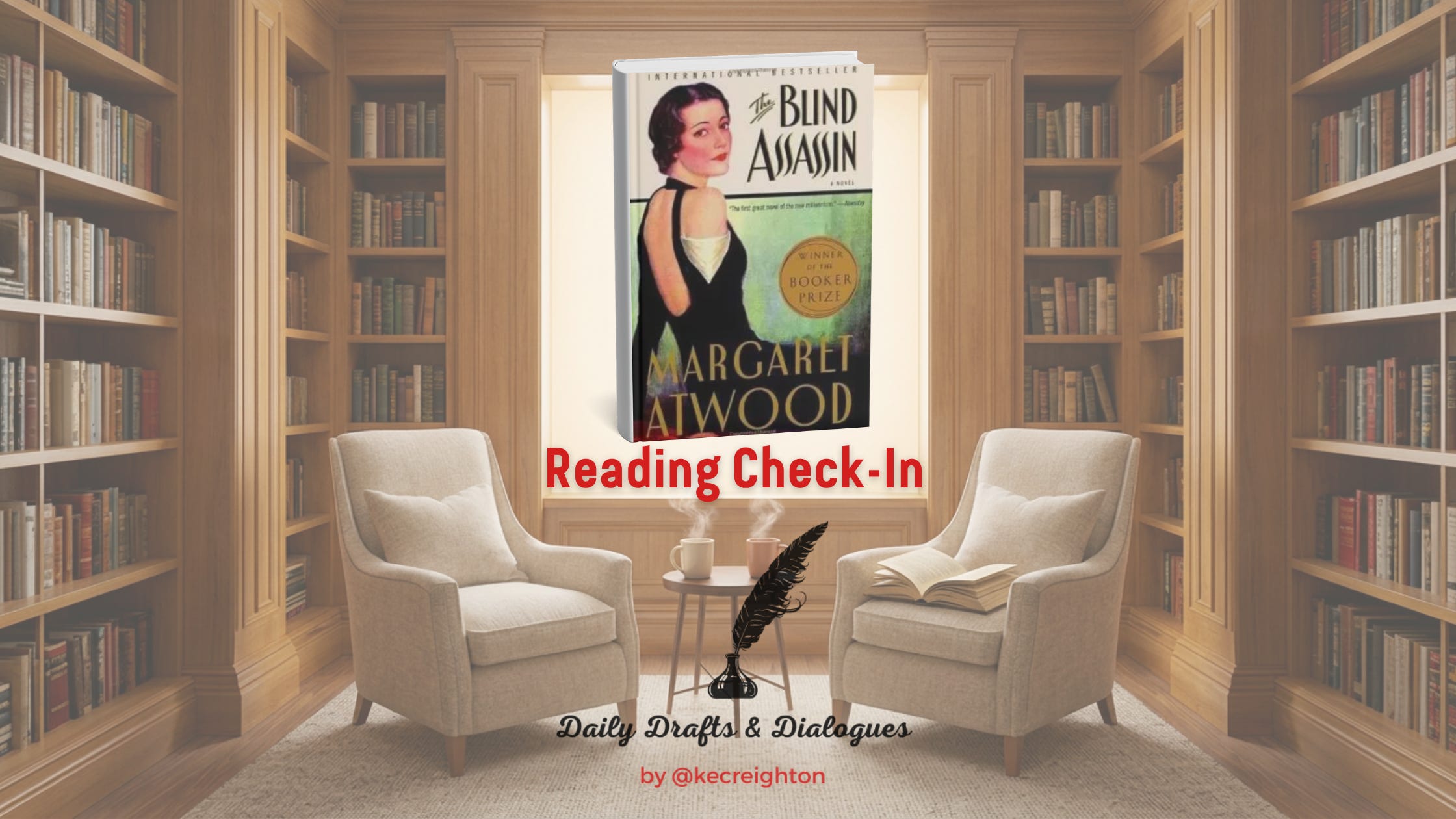
To kick off our book club’s fourth week exploring The Stories We Carry in September, we’re reading The Blind Assassin by Margaret Atwood.
According to Storygraph, The Blind Assassin is for a reader who “enjoys unraveling complex, multi-layered narratives that blend memory and storytelling.” Which is what makes it a great selection for this month’s Literary Dive pick.
Margaret Atwood’s The Blind Assassin, which won the prestigious Booker Prize in 2000, is a masterful demonstration of narrative layering and the power of storytelling. Set against the backdrop of mid-20th-century Canada, a great portion of the novel is narrated by Iris Chase Griffen, an elderly woman looking back on her youth and her fraught relationship with her sister, Laura. And it mainly explores how individuals construct, manipulate, and share narratives to survive societal expectations and personal trauma.
The bulk of the book is framed as a memoir Iris is writing, so readers come to understand from the very beginning that storytelling is rarely neutral and is instead often an act of survival, confession, and careful curation. And this major theme in the novel is further established through a complex, nested narrative structure of stories within stories.
The outermost narrative of the novel is Iris’s cynical, sharp-tongued recollection of her privileged yet sheltered childhood and her eventual marriage to the ruthless industrialist Richard Griffen. Nestled inside her memoir is a second narrative that tells the story of a scandalous, posthumously published novel titled The Blind Assassin, attributed to Laura. And inside the excerpts of that novel lie yet another story about a pulpy science fiction tale an on-the-run leftist radical is telling his wealthy, secret lover in unseemly places. And through these nested layers of stories, the first half of the book demonstrates how the characters use fiction to communicate dangerous or forbidden truths that they cannot speak aloud in their rigid, upper-class reality.
In the inner narrative, which gives the entire book its title, the man who is on the run spins a grim yarn about the fictional city of Sakiel-Norn, where children who are tortured are trained as blind assassins and exploited. This narrative serves as a fascinating example of how we use allegory to share our internal struggles with others, as the storyteller uses this fantastical, brutal myth to mirror his own political desperation and to criticize the capitalist society that oppresses him and the woman listening to his story. For the woman listening to his story, however, this shared fiction becomes an emotional sanctuary in a world that oppresses her and silences her in another way. Still, it allows them to forge an intense bond based on private, collaborative, coded storytelling, demonstrating how the stories we tell others can carve out spaces of intimacy and freedom in an otherwise suffocating existence.
At the same time, the first half of the novel constantly contrasts the positive public image the Chase family tries to maintain with the darker accounts of their lived realities captured in both Laura’s fictional manuscript and Iris’s documented memories. By weaving together local newspaper clippings, society columns, fictional and private recollections, the profound gap between the sanitized history we present to the world and the messy, painful realities we hide are highlighted throughout the novel, showing that the public stories we tell are often intricately constructed bulwarks meant to protect reputations or project a false sense of security, while fictional stories whispered in secret often reveal fundamental truths.
Ultimately, The Blind Assassin serves as a brilliant meditation on the ambiguity of authorship and intent and the power and purpose of storytelling. As the reader pieces together the fragments of Iris’s early life, the sci-fi world, and the scandalous book within the book, it becomes clear that every story told to another person is a performative act of some kind, especially those that are a part of public record. It also suggests that we can never fully know the absolute truth of another person’s experience or life story. Instead, in the end, we will only ever be able to grapple with the specific versions of the stories they choose to share with us.
As we read The Blind Assassin, let’s explore the narratives we choose to tell others, how and why we construct them the way we do, and what this tells us about ourselves, the world we live in, and or the nature of storytelling itself.

💭Initial Reflections on The Blind Assassin
The first sentence of the novel immediately grabs the reader’s attention: “Ten days after the war ended, my sister Laura drove a car off a bridge.” And they are at once pulled into the story of who Laura was and the stories she carried and told alongside her sister Iris’s first-person account alongside the public stories written about their family. All of which signals to the reader that no ink will be wasted in this novel.
It took me 50 pages or so to get used to the nested narrative structure, as one minute I was reading about a post-war memory and the next I was reading about a childhood memory and the next I was reading a news article and the next I was reading about a shady love affair and the next I was reading about a sci-fi world with children sacrifices. However, once I started reading, I couldn’t stop, as Atwood’s writing style is addictive and easy to follow, allowing me to invest in the story and the stories within the stories long before I was able to make heads or tails of what was going on. Which is to say: If you are a little lost in the beginning, keep reading, because it will click and make sense soon enough!
There are so many interesting things to discuss about this novel that it’s hard to know where to start. Its structure is obviously worth unpacking, especially when exploring the power and purpose of storytelling and literary devices and techniques. Yet this novel also surfaces practical questions about whose stories we tend to believe and why, that readers who don’t identify with the label ‘Lit Nerd’ will also enjoy and appreciate.
For instance, are the public articles shared about the Chase family throughout the novel more believable than Iris’s first-person account? Why or why not? And does this have to do more with the fact that she’s a woman living in the early 20th century, the polite strictures of her class, or whether they are less personalized (‘objective’) and publicly recorded? Or is the novel within the novel, The Blind Assassin, ironically more believable or trustworthy than Iris’s account or the public articles? And what do our answers to those questions reveal about the true limitations of storytelling?
I am in awe at the care and detail that went into creating the novels and stories within this novel. And I’m also appreciating Atwood’s wit, as certain excerpts have me laughing out loud one second and glazed over in foreboding or dread the next. There is not only noticeable literary acuity happening in this novel, illustrating how and why it won the Booker Prize. Each character is complex and stands on their own yet also contributes to the overarching narrative, making the story bingeworthy. And the plot is so intriguing and compelling, engaging the reader to keep reading so that they can unpack the mysteries surrounding Laura’s death and the stories she carried and told alongside Iris’s words and their family’s public-facing narrative.
Not to mention that I am now dying to read The Blind Assassin, the novel within this novel, though it doesn’t currently exist in full. It sounds so compelling, but is also alarming to read even in excerpts, as Atwood herself has mentioned multiple times in interviews that she prefers to pull ideas from real-world stories and things that have happened and been documented in history to inform her fiction. She has noted, “Nothing I wrote hasn’t already happened somewhere.” and “When I wrote The Handmaid’s Tale, nothing went into it that had not happened in real life somewhere at some time.” and “For me, ‘speculative fiction’ means plots that descend from Jules Verne’s books... things that really could happen but just hadn’t completely happened when the authors wrote the books. I would place my own books in this second category: no Martians.”
Overall, I think I might end up reading this book twice. Once to follow the exciting plot and its characters, then another to unpack all it reveals about storytelling and the art of crafting different types of narratives. I might have more notes in Friday’s post, but I might need some extra time to consider all this novel offers. Stay tuned and be sure to join the Buddy Read for this pick, because I want to know more about what you think!
As I read, I keep asking myself questions like:
Does reading a narrator’s unvarnished, unrestrained ‘truth’ make them more or less likeable?
Is a first-person account more trustworthy than a third-person account? Why or why not?
Can intertextual analysis help us better understand this novel and what it reveals about the power of storytelling?
Does whether I ‘like’ Iris or Laura matter when deciding on their family’s ‘truth’?
What role does the sci-fi narrative play in understanding the other narratives in the novel?
Can fictional narratives reveal fundamental human truths that nonfiction narratives cannot?
Is nonfiction (especially memoir) actually ‘true’ when all it typically includes is one account or perspective?
💬Notable Quotes and Passages from the First Half of the Novel
“I’ll take it back. I’ll change it. I’ll rewrite history for you. How’s that? You can’t, she says. The word has gone forth. You can’t cancel half a line of it. (p.30)
“Then of course it was a different story. What people remember isn’t the book itself, so much as the furor: ministers in church denounced it as obscene, not only here; the public library was forced to remove it from the shelves, the one bookstore in town refused to stock it. There was word of censoring it. People snuck off to Stratford or London or Toronto even, and obtained their copies on the sly, as was the custom then with condoms. Back at home they drew the curtains and read, with disapproval, with relish, with avidity and glee — even the ones who’d never thought of opening a novel before. There’s nothing like a shovelful of dirt to encourage literacy.” (p.39)
“But also they wanted to finger the real people in it— apart from Laura, that is: her actuality was taken for granted. They wanted real bodies, to fit onto the bodies conjured up for them by words. They wanted real lust. Above all they wanted to know: who was the man? In bed with the young woman, the lovely, dead young woman; in bed with Laura. Some of them thought they knew, of course. There had been gossip. For those who could put two and two together, it all added up. Acted like she was pure as the driven. Butter wouldn’t melt. Just goes to show you can’t tell a book by its cover.” (p.40)
“For whom am I writing this? For myself? I think not. I have no picture of myself reading it over at a later time, later time having become problematic. For some stranger, in the future, after I’m dead? I have no such ambition, or no such hope.
Perhaps I write for no one. Perhaps for the same person children are writing for, when they scrawl their names in the snow.
I’m not as swift as I was. My fingers are stiff and clumsy, the pen wavers and rambles, it takes me a long time to form the words. And yet I persist, hunched over as if sewing by moonlight.” (p.43)
“Where was I? I turn back the page: the war is still raging. Raging is what they used to say, for wars; still do, for all I know. But on this page, a fresh, clean page, I will cause the war to end— I alone, with a stroke of my black plastic pen. All I have to do is write: 1918. November 11. Armistice Day.
There. It’s over. The guns are silent. The men who are left alive look up at the sky, their faces grimed, their clothing sodden; they climb out of their foxholes and filthy burrows. Both sides feel they have lost.” (p.75)
“You may be sure that all travelers, magicians, strangers or beggars who find themselves in the vicinity of the People of Desolation take care to provide themselves with a stash of obscure parables— cloud words, they’re called, or knotted silk—enigmatic enough to be useful on various occasions, as circumstances may dictate. To travel among the People of Joy without a riddle or a puzzling rhyme would be to court certain death.” (p. 117)
“Miss Violence sighed. “It’s a poem, dear,” she said. “Lord Tennyson wrote it and I suppose he knew best. A poem does not reason why. ‘Beauty is truth, truth beauty— that is all ye know on earth, and all ye need to know.’” (p.156)
🗣️Book Discussion Questions
Iris Chase Griffen spends her later life attempting to set down her version of family scandals. How do the public-facing narrative of the Chase and Griffen families contrast with the hidden realities behind their closed doors?
How does the science-fiction story-within-a-story (about the blind assassin and the girl from Sakiel-Norn) function as a cover, a confession, or a coded message between the lovers?
Who ultimately owns or controls a story once it’s told? Consider how Laura’s posthumous publication of The Blind Assassin alters, hijacks, or reframes Iris’s actual lived experiences.
Atwood intersperses newspaper clippings and public records throughout the novel. How do these external media narratives compete with Iris’s first-person retrospective memory and narrative? Are we conditioned to trust print over personal testimony, and why?
Iris tells herself specific stories to survive her loveless marriage to Richard Griffen and the tragedies surrounding her sister. At what point does a coping mechanism or a protective narrative become a destructive lie?
The title alludes to assassins who are blinded so they feel no pity. How are the characters in the novel ‘blinded’ by the societal myths, class expectations, and gender roles they are fed and expected to adopt by the world around them?
👇 Drop your thoughts, reading progress updates, and favorite quotes from the book below! Or join our Buddy Read in Storygraph to share your thoughts there based on where you are in the book. I can’t wait to see what everyone thinks of this book so far! 👇
📝 Bonus Writing Prompts for Drafts
This is for the active writers, journalers, and literary artists in our community. If this book has your creative wheels spinning, consider completing one or both of these writing prompts.
Creative Prompt
Write a scene about a highly publicized, dramatic event from the past (e.g. a factory fire, a child’s disappearance, a celebrity’s murder) from the perspective of a character who is actively rewriting the event in their diary or a letter to protect their reputation, but intersperse supposedly ‘objective’ newspaper clippings, police reports, or official announcements (real or imagined) throughout their personal narrative to create friction between the media’s record and the character’s emotional, revisionist story.
Reflective Journaling Prompt
Think about a difficult period, a major life transition, or a challenging relationship from your past. What was the specific story you told friends, family, or coworkers at the time to explain what you were going through? And looking back now, how did that public narrative protect you or influence you, and what deep truths or messy realities did it force you to leave out?
Share what you write in the Drafters Workshop Chat.
💬 Let’s Dialogue
Writers and readers can have varied creative lifestyles and approaches. Let’s discuss them!
As a reader, do you feel betrayed when a narrator turns out to be unreliable, or does it make the story feel more realistic? As a writer, how do you signal to the reader that a character is lying to the world without giving the twists in your story away too soon?
In The Blind Assassin, fiction is used to exchange secret truths between lovers. How can writers use metaphors and subtext to help characters say the unsayable, and how can readers train themselves to catch these hidden messages?
How do ‘objective’ texts like news articles or historical records change how we read a personal story? For writers: How does blending real or fictional documents into a narrative change the way you build trust with your audience?
Characters often rewrite their pasts to survive trauma or protect their reputation. As creators and consumers of stories, where do we draw the line between a character’s harmless coping mechanism and a malicious, destructive lie?
When a story leaves a character’s control, like Laura’s book being published posthumously, who does the story truly belong to? How do writers navigate the ethics of telling someone else’s story, and how should readers judge who has the right to tell it?
Share your responses in the Dialoguers chat or leave a comment.
See all our September Book Club Picks with optional and customizable reading schedules.

Whether you join a chat, one of our Buddy Reads in Storygraph, or lay it all out in the comments, I look forward to hearing more about your thoughts on our book club picks this month!
If you enjoyed this post, please like and share it so others can enjoy it and read with us too. Thank you and happy reading!
Continue Exploring September’s Theme, The Stories We Carry
This Week: The Stories We Tell Others
Writing Prompts About The Stories We Tell Others
Is it possible for a writer’s public work to remain separate from their private life?
Week 3: The Stories We Tell Ourselves
Writing Prompts that Navigate the Stories We Tell Ourselves
Can you write great work without challenging your own beliefs?
Reading Notes: Interior Chinatown
The Story of My Flaws Sounds Like Death Metal
Rewriting Our Narratives: How to Evolve as a Writer Without Losing Yourself
Historical Fiction that Challenges the Stories We Tell Ourselves
Popular Posts Week 2: Memory and Storytelling
Writing Prompts About Memory and Storytelling
The Art of Autofiction: Memory, Markets, and the Modern Confessional
Popular Posts Week 1: The Books That Changed Us
Writing Prompts About Books That Changed Us
What My Favorite Books Say About Me
20 Banned Books That Have Changed Us
Go Deeper with Daily Drafters Exclusives
This month: The Stories We Carry Writing Collection

This collection offers a month of guided writing exercises, mini workshops, and creative writing experiments designed to take you beyond a single prompt and into a deeper creative practice. It gives you the creative spark and space you need to explore memory, identity, inheritance, perspective, voice, and the stories we tell ourselves and others. It will also encourage you to consider how those stories shape the work we create and the creative lives we lead.
Inside this collection, you’ll find 30 original writing prompts (designed as mini writing workshops) across five sections with focused themes, craft-focused exercises, curated reading suggestions, reflective questions, and three optional month-long writing challenges designed to help you develop your ideas, explore your personal material and stories, and build a consistent writing practice.
You can follow the prompts in order, choose the exercises that speak to you, or return to a section whenever you need a new way to explore your writing craft. As a paid subscriber, you will also be able to come back to the collection throughout the month or any other time you feel like exploring The Stories We Carry in the future.