
Reading Notes: The Unabridged Journals of Sylvia Plath
Here are some reflections, notes, and discussion questions for this week’s book club pick, with bonus writing and dialogue prompts. Keep reading, then join our book club discussions!

August Theme: The Creative Life
Big Question: How do we build a creative life that works for us?
Week 2: Creative Habits
This week, we’re reading our second ever book club pick together!
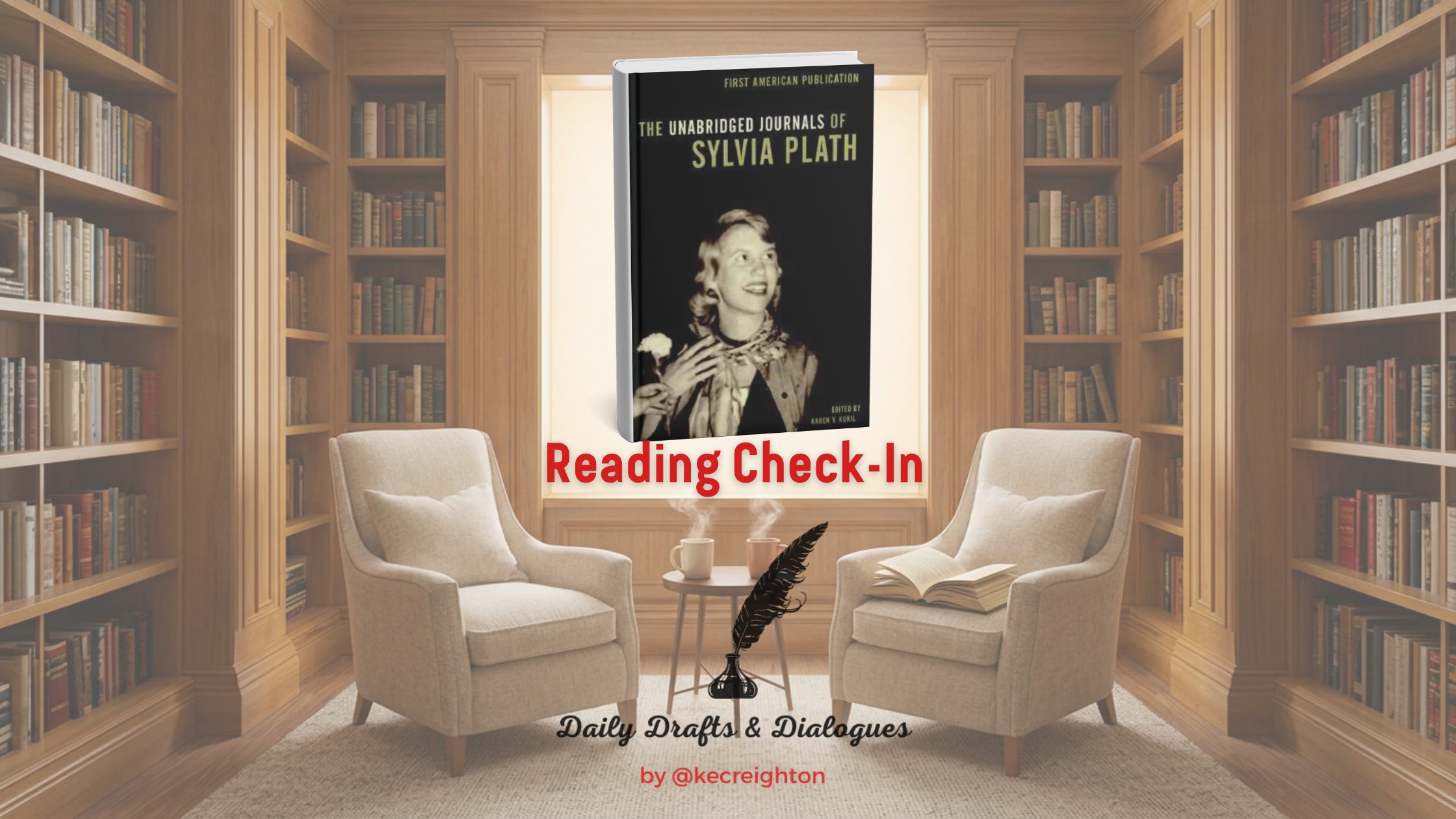
We’re reading The Unabridged Journals of Sylvia Plath, which includes the complete, uncensored journals of Sylvia Plath, published in their entirety for the first time in this 2000 edition.
According to Storygraph: “Sylvia Plath’s journals were originally published in 1982 in a heavily abridged version authorized by Plath’s husband, Ted Hughes. This new [2000] edition is an exact and complete transcription of the diaries Plath kept during the last twelve years of her life. Sixty percent of the book is material that has never before been made public, more fully revealing the intensity of the poet’s personal and literary struggles, and providing fresh insight into both her frequent desperation and the bravery with which she faced down her demons. The Unabridged Journals of Sylvia Plath is essential reading for all who have been moved and fascinated by Plath’s life and work.”
This journal collection has been lauded as profoundly valuable and insightful reading for people who are drawn to raw, unfiltered reflections on the internal struggles and emotional complexities of the human experience, especially creatives and poets. It contains 23 surviving notebooks and fragments from 1950 to 1962. Edited by Karen V. Kukil, it records Plath’s life from her student years at Smith College through her marriage to Ted Hughes and captures her later years as a mother as well as her severe bouts of depression, offering an unvarnished look at her inner and artistic worlds.
Plath’s journal entries reflect on the urge to turn private crises into public art, consider the poetic speaker as a created persona, and often approach and even embrace taboo subjects such as mental illness, desire, shame, and rage without glossing over or downplaying them. Throughout her journals, she exhibits raw emotion alongside constant, diligent craft, and demonstrates how they are rarely mutually exclusive. She also depicts herself as both complex and vulnerable as she writes about building the creative life she wants— as brilliant student, ambitious writer, philosopher, diligent worker, lover, sensuous observer, dutiful daughter, desired and desiring young woman, rival, moral judge, and more.
These journals detail the intense feelings, thoughts, relational frictions, inspirational euphoria, and deep psychological distress that come with building the creative lives we want. And regardless of where you are in your creative journey right now, there are plenty of entries that are bound to resonate.
As we read these journals, let’s reflect on how the creative habits we form and keep influence the trajectories and satisfaction of our creative lives, then come together to share our reflections in the chat or Buddy Read in Storygraph.

💭Initial Reflections on The Unabridged Journals of Sylvia Plath
I know that our original August reading plan said we should only be reading the 1955–1959 section of journals in this book this week. But as soon as I opened the book, I dove right in and started reading some of Plath’s earlier journals, from when she was in her late teens and attending Smith College. So, I have just finished those and plan to start the 1955-1959 section today, though I hope my notes on her earlier journals in the book might offer some valuable insight to our broader discussions of the book after all.
Right off the bat, I was struck by how forthright and honest teenage Sylvia is with herself and her craft and what she wants out of life, though she does acknowledge, loathe, and struggle with the severe limitations placed on women in the 1950s, as well as those placed on her own literary ambitions. In her earlier journals, she constantly talks about her writing as being something that is integral to her survival, to her selfhood, as something she is constantly critiquing and working to continually improve, and bemoans things that get in the way of her creative writing, like needing to study subjects like botany.
Teenage Sylvia goes on a lot of dates and explores the unfairness of her lot in life compared to those young men she dates in her earlier journals, as well. While they will be able to live the lives they want to live, she is unsure she will be able to, as she wants a family but doesn’t want to have to sacrifice her writing career in order to have one. She also resents being expected to leave her literary ambitions behind to support another person’s career and aspirations who will not support hers in equal measure as well. However, all that is construed with the fact that Sylvia does not sugarcoat her desires and lusts, of both the mind and the flesh, in these earlier journals, as she is a teenager with raging hormones she must keep in check after all.
At the same time, Sylvia uses her earlier journals to unpack everything from the meaning of life, language, religion, learning, love, relationships, and the act of writing itself, all while designating writing quotas and strict deadlines for herself. She celebrates winning prestigious writing contests with cash prizes and holding various editorial positions with publications at school but still berates herself from time to time when she’s not working and is taking a moment to enjoy being young. Like many writers and creatives, it is clear that money, and the security that often comes with it, is top of mind for Sylvia too. As the journals illustrate, she was constantly working, whether as a farm worker or hotel worker or babysitter, and was always planning and nervous about her next move in life, both creatively and personally.
So far, I have found Sylvia’s journals fascinating because they illustrate the realities of a deeply creative, passionate, and philosophical young woman who is caught between a lower-middle-class life and an elite education, as well as the expectations of society for a pretty young girl and the assumed security that brings (i.e. marriage and babies) with the roiling ambition and desires she has in the deepest pits of her mind and gut.
I’m already impressed by Plath’s raw intensity, wit, and intellect, and understand why her work was published so much, even at a very young age. And I’m looking forward to following her creative growth as a young woman and poet in the following journals.
As I read, I keep asking myself questions like:
Is it truly ever possible to be ‘satisfied’ with the creative lives we create, or does the fundamental nature of a vivacious creative life require perpetual dissatisfaction?
Do women, especially young women, have different requirements and expectations than men when building the professional creative lives they want?
How did the adults and mentors of my youth influence the creative life I have today?
If I could meet teenage Sylvia today, what would I say to her?
Do the writing and reading quotas Sylvia places on herself ultimately help or hinder her creative work?
How do the societal expectations placed on Sylvia end up influencing her creative life and work in the long run?
Stay tuned for Friday’s post, which will include my final thoughts on the book and any other relevant reading notes I have from the week, along with reminders for upcoming book club picks and additional reading recommendations.
Favorite Quotes and Passages from the Book
“I would like to be everyone, a cripple, a dying man, a whore, and then come back to write about my thoughts, my emotions, as that person. But I am not omniscient. I have to live my life, and it is the only one I’ll ever have. And you cannot regard your own life with objective curiosity all the time…” (p.9)
“Some things are hard to write about. After something happens to you, you go to write it down, and either you over dramatize it or underplay it, exaggerate the wrong parts or ignore the important ones. At any rate, you never write it quite the way you want to.” (p.10)
“If only I can find him… the man who will be intelligent, yet physically magnetic and personable. If I can offer that combination, why shouldn’t I expect it in a man?” (p.21)
“I love you because you are me… my writing, my desire to be many lives. I will be a little god in my small way. At home on my desk is the best story I’ve ever written. How can I tell Bob that my happiness streams from having wrenched a piece out of my life, a piece of hurt and beauty, and transformed it to typewritten words on paper? How can he know I am justifying my life, my keen emotion, my feeling, by turning it into print?” (p.22)
“I have just completed my third English theme: ‘Character is Fate.’If I had to hazard three words to sum up my philosophy of life, I’d choose those.” (p.28)
“God, I scream for time to let go, to write, to think. But no. I have to exercise my memory in little feats just so I can stay in this damn wonderful place which I love and hate with all my heart.” (p.33)
“Such is the resiliency of man that he can become fascinated by ugliness which surrounds him everywhere and wish to transform it by his art into something clinging and haunting in its lovely desolation.” (p.35)
“I want to express my being as fully as I can because I somewhere picked up the idea that I could justify my being alive that way.” (p.45)
“How much of my brain is willfully my own? How much is not a rubber stamp of what I have read and heard and lived?” (p.47)
“I am I, with all the individuality of an earthworm.” (p.62)
“I am at my best in illogical, sensuous description.” (p.87)
✨When she contemplates her obsession with getting published and what it means for her creative life and ambitions, pages 92-93.
“The fact remains that writing is a way of life to me: And writing not just from a pragmatic, money-earning point of view either.” (p.107)
“That’s what it feels like: getting shed of a routine. Even though one has rebelled terribly against it, even then, one feels uncomfortable when jounced out of the repetitive rut.” (p.118)
✨When on pages 124 and 143 she gives herself daily writing and reading quotas that are pretty ambitious— 1,000 words and four pages of writing per day (on top of any school work), along with 70 pages of reading per day.
🗣️Book Discussion Questions
How does seeing the raw, unedited struggle of a well-known author’s creative life change your perception of inspiration and creative habits? Does demystifying an artist’s process make their final work more or less impactful to you?
In what ways do modern creators still face a ‘double bind’ between personal fulfillment and artistic devotion? Can a ‘serious’ artist ever achieve a true balance, or does high-level creativity inherently require a degree of selfishness and or daily mundanity?
Where is the line between writing for self-therapy and writing as a creative exercise? In our modern era of public micro-journaling (like social media), is it still possible to maintain a truly private space for raw, unpolished artistic growth? And should that be a goal?
What are the ethical and emotional risks of using one’s own trauma as raw material for art? At what point does autobiographical art cross from healthy creative processing into harmful self-exploitation?
Are Plath’s creative habits and ambitions ones that you would want to adopt? Why or why not?
How should a creator measure their success when public validation (i.e. awards, publication) conflicts with their internal artistic standards? How can an artist build psychological resilience against the inevitable rejections of their creative life into their daily and weekly habits?
👇 Drop your thoughts, reading progress updates, and favorite quotes from the book below! Or join our Buddy Read in Storygraph to share your thoughts there based on where you are in the book. I can’t wait to see what everyone thinks of this book so far! 👇
📝 Optional Writing Prompts for Drafts
This is for the active writers, designers, journalers, and artists in our community. If this book has your creative wheels spinning, consider completing one or both of these writing prompts.
Creative Writing Prompt
Plath used her journals as an observational laboratory, urging herself to capture the hyper-specific, mundane details of her surroundings to build raw material for her poems and creative work.
Go to an ordinary, everyday, unglamorous space in your current environment (a kitchen sink full of dishes, a crowded bus stop, a desk littered with papers and tangled cords). Then urge yourself to describe or visually sketch this scene using only sensory details that convey a specific, intense emotion like claustrophobia, radical hope, or deep exhaustion without ever naming the emotion itself.
Do this to practice ‘the objective correlative,’ where you convert external, physical reality into a precise psychological mirror, just as Plath did before drafting The Bell Jar.
Reflective Journaling Prompt
Plath frequently battled the paralyzing fear of mediocrity, writing explicitly about how her high expectations of ‘genius’ often blocked her from starting a simple piece of work.
Write a completely uncensored letter to your own artistic ego or ‘internal editor.’ As you write, ask yourself: What standard am I holding my rough drafts to right now, and how is that standard protecting me from the fear of being perceived as average? Then explore what your creative work would look like if you officially gave yourself permission to create something deeply flawed, experimental, and unmarketable today. The goal of this writing exercise is to dismantle the illusion of effortless creation and confront the exact psychological roadblocks that Plath regularly documented.
Share what you write in this week’s Drafters Workshop Chat.
💬 Let’s Dialogue
Writers and readers can have varied creative lifestyles and habits. Let’s discuss them!
How do your current creative surroundings and schedule impact your work, and what prevents you from changing them?
How do you personally judge if a creative session was successful without relying on external validation or praise?
Where do you draw the line between personal experiences that are fair game for your art and those that must stay private?
When you face creative resistance, is it harder for you to start a brand-new project or to face a flawed, half-finished one?
Should writers have quantifiable creative habits? Should readers?
Share your responses in the Dialoguers chat or leave a comment.
Not able to read this book with us this month? No worries! We have other options to choose from. See our other August Book Club picks here.

Whether you join a chat, one of our Buddy Reads in Storygraph, or lay it all out in the comments, I look forward to hearing more about your thoughts on our book club picks this month!
If you enjoyed this post, please like and share it so others can enjoy it and read with us too. Thank you and happy reading!
Continue Exploring August’s Theme, The Creative Life
This Week: Creative Habits
Writing Prompts for Building the Creative Habits You Want
Immersive Storytelling Mode and the ArXiv
Should writers have quantifiable creative habits?
ICYM Week 1: Making Space
Writing Prompts for Making Space in Your Creative Life
A Day Alive in the Lakeside Library
Do writers need to protect creative time like an appointment?
Reading Notes: Tomorrow, and Tomorrow, and Tomorrow
My Ideal Yet Practical Creative Life Scenario
How to Make Space and Time for Your Creative Life
The Creative Life as Play and Work
Consider going more in depth with this month’s theme with The Creative Life Writing Collection

Every prompt, draft, and dialogue begins a conversation, but some of those conversations deserve more of our time and attention.
If today’s post sparked an idea or practice you want to explore further, The Creative Life Writing Collection offers a guided month of prompts, craft exploration and techniques, reflection, and customized reading recommendations for writers who want to go deeper.
And if you want to explore past themes, paid subscribers also have access to the full archive, including previous writing prompts, discussions, and reading lists, as well as full access to the community chat and Daily Drafters Exclusives writing collections.