
Striking Matches: Sylvia Plath’s Reading and Writing Practice as a Syllabus for Fueling a Creative Life
Today’s post explores how the books Sylvia Plath devoured shaped her poetic voice and creative life, and what we can learn and practice from her masterclass notes and writing lessons.

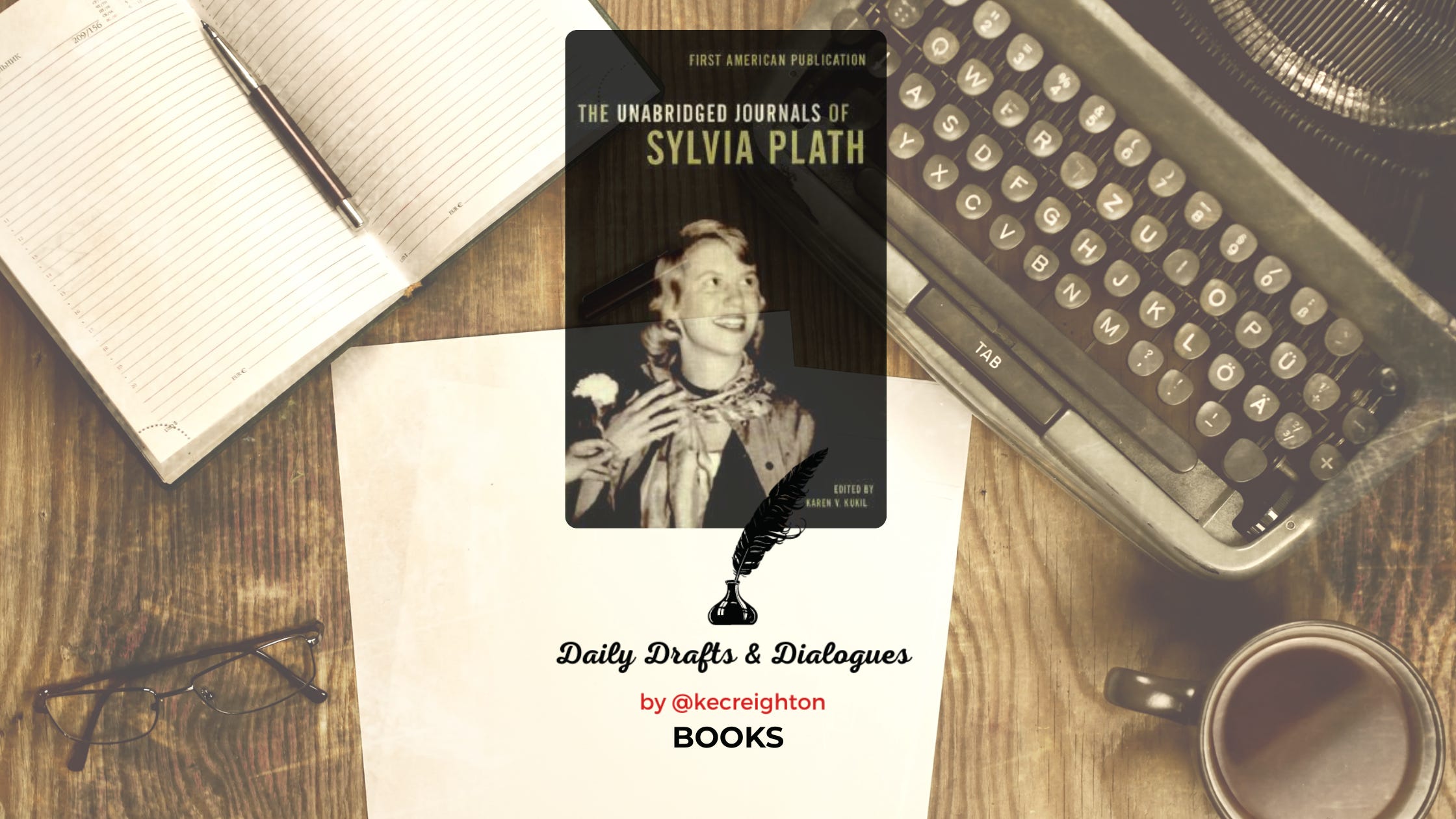
August Theme: The Creative Life
Big Question: How do we build a creative life that works for us?
Week 2: Creative Habits
On Tuesday, I shared Reading Notes: The Unabridged Journals of Sylvia Plath, which includes my initial reflections on Sylvia Plath’s journals, along with some questions that kept resurfacing as I continued to read it. The post also includes some of my favorite quotes and passages from the first few sections of the book, and a list of discussion questions and prompts I wanted our book club to mull over as we finished the last half of the book.
Quick note: If you haven’t finished, or even started, the book yet, that’s okay! There’s still time to join the Buddy Read in Storygraph. You can also join our discussions on the book in post comments and the chat at any time in August.
Now, I’d like to take the time in today’s post to unpack what Sylvia Plath’s journals can offer us and our creative lives, to the extent that I am able given my current constraints of time and space.
At first, I was considering unpacking her crippling sense of perfectionism, the creative routines she followed, and how her new domestic responsibilities and worries stunted her burgeoning literary career, though Plath persevered through them despite her sincere lack of self-love and domestic support… for a little while at least…
But then I realized that that has all been done before. And that covering all those things yet again doesn’t recognize everything Plath actually achieved in her tragically short yet impressive literary career, or how her feats of words have deeply influenced and affected millions of writers and creatives for generations and will continue to do so.
So, instead, I’d like today’s post to focus on what Plath’s journals and work can literally teach us, as we continue to build the creative lives that work for us. And in order to do that, we must start with her reading lists and how she engaged with the works she read, which inevitably influenced her own writing in life-altering ways, though not by accident.
For Sylvia Plath, reading was never a passive act, but a matter of creative survival, which she saw as essential to her creative life, sometimes even her literal life.
In The Unabridged Journals of Sylvia Plath, Plath meticulously documents her relentless, visceral hunger for literature, tracking her impressive reading lists not just as a student but as an artisan reverse-engineering the masters’ works she studied both while in school and independently. In other words, Plath read with deep intention and purpose, to ultimately understand and practice what the works she was reading could teach her about herself and her own work.
To Plath, the literature she read was the vital, artistic fuel she needed to ignite and feed her own prose and poetry, and the two were always interlinked. As laid out in her journals, she used the master works she read as frameworks for her own creative aspirations and endeavors, often using them to break through her own creative blocks via reflections and writing exercises she designed for herself based on them.
When the pressures of academic life or domestic paralysis threatened to dim her creative spark, Plath turned to her bookshelves and what she was reading for guidance and solace. She also pulled from and adapted the techniques of writers like Virginia Woolf, T.S. Eliot, and Fyodor Dostoevsky into well-thought-out and intentional writing experiments designed to sharpen her artistic prowess and push her voice to its absolute limits— writing experiments worth noting and trying ourselves.
The master syllabus that follows maps out how the books Sylvia Plath devoured shaped her poetic voice and creative life. By breaking down her private laboratory of craft, we can uncover timeless masterclass lessons on how we can rely on deliberate creative practice with intentional writing exercises to fuel our own artistic journeys, inevitably proving that to be the best writers we can be, we must first learn how to be the best readers we can be.
As we continue to explore The Creative Life this month, I suggest hanging on to Sylvia Plath’s syllabus, sketched out below.
A Creative Roadmap Through Plath’s Journals: A Masterclass Syllabus
To understand Plath’s evolution as an author and poet, and what that evolution can teach us, we should look at her creative life as a series of distinct experimental stages. Across her journals, she moves through unique geographical, emotional, and mental shifts—from a hyper-focused, bright-eyed college undergraduate to a more tortured and slightly more reckless Cambridge student, then finally, to an independent literary artist breaking free of traditional forms while struggling with domestic concerns.
In each of the seven lifecycle stages outlined below, we step directly into Plath’s private creative laboratory. You will see the specific books she devoured, the exact reflections and creative constraints she assigned herself to absorb their techniques, and the profound ways those reading and writing exercises influenced her voice and body of work. By tracing this timeline, we are able to get a clearer picture of how her reading list transformed her work into the visceral, earth-shattering poetry and prose that defines her enduring legacy.
Feel free to follow this syllabus chronologically, or use it to generate one for yourself. Either way, be prepared to enter a masterclass in craft, both designed and inspired by Sylvia Plath herself.
⏳ The Chronological Reading, Writing, and Submission Timeline of Sylvia Plath’s Creative Life with Added Writing Experiments 📚✍️
📌 Stage 1: Smith College & The Splitting Identity (1950–1953)
📖Core Reading: The Double by Fyodor Dostoevsky
Dostoevsky’s psychological masterpiece explores the agonizing disintegration of identity when a man is confronted by his own mirror-image clone. This work is ideal for readers who enjoy surreal character studies that delve into the fragmented nature of identity and the darker depths of the human mind.
📓Plath’s Creative Interaction: Deeply drawn to the concept of the fractured self, Plath used her journal entries to actively examine her own internal dualities while reading this work. She analyzed literary doubles to better understand the split between public presentation and private artistic isolation.
📝Direct Influence on Plath’s Work: First encountered during her Russian Literature coursework in October 1952, the precise experiment this work helped her design served as the core analytical framework for her Smith College English Honors Thesis, “The Magic Mirror: A Study of the Double in Two of Dostoevsky’s Novels.” It directly broke down the psychological barriers she faced, giving her the blueprint to later write her split-identity novel, The Bell Jar.
✍️Try This Writing Experiment: The Dual-Narrator Friction. Write a scene from the perspective of an unreliable narrator, then write the exact same scene from the perspective of their own idealized or dark ‘shadow self.’ Force the two narratives to conflict on key sensory details, exposing the fracture in their identities. And include a literal mirror in the scene if you want.
✉️ Submissions Log: During this period, Plath’s submission strategy focused on large, highly competitive national magazines that published sophisticated young fiction and poetry. Her primary targets were Mademoiselle (where she famously won the guest editorship in 1953) and Seventeen (which famously sent her dozens of rejections before accepting her work).
📌 Stage 2: Cambridge University & Traditional Forms (1955)
📖Core Reading: Troilus and Criseyde by Geoffrey Chaucer
Chaucer’s tragic courtly narrative relies on strict metrical discipline and the hyper-structured seven-line rhyme royal stanza. A reader who appreciates slow-paced, challenging narratives and the refined beauty of historical poetry will enjoy this work.
📓Plath’s Creative Interaction: Facing the grueling standards of the Cambridge Tripos, Plath used Chaucer’s Middle English structure for mandatory translation exercises and reverse-engineered the stanza layout to actively practice maintaining absolute metrical control over longer poems and narrative forms.
📝Direct Influence on Plath’s Work: Plath heavily reinforced the complex, rigid stanza constraints and formal line lengths of some of her mid-1950s academic poems (some drafts she wrote at Smith), most notably “Winter Words,” which was published later in the Summer 1956 issue of the Cambridge literary magazine, Delta.
✍️Try This Writing Experiment: The Structural Handrail. Take a single page of text written in an archaic or highly stylized form (like Chaucer’s or one used in an old ballad). Without copying the words, map its exact syllable counts, stresses, and rhyme scheme. Next, force your own modern, everyday subject matter into that exact ancient skeletal framework.
📖Core Reading: The Portrait of a Lady by Henry James
James utilizes thick social subtext and dialogue patterns where societal conflict occurs under a polite, repressed surface. A reader who enjoys slow-paced character studies that explore the tension between personal independence and societal expectations will enjoy this work.
📓Plath’s Creative Interaction: The Henry James Dialogue Constraint. Plath studied James’ short stories and novels to understand how high-stakes tension could be conveyed through domestic friction, tracking how characters weaponized speech, subtext, physical omission, and what was left unsaid.
📝Direct Influence on Plath’s Work: James’ work directly informed the alienation, quiet conversational walls, and psychological boundaries seen in her early dramatic dialogue poem, “Wreath for a Bridal.”
✍️Try This Writing Experiment: The Dialogue Subtext Constraint. Write a dialogue between two characters who are experiencing a massive relational rupture. Rule: Neither character is allowed to name, mention, or directly hint at the actual problem. The entire conflict must be communicated through subtext, changing subject lines, and minor physical omissions.
✉️ Submissions Log: Immersed in the British academic system, Plath began target-marketing poetry to elite UK collegiate and national journals. She logged submissions to The Cambridge Review, Granta, and The London Magazine, matching her writing output to her new intellectually rigorous European environment.
📌 Stage 3: The Tripos Exams & Tragic Architecture (1956)
📖Core Reading: Phèdre by Jean Racine
Racine’s tragedy utilizes strict, unyielding French neoclassical alexandrines to trap massive, chaotic human emotions inside a rigid, architectural verse form. This work is ideal for readers who are drawn to emotionally charged narratives about the destructive power of passion and the inevitability of fate.
📓Plath’s Creative Interaction: Plath studied this work in the original French in early 1956 (around the time she met Ted Hughes) while writing papers that came before her Cambridge tragedy papers, then used Racine’s severe structures as an objective lesson in poetic containment. She deliberately studied how to lock her naturally sprawling, sensory impulses and adjective choices into hyper-restrained, symmetrical verse layouts.
📝Direct Influence on Plath’s Work: This work helped shape the severe structural geometry and split balances of her mid-50s landscape poetry, specifically her poem “Two Sisters of Persephone.”
✍️Try This Writing Experiment: The Chaos Box. Write a paragraph or a poem about an intensely violent, chaotic, or highly emotional memory. Now, intentionally force that content into a highly restrictive mathematical form like a strict sonnet, or use an exact syllable-count constraint per line. Notice how the tension builds when raw chaos is forced into a rigid container.
📖Core Reading: The Duchess of Malfi by John Webster
This Jacobean drama features morbid, violent themes, systems of corruption, and hyper-dramatic choric stagings of madness. A reader who appreciates dark, macabre narratives and complex character studies written in poetic, evocative language will be drawn to this work.
📓Plath’s Creative Interaction: Plath explored this work in the spring of 1956, analyzing Webster’s stark theatricality and use of vengeful, high-stakes monologues, eventually practicing how to project an authoritative, gothic voice that didn’t shrink away from violent imagery.
📝Direct Influence on Plath’s Work: Plath would later channel the defiance of Webster’s heroine. In her poem “The Beast,” she directly subverts the play’s most famous line—“I am Duchess of Malfi still”—by calling her own narrator the “Duchess of Nothing.” This work also helped her lay the structural, theatrical groundwork for the intense, soliloquy-style delivery and dark choric personas that would define her famous late-career manuscripts, most notably the vengeful performance in “Lady Lazarus.”
✍️Try This Writing Experiment: The Gothic Soliloquy. Write a dramatic monologue from the perspective of a character who has been deeply wronged or institutionalized. Borrow Webster’s Jacobean palette: focus your metaphors on mortality, decay, and corruption, and force the speaker’s voice to carry a cold, unsettling choric authority.
📖Core Reading: Ulysses and A Portrait of the Artist as a Young Man by James Joyce
Joyce uses rapid compounding, stream-of-consciousness, punning, and hyper-dense semantic layers that break traditional grammar boundaries in these works. These are great books for readers who enjoy challenging, experimental narratives that prioritize linguistic artistry and psychological depth over traditional pacing, the Introspective Explorer—a reader who appreciates challenging, slow-paced narratives that prioritize the internal evolution of a character’s identity and artistic awakening over a fast-moving plot.
📓Plath’s Creative Interaction: Documented with awe in her reading notebooks throughout her literary studies, even going back to her undergraduate years, Plath expressed deep respect toward Joyce’s linguistic density, evaluating his radical use of language, compound words, and internal associations, studying how Joyce built complex layers of memory and myth into concrete physical actions and the human psyche. And went on to teach his work in later years at Smith as well.
📝Direct Influence on Plath’s Work: This work encouraged her to use complex verbal compounding, heavy sound layering, and thick, multi-layered nouns, seen clearly in poems like “Sow.”
✍️Try This Writing Experiment: The Compounded Concrete Object. Select a single, ordinary object in your room. Describe it using only self-invented compound words (e.g., “sky-breaking,” “iron-heavy,” “dust-deep”) and heavy alliterative sound structures. Avoid standard adjectives entirely to shock the reader into seeing the object anew.
✉️Submissions Log: This was the year Plath met and married Ted Hughes. Together, they functioned as an aggressive, two-person manuscript submission engine. Plath took charge of typing and circulating their work, heavily targeting prestigious career-making literary institutions including The Kenyon Review, The Hudson Review, and Poetry (Chicago).
📌 Stage 4: Post-Cambridge & The Internal Landscape (1957)
📖Core Reading: The Years and The Waves by Virginia Woolf
Woolf uses sweeping sensory landscapes and external transitions in weather, light, and wind as structural tools to chart the internal movements of the mind. A reader who prioritizes lyrical prose and the exploration of internal consciousness over traditional plot and action will appreciate The Waves, while a reader who appreciates fluid, atmospheric prose and prefers deep character reflections over traditional, fast-paced plotting will want to read The Years.
📓Plath’s Creative Interaction: The Woolf Setting Shift. In her defining journal entries from 1957, Plath explicitly used Woolf’s prose to benchmark her own descriptive discipline. She analyzed how Woolf utilized external transitions in weather, wind, and light to mirror a character’s internal mental states, then consciously practiced mapping internal emotional volatility onto natural landscapes, treating the physical environment as a psychological mirror.
📝Direct Influence on Plath’s Work: These works transformed her landscape verse entirely. External terrain ceased to be decoration and became an active vehicle for projecting psychological strain, as demonstrated in her breakthrough poem, “Hardcastle Crags.”
💬”Virginia Woolf helps. Her novels make mine possible: I find myself describing episodes: you don’t have to follow your Judith Greenwood to breakfast, lunch, dinner, or tell about her train rides, unless the flash forwards her, reveals her. Make her enigmatic...” (p.289, The Unabridged Journals of Sylvia Plath)
💬”What is my voice? Woolfish, alas, but tough. Please, tough, without any moral other than that growth is good.” (p.315, The Unabridged Journals of Sylvia Plath)
💬 “And just now I pick up the blessed diary of Virginia Woolf which I bought with a battery of her novels Saturday with Ted. And she works off her depression over rejections from Harper’s (no less!--- and I hardly can believe that the Big Ones get rejected, too!) by cleaning out the kitchen. And cooks haddock & sausage. Bless her. I feel my life linked to her, somehow. I love her...” (p.269, The Unabridged Journals of Sylvia Plath)
✍️Try This Writing Experiment: The Weather Shift. Write a short scene where a character experiences a sharp internal emotional pivot (example: going from hope to sudden grief). Rule: You cannot describe their face, actions, or thoughts. Their emotional shift must be communicated entirely through a changing transition in the room’s atmosphere or in the physical environment around them, like a shift in ambient light, wind, natural sounds, or the weather outside the window, etc.
📖Core Reading: Collected Poems of Dylan Thomas
In his poetry, Thomas relies on thick rhetorical cadences, intense alliterative density, and heavy sound play that can easily influence a young writer’s style. Readers who find beauty and solace in deeply emotional reflections on the transience of existence will appreciate this work.
📓Plath’s Creative Interaction: Thomas’s thick alliterative sound-play and heavy rhetorical rhythms dominated Plath’s early writer’s ear, and served as a massive early stylistic influence that she returned to heavily in her post-Cambridge notebooks. Recognizing his overwhelming hold on her early work, Plath spent this period performing metrical paring exercises, consciously stripping away his echoing cadence to uncover her own rhythmic footprint.
📝Direct Influence on Plath’s Work: Studying and revisiting this work led her to pare down her vocabulary, pivoting away from early rhetorical mimicry into the harder, leaner line forms found in her debut collection, The Colossus.
✍️Try This Writing Experiment: The Metrical Strip-Down. Take a poem you have written that relies heavily on ‘flowery language’ or complex metaphors. Systematically rewrite it, cutting every single adjective and adverb. Force yourself to rely purely on hard, visceral nouns and active verbs to carry the rhythm of the poem.
✉️Submissions Log: Returning to the United States after graduating, Plath consolidated her focus on the apex of mainstream American letters. She methodically tracked submissions to The New Yorker and The Atlantic Monthly, aiming for outlets that demanded the precise lyrical discipline she was studying in Woolf.
📌 Stage 5: Instructor Duties & Critical Distraction (1958)
📖Core Reading: The Marble Faun by Nathaniel Hawthorne
Hawthorne utilizes dark New England landscapes and deep regional gothic atmospheres to build an underlying sense of historical dread in this work, which is ideal for a reader who appreciates a slow, reflective pace and enjoys exploring deep moral questions within a classic literary setting.
📓Plath’s Creative Interaction: Plath read this work prior to balancing her teaching load as a faculty member at Smith College, which eventually included Hawthorne’s short stories. Throughout her life, she analyzed Hawthorne’s use of landscape, explicitly identifying his ‘gothic charm’ and sylvan atmospheres as vital tonal mechanisms, studying his dark environmental details, experimenting with how to generate psychological tension entirely through regional architectural and natural backdrops.
📝Direct Influence on Plath’s Work: Hawthorne’s work influenced much of Plath’s earlier work with a distinct, historical New England gothic focus, as well as a few of her later poems. Scholars have also noted thematic and visual echoes between the striking crimson imagery in Plath’s “Poppies in October” and the scarlet symbolism in Hawthorne’s The Scarlet Letter.
✍️Try This Writing Experiment: Regional Gothic Architecture. Choose a real, local historical landmark or an old building in your town. Then write a description of it focusing entirely on its shadows, angles, and decay, relying on the architecture to construct an underlying sense of historical dread to use the building as a living antagonist.
📖Core Reading: Harmonium by Wallace Stevens
Stevens’ work relies on crisp linguistic precision, intellectual coolness, and philosophical abstraction. And is ideal for readers who enjoy slowing down to appreciate vivid imagery and the philosophical exploration of existence.
📓Plath’s Creative Interaction: Plath studied this work closely alongside her academic responsibilities, admiring Stevens’ crisp linguistic precision, though carefully monitored his tendency toward extreme philosophical abstraction. To keep her own poetry from becoming overly academic or emotionally detached, she practiced grounding Stevens’ crisp, exact vocabulary choices in deeply personal, raw physical stakes.
📝Direct Influence on Plath’s Work: This work helped Plath define the clean, intellectual vocabulary of her poem “On the Difficulty of Conjuring up a Dryad.”
✍️Try This Writing Experiment: The Intellectual Counter-Poem. Write down a highly abstract, intellectual philosophical statement (example: “Time is an illusion of human perception.”). Now, write a poem that intentionally attacks that abstraction using intensely raw, visceral physical stakes (blood, hunger, cold, a breaking bone) to prove the philosophy wrong.
✉️Submissions Log: Working in the competitive ecosystem of New England faculty lines, Plath looked to tier-one literary quarterlies that valued dense, academic, and hyper-precise formal verse. Her logs show concentrated submissions to The Yale Review, The Partisan Review, and The Nation.
📌 Stage 6: The Yaddo Residency & Gritty Realism (1959)
📖Core Reading: Sanctuary and Collected Stories by William Faulkner
Faulkner uses visceral pacing, unflinching grit, and raw realism to portray sordid everyday settings. These works are ideal for readers who appreciate challenging, slow-paced narratives that delve into the darker complexities of human nature and psychology.
📓Plath’s Creative Interaction: Plath explored these works during her 1959 craft shifts. And Faulkner’s visceral pacing and dark, unflinching focus on sordid everyday realities challenged her style. To combat what she felt was a tendency toward ‘flowery’ language, Plath studied Faulkner’s realism, forcing herself to observe public spaces with a detached, objective third-person gaze to ground her imagery in real-world grit.
📝Direct Influence on Her Work: This work grounded much of Plath’s imagery in visceral, real-world grit, directly shaping transitional poems like “Blackberrying.”
✍️Try This Writing Experiment: The Unflinching Realism Gaze. Go to a crowded, mundane public space (a laundromat, a bus station, a local diner). Write a third-person description of the scene using a completely objective, cold, and detached gaze. Eliminate any soft, comforting, or beautiful phrasing and focus entirely on the unvarnished grit of the environment.
📖 Core Reading: Complete Poems by Emily Dickinson
Dickinson uses extreme line compression, internal slant rhymes, and domestic metaphors that mask deep psychological power. A reader who appreciates slow-paced and emotional reflections on the complexities of existence and nature will enjoy this work.
📓Plath’s Creative Interaction: Plath read this work during her concentrated writing sprints at the Yaddo colony in late 1959 and deeply identified with Dickinson’s stark, compressed lines, internal slant rhymes, and fierce creative independence. She studied Dickinson’s ability to hide intense psychological violence under ordinary domestic imagery, adopting sharper, tighter line lengths.
📝Direct Influence on Plath’s Work: This work altered Plath’s rhythmic choices, helping her strip away mid-century formal decorations to develop the sharp, visceral lineation seen in poems like “The Manor Garden.”
✍️Try This Writing Experiment: The Skeletal Line Shift. Write a poem utilizing short, abrupt lines (three to four words maximum per line). And use a plain, innocent domestic object (a needle, an iron, a kitchen knife) as a metaphor to mask an undercurrent of intense psychological power or danger. Rely heavily on internal slant rhymes rather than end rhymes.
📖Core Reading: The Waste Land and Critical Essays by T.S. Eliot
These works are ideal for a reader who enjoys rigorous academic analysis and exploring the intersection of philosophy and art, as well as a reader who enjoys challenging, multilayered works that require deep reflection and analytical thinking to fully uncover.
📓Plath’s Creative Interaction: Plath analyzed these texts closely and studied Eliot’s formula of the “objective correlative,” which is the theory that the only way to express emotion in art is by finding an exact index of concrete, physical objects that serve as the formula for that specific feeling. Then she applied Eliot’s formula systematically, also training herself to evoke extreme psychological states by anchoring them solely to concrete household items.
📝Direct Influence on Plath’s Work: These works taught Plath how to map psychological horror onto plain domestic settings, a craft breakthrough that underpins the structure of poems like “The Colossus.”
✍️Try This Writing Experiment: The Objective Correlative Index. Think of a heavy emotional state like profound guilt or quiet dread. Then follow this rule: You are completely forbidden from naming the emotion or describing human tears, sighs, or heartbeats. Instead, evoke the feeling entirely by describing an index of five cold, ordinary household objects (a rusted key, a stained teapot, a cracked mirror, etc.).
✉️Submissions Log: Around this time, Plath was focused on building her professional portfolio, targeting international markets and premier journals that embraced high-modernist and experimental poetry. She submitted to The Paris Review, The Sewanee Review, and The Virginia Quarterly Review while finalizing the contents of her first full-length novel manuscript.
📌 Stage 7: The Late Fragments & Primal Release (1960–1962)
📖Core Reading: The Rainbow and Women in Love by D.H. Lawrence
Lawrence incorporates thick, sensuous imagery, raw human passion, and an elemental focus on earth, blood, and fire that rejects polite societal filters. These works are ideal for a reader who appreciates slow-burn character studies and the deep psychological exploration of human relationships across time, as well as slow-paced narratives that prioritize psychological depth and emotional intensity over plot.
📓Plath’s Creative Interaction: Plath tracked Lawrence’s work across her journals and notebooks and evaluated Lawrence’s sensuous human relationships and his reliance on raw, elemental textures of earth, blood, and fire that rejected polite societal filters. She studied his ability to capture unvarnished human emotion without a filter, applying that raw, physical sensory density directly to her late stanzas.
📝Direct Influence on Plath’s Work: Lawrence’s work encouraged her to completely abandon polite literary manners, which likely directly fueled the primal, urgent imagery of blood, earth, and fire that defines her posthumous masterpiece, Ariel.
✍️Try This Writing Experiment: The Elemental Unfiltering. Write a narrative piece or poem that completely rejects polite, conversational, or intellectual manners. Focus your imagery entirely on raw, primal, and elemental components like blood, earth, teeth, bone, or fire. Force the stanzas and lines to be urgent, fast-paced, and intensely physical.
✉️Submissions Log: Now living back in England, a published book author, and moving rapidly toward the lightning-fast creative window of her final poems, Plath focused on high-visibility global literary mainstays. She aggressively routed her late work to The New Yorker (maintaining a first-reading agreement with editor Howard Moss), The Observer, The New Statesman, and The Critical Quarterly.
🎧DON’T MISS THE OPPORTUNITY TO LISTEN TO SYLVIA PLATH READ YOU HER POETRY
📚 The Extended Reading List Beyond the Core Syllabus
For those looking to expand their own libraries centered around The Creative Life and Plath’s work, Plath’s journals document other notable works worth reading, and reference plenty of others. This is not an exhaustive or comprehensive list but includes books Plath fans won’t want to miss.
Anna Karenina by Leo Tolstoy
The Brothers Karamazov by Fyodor Dostoevsky
The Lost Son by Theodore Roethke
Life Studies by Robert Lowell
Oedipus Rex by Sophocles
The Lord of the Rings and The Hobbit by J.R.R. Tolkien
The Sun Also Rises by Ernest Hemingway
To the Lighthouse by Virginia Woolf
The Egoist by George Meredith
The House of the Seven Gables by Nathaniel Hawthorne
The Odyssey by Homer
Aria by Susan Howe
Selected Poems by Anne Sexton
💭Final Reflection on Sylvia Plath’s Journals and Creative Life Syllabus
Sylvia Plath’s reading life demonstrates that exceptional art is never born in a vacuum. Instead, it is forged through a deep, ongoing dialogue with the voices that came before it and continue to influence it. From her early days analyzing psychological doubles at Smith College to the elemental release of her final poems, Plath used her reading lists as a laboratory to study and then experiment her craft. Her deliberate reading lists and writing exercises and experiments show us that creative inspiration is something to be actively chased, dissected, and mastered through fierce discipline.
The primary lesson we can learn from Plath’s creative life is that inspiration requires intent. Especially when our minds feel flat or sterile, we cannot simply wait for an inspirational spark but must search for it in what we choose to read.
By looking closely at how the books she devoured shaped her poetic voice, we see an immensely disciplined writer who fought through self-doubt, academic suffocation, and domestic routines by constantly returning to the page, which included those pages she read as well as those she wrote.
For anyone navigating their own creative life today, Plath’s journals remain the ultimate blueprint for when we feel blocked and encourage us to look to the words of others, especially the masters, to find the syntax and literary art for our own creative work and lives, so that we can learn to strike our own matches in the dark.
Join Our Book Club Discussions
What are your thoughts on The Unabridged Journals of Sylvia Plath?
Check out the discussion questions and or drafting and dialoging prompts in Tuesday’s post, Reading Notes: The Unabridged Journals of Sylvia Plath, to get your wheels rolling if you want. Then join our Buddy Read on Storygraph at any time this month to discuss this book with us. We’re starting a new book next week, but discussions for this August book club pick will still be up for the remainder of the month.
Let’s Also Discuss: What books do you turn to when your creative reservoir runs dry? Do you prefer to read for comfort, or do you actively reverse-engineer your favorite authors to unlock your own craft? Let’s discuss in the comments below.

📘Our Next Book Club Read

For week three in August, which starts tomorrow, the Daily Drafts & Dialogues Book Club is reading our Diverse Perspective Pick: The Cemetery of Untold Stories by Julia Alvarez, a novel in which a Dominican-American author literally buries her unfinished drafts in a plot of land… only for her abandoned characters to start talking back.
As always, you can read at your own pace throughout the month, but here’s what you’ll want to know if you plan to follow The Weekly Buddy Read Schedule for Tuesday Reading Notes and Check-Ins:
Daily Target: Days 15-21 (approx. 35-40 pages/day) to finish in one week.
Tuesday Check-In Post: August 18, 2026: Our third check-in post this month tackles creative legacy and abandoned art. We will explore the emotional toll of letting stories go, the guilt of leaving manuscripts unfinished, and the idea that our creative ideas have a living, breathing life of their own.
See the Complete August Book Club Pick Lineup with Customizable Reading Schedules

Whether you join a chat, one of our Buddy Reads in Storygraph, or lay it all out in the comments, I look forward to hearing more about your thoughts on our book club picks this month as we continue to discuss The Creative Life!
Please remember to like and share this post with your network so other readers can join us too!
✨📚✨Thank you! 🫶
Continue Exploring August’s Theme, The Creative Life
This Week: Creative Habits
Writing Prompts for Building the Creative Habits You Want
Immersive Storytelling Mode and the ArXiv
Should writers have quantifiable creative habits?
Reading Notes: The Unabridged Journals of Sylvia Plath
The Habits That Help Me and My Creative Life Most
Striking the Right Balance with Quantifiable Creative Habits
ICYM Week 1: Making Space
Writing Prompts for Making Space in Your Creative Life
A Day Alive in the Lakeside Library
Do writers need to protect creative time like an appointment?
Reading Notes: Tomorrow, and Tomorrow, and Tomorrow
My Ideal Yet Practical Creative Life Scenario
How to Make Space and Time for Your Creative Life
The Creative Life as Play and Work
Consider going more in depth with this month’s theme with The Creative Life Writing Collection

Every prompt, draft, and dialogue begins a conversation, but some of those conversations deserve more of our time and attention.
If today’s post sparked an idea or practice you want to explore further, The Creative Life Writing Collection offers a guided month of prompts, craft exploration and techniques, reflection, and customized reading recommendations for writers who want to go deeper.
And if you want to explore past themes, paid subscribers also have access to the full archive, including previous writing prompts, discussions, and reading lists, as well as full access to the community chat and Daily Drafters Exclusives writing collections.