
The Creative Life as Play and Work
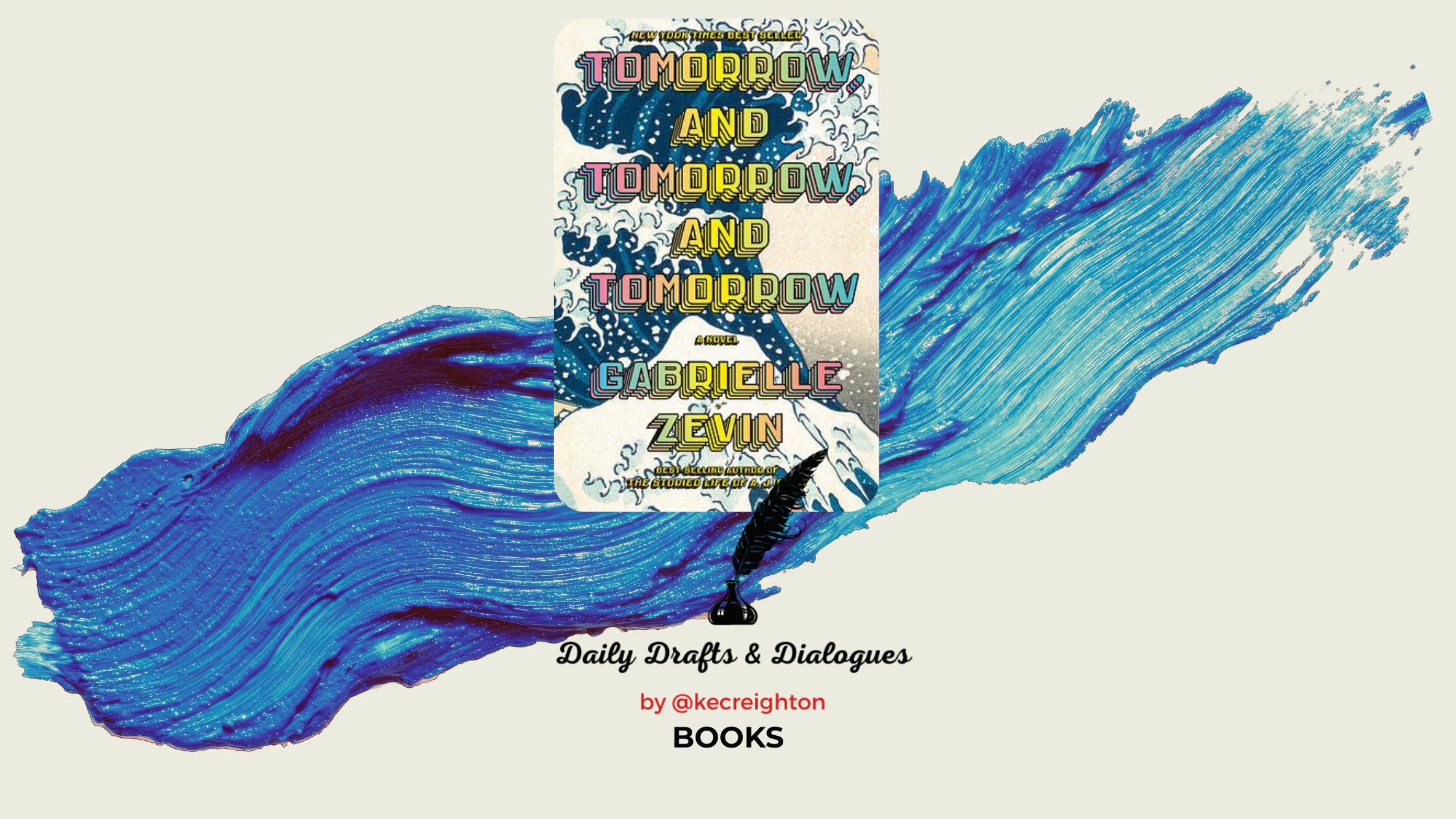
What Tomorrow, and Tomorrow, and Tomorrow by Gabrielle Zevin Reveals About Making Space for Play and Work in Our Creative Lives

August Theme: The Creative Life
Big Question: How do we build a creative life that works for us?
Week 1: Making Space
On Tuesday, I shared Reading Notes: Tomorrow, and Tomorrow, and Tomorrow, which includes my initial reflections on Gabrielle Zevin’s 2022 novel, along with some questions that kept resurfacing as I continued to read it. The post also includes some of my favorite quotes and passages from the first half of the book, and a list of discussion questions and prompts I wanted our book club to mull over as we finished the last half of the book.
Quick note: If you haven’t finished, or even started, the book yet, that’s okay! There’s still time to join the Buddy Read in Storygraph. You can also join our discussions on the book in post comments and the chat at any time in August.
So, today’s post will offer some of my final thoughts on the book, as well as some of my responses to the questions included in Tuesday’s post. And it will also explore what the novel reveals about the spaces we make in our creative lives, to tie some of its major themes back to our current themes and discussions on Daily Drafts & Dialogues. Oh, and don’t skip the section with similar books to Tomorrow, and Tomorrow, and Tomorrow that you’ll want to add to your Making Space for a Creative Life TBR.
Final Reflections on Tomorrow, and Tomorrow, and Tomorrow
Overall, I thought this novel was beautiful and inventive, and I loved its open-ended, bittersweet ending. I also genuinely appreciated how it captured the profound essence and human value of storytelling and how critical storytelling is to living a full and authentic creative life. And not just via the stories we want to develop and create and tell, but also via the stories that develop and create us, even long before we’re here and long after we’re gone.
Of all the questions that surfaced as I read the first half of the book (see Tuesday’s post), there’s one that the book allowed me to explore a little deeper.
Determining which financial factors must be weighed while designing a creative life, and when, will probably always be a struggle for most creatives, including myself. And fostering creative partnerships will likely happen organically over the years, surfacing on their own timetables when creative interests align with others. So, the answers to those questions, shared earlier this week, are still TBD…
But the novel did get me closer to unpacking the answer to this one question I had: How much do the worlds I create influence my creative life and identity, and vice versa?
In the novel, we see how Donkey Kong and Super Mario Bro.s shape the beginning of Sadie’s and Sam’s friendship. And then how their shared love of playing those video games eventually leads to their life-long collaboration creating and playing video games together at scale. We also see how the stories of their lives and personal tragedies intermingle and influence their creative lives and games, and vice versa, consistently throughout the novel.
We see video game characters modeled after Sadie and Sam, and their personalities and personal tragedies integrated into every game they create, from Ichigo and Mapleworld to Pioneers. And throughout the novel, they both use the games they create to discover themselves, express themselves, cope with their real lives, and find themselves and each other in the end. Which is what makes this novel so resonant and relatable to all creatives, even if they don’t know a thing about video games— its focus on storytelling as both play and work, and how critical both are to our creative lives.
Ultimately, this novel reveals how making space in our creative lives also means making space for connecting and playing with other people, even if we do so subconsciously or under duress or across time through others’ creative works that have lived on after them. And how essential and inevitable it is that we make space for and play with others’ ideas, energies, creativity, and personal stories when we design our own creative lives and works, as well as how inescapable doing so can be, which is also its own sort of game worth playing that never comes without a certain level of risk.
Whether we like it or not, our creative lives consist of the stories we are born with and consume, as well as the stories we make and share with others based on those stories that have formed us. And this corkscrew symmetry is integral to the storytelling games and work we engage in and play with day after day, which are often interconnected in ways we can’t even fathom let alone quantify, though we will never stop trying…
Favorite Quotes and Passages from the Last Half of the Book
✨When Sam tells Sadie, “Physical malady gives our character more obstacles in the real world, and more contrast with her avatar in the fantasy world. What is the point of having two worlds, if not to draw these contrasts?” (p.184)
“It was Sam’s idea that Alice should die twice in the game within a game before she could win the game properly. It was the inversion of the opening scene of Mapletown, in which moving forward meant giving up, and Sadie thought it was brilliant.” (p.199)
✨When Dov tells Sadie, “... I fail in my work every day, but I keep turning over the problems until I’m not failing anymore. But public failures are different, it’s true… You go back to work. You take advantage of the quiet time that a failure allows you. You remind yourself that no one is paying any attention to you and it’s a perfect time for you to sit down in front of your computer and make another game. You try again. You fail better.” (p.219)
“As it turned out, in the late fall of 2001, Mapleworld was exactly what people craved. A virtual world that was better governed, kinder, and more understandable than their own.” (p.252)
✨The description of Master of the Revels on page 275, the game Sadie and Marx create and produce, which is set in the theatrical world of 16th-century Elizabethan London, where the player attempts to solve the murder of playwright Christopher Marlowe. This section of the book also serves as a major turning point in the novel, with the game’s massive commercial success becoming the harbinger for one of the book’s central tragedies.
✨ When Marx recalls his first time meeting Sadie, which is written in the second person.
“‘I know you already,’ you replied. ‘I’ve played two of your games.’
She surveyed you over the top of her yellow sunglasses. ‘You think you can know a person from playing their games?’
‘I do. No better way, in my humble opinion.’” (p.285)
✨ When Sam sees Sadie’s ‘Easter egg’ in The Scottish Expansion, also revealing the story and meaning behind the title of the novel Tomorrow, and Tomorrow, and Tomorrow. Seriously, I cried. (Part VIII, Chapter 6)
“Alas, what is the point of writing a poem if there is no one with whom to share it?” (p.343)
“‘And what is love, in the end?’ Alabaster said. ‘Except the irrational desire to put evolutionary competitiveness aside in order to ease someone else’s journey through life?’” (p.355)
✨The entire last part of the novel, Part X, ‘Freights and Grooves’.
See Tuesday’s post for my favorite quotes and passages from the first half of the book.
Books to Add to Your TBR on Making Space for a Creative Life
Fates and Furies by Lauren Groff: A sweeping portrait of a decades-long marriage between a charismatic playwright and his enigmatic wife. Much like Tomorrow, and Tomorrow, and Tomorrow, it shows how a creative partnership is built on hidden sacrifices, creative collaboration, and the distinct, sometimes conflicting narratives two people carry about the very same life.
The Ensemble by Aja Gabel: This intimate novel charts the intense, volatile, and deeply collaborative lives of four young classical musicians in a string quartet as they navigate passion, ambition, sacrifice, and loyalty.
The Savage Detectives by Roberto Bolaño: A chaotic, energetic, and highly experimental journey through the lives of young creatives and poets and writers moving across decades and continents. Told through a mosaic of diary entries, interviews, and shifting perspectives, it perfectly mimics the electric feel of belonging to a passionate, rebel literary movement.
The Amazing Adventures of Kavalier & Clay by Michael Chabon: Two teenage cousins in 1939 New York team up to create a legendary comic book superhero, blending history, art, and a decades-long bond shaped by ambition and grief.
The Bar Harbor Retirement Home for Famous Writers (And Their Muses) by Terri-Lynne DeFino: For a softer but equally poignant look at the writing life, this novel follows aging literary icons living out their final days together. It deals heavily with the heavy cost of choosing artistic greatness over personal love, and the magical way a new muse can break a lifelong case of writer’s block.
The Interestings by Meg Wolitzer: This story tracks a close group of teenagers who meet at an arts camp in 1974 and follows them across decades as they grapple with what it means to be talented, successful, or ordinary in the creative world.
Join Our Book Club Discussions
What are your thoughts on Tomorrow, and Tomorrow, and Tomorrow by Gabrielle Zevin?
Check out the discussion questions and or drafting and dialoging prompts in Tuesday’s post, Reading Notes: Tomorrow, and Tomorrow, and Tomorrow, to get your wheels rolling if you want. Then join our Buddy Read on Storygraph at any time this month to discuss this book with us. We’re starting a new book next week, but discussions for this August book club pick will still be up for the remainder of the month.

📗Our Next Book Club Read

For week two, which starts tomorrow, the Daily Drafts & Dialogues Book Club is reading our Real World Application Pick: The Unabridged Journals of Sylvia Plath (1955-1959). These are the actual, unedited diaries of the literary icon, Sylvia Plath, capturing her daily writing routines, intense perfectionism, and deep creative self-doubt.
As always, you can read at your own pace throughout the month, but here’s what you’ll want to know if you plan to follow The Weekly Buddy Read Schedule for Tuesday Reading Notes and Check-Ins:
Daily Target: Days 8-14 of August (approx. 35-40 pages per day) to finish in one week, or by next Friday.
Tuesday Check-In Post: August 11, 2026: In this week’s check-in post, we strip away fiction to look at the psychology of the creator. We will discuss how Plath navigated the internal warfare of perfectionism, the rigid discipline of daily drafting, and the crushing weight of artistic isolation… and then some.
See the Complete August Book Club Pick Lineup with Customizable Reading Schedules

Whether you join a chat, one of our Buddy Reads in Storygraph, or lay it all out in the comments, I look forward to hearing more about your thoughts on our book club picks this month as we continue to discuss The Creative Life!
Please remember to like and share this post with your network so other readers can join us too!
✨📚✨Thank you! 🫶
Continue Exploring The Creative Life (August Series)
This week’s Posts: Making Space
Writing Prompts for Making Space in Your Creative Life
A Day Alive in the Lakeside Library
Do writers need to protect creative time like an appointment?
Reading Notes: Tomorrow, and Tomorrow, and Tomorrow
My Ideal Yet Practical Creative Life Scenario
How to Make Space and Time for Your Creative Life
Go more in depth with this month’s theme with The Creative Life Writing Collection

Every prompt, draft, and dialogue begins a conversation, but some of those conversations deserve more of our time and attention.
If today’s post sparked an idea or practice you want to explore further, The Creative Life Writing Collection offers a guided month of prompts, craft exploration and techniques, reflection, and customized reading recommendations for writers who want to go deeper.
And if you want to explore past themes, paid subscribers also have access to the full archive, including previous writing prompts, discussions, and reading lists, as well as full access to the community chat and Daily Drafters Exclusives writing collections.