

September Theme: The Stories We Carry
Big Question: Why do certain stories stay with us?
Week 4: The Stories We Tell Others
What I wrote below is based on the following reflective writing prompt included in Saturday’s Writing Prompts About The Stories We Tell Others post.
Prompt: Reputation Trap
What is a compliment people frequently give you that secretly makes you feel trapped or forced to perform?
Why did I choose it?
I chose this prompt because it seems pertinent to understanding the stories we carry about ourselves and who we are. And it will certainly get me out of my comfort zone as a writer, as I don’t usually write anything that I would dub ‘confessional’. Though that probably has more to do with my writing habits and what I’m used to writing than the fact that I’m actively trying not to be confessional.
So, here goes…
My Response
Like many women and girls, most of the compliments and criticisms I have received most of my life have been centered around my outward appearance and comportment— my hair, eyes, clothes, and how agreeable or disagreeable I’m behaving in others’ eyes. All typical, eye-roll-worthy, subtle and sometimes not-so-subtle misogynistic assessments and comments.
And like many women and girls, I’ve also received those backhanded ‘compliments’ like “Wow, you’re actually pretty smart.” or “Wow, that’s actually a good idea.” or “Wow, you’re actually pretty funny.” But I know many of those comments and how they’re delivered have more to do with societal constructs and those who blindly or subconsciously follow them than me, so I try to let them go and just get on with my life and keep my distance from the people who utter them.
So then, what compliment makes me feel trapped or forced to perform?
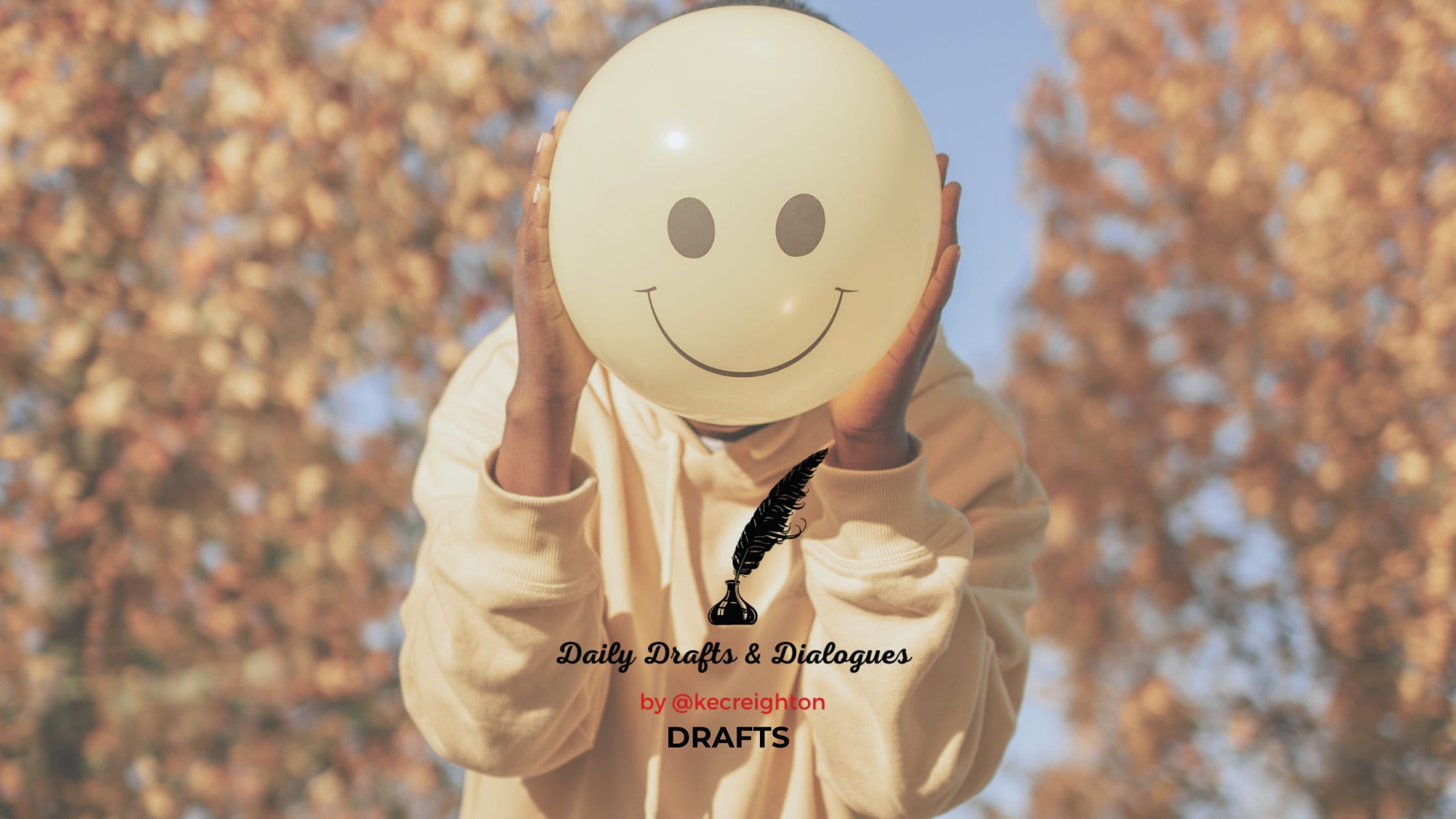
“You’re always so happy.”
That is a compliment I have been receiving most of my life, and at every age. And it’s typically quickly followed by a comment about my smile and how big it is. People regularly comment that they can see all my teeth when I smile, then laugh, expecting me to laugh along with them. A person who was being unkind once even called me ‘the joker’, though he certainly thought it was funny.
But the truth is, when people say those things to me, I am genuinely happy at those moments. Well, until they compliment my joy, which honestly just seems bizarre to type out right now. How can one ‘compliment joy’, when they should simply revel in it and appreciate it, no?
Still, like I was saying, you can’t fake full-faced smiles like the ones I give when I am feeling sincerely joyful. You just can’t. And I am honestly joyful up until I receive the ‘compliment’ about my supposed happiness.
So, why does it make me feel like I am trapped or forced to perform then?
Because of what happens after I receive the ‘compliment’, or in subsequent interactions with the people who gave me the ‘compliment’, and how my sincere joy becomes something that is slowly but surely expected at every moment I interact with them from that point on, and at full wattage. Which is, quite frankly, not only impossible on a practical and biological or human level. It’s also downright exhausting and disheartening in the long run, for me. Which, unironically, does make me less joyful and happy around the supposed compliment givers over time.
I have also been perceived as less intelligent and taken less seriously after exhibiting moments of genuine joy (especially in academic or professional environments), as if joy can’t coexist with deep, rational thought, astute composure, and a solutions-oriented attitude, when in fact it can and often does. At least, it does in the world in which I exist, or want to exist in, I should say. Though accepting that truth also requires a level of emotional intelligence and maturity which, let’s face it, not that many people in the world seem to possess these days, especially those who falsely equate mean-spirited, reactionary critiques driven by personal insecurities with profound mental acuity or intelligence, or assume that complete misery and discontent are a sign of one’s intellect when perhaps it has more to do with one’s self-imposed emotional neglect, limitations, or general feebleness. But that is something to explore further some other day…
Bottom line, I guess what I want to say, for the record, even if only to and for myself, is this: Because I exhibit genuine joy does not mean I do not hurt, have not hurt, or have not experienced real trauma to such an intense level that many humans out there would feel incapacitated. It also does not mean that it is a switch I can flip on at another’s behest or for their personal comfort alone, especially if the joy I’m exhibiting is being genuinely expressed. It simply means that I am emotionally intelligent enough and deliberate enough to also make it a point to focus on what is bringing beauty and color and lightness and possibilities into my life and the world, however complex that world and all its inhabitants may be, whenever and however it arrives. And that I practice this skill, of joyful attention and appreciation and expression, on purpose, even and especially when it may not be all that easy.
People get full-faced, high-wattage-smile joy all wrong, I think, particularly as it pertains to me. Because such joy is not often something that happens by accident, or because all rational thought has vanished. It is something that is harnessed and expressed on purpose. And it in no way minimizes the pain someone is going through every day. Or indicates that they are not capable of rational ideas or deep thought or more unpleasant emotions. In fact, I would contend the exact opposite is true…
Share Your Writing and Join the Conversation
What’s your response to the question I answered in today’s post, or any of the other reflective journaling prompts in this week’s Writing Prompts About The Stories We Tell Others post?
Leave a comment or join the Drafters Workshop Chat or Dialoguers Chat, where we’ll be discussing the stories we tell others for the rest of the week, and the stories we carry for the rest of the month.
Whether you leave a comment or join one of the chats to share your responses, ask questions, or connect with other writers and support their work, I can’t wait to see what you contribute!
Please don’t forget to like and share this post with your network so others can see it too. Thanks in advance. I hope to see you in the comments or chat threads soon!
Continue Exploring September’s Theme, The Stories We Carry
This Week: The Stories We Tell Others
Writing Prompts About The Stories We Tell Others
Is it possible for a writer’s public work to remain separate from their private life?
Reading Notes: The Blind Assassin
Week 3 Popular Posts: The Stories We Tell Ourselves
Can you write great work without challenging your own beliefs?
The Story of My Flaws Sounds Like Death Metal
Historical Fiction that Challenges the Stories We Tell Ourselves
Week 2 Popular Posts: Memory and Storytelling
Writing Prompts About Memory and Storytelling
The Art of Autofiction: Memory, Markets, and the Modern Confessional
Week 1 Popular Posts: The Books That Changed Us
Writing Prompts About Books That Changed Us
What My Favorite Books Say About Me
20 Banned Books That Have Changed Us
Go Deeper with Daily Drafters Exclusives
This month: The Stories We Carry Writing Collection

This collection offers a month of guided writing exercises, mini workshops, and creative writing experiments designed to take you beyond a single prompt and into a deeper creative practice. It gives you the creative spark and space you need to explore memory, identity, inheritance, perspective, voice, and the stories we tell ourselves and others. It will also encourage you to consider how those stories shape the work we create and the creative lives we lead.
Inside this collection, you’ll find 30 original writing prompts (designed as mini writing workshops) across five sections with focused themes, craft-focused exercises, curated reading suggestions, reflective questions, and three optional month-long writing challenges designed to help you develop your ideas, explore your personal material and stories, and build a consistent writing practice.
You can follow the prompts in order, choose the exercises that speak to you, or return to a section whenever you need a new way to explore your writing craft. As a paid subscriber, you will also be able to come back to the collection throughout the month or any other time you feel like exploring The Stories We Carry in the future.