


SCROLL TO THE BOTTOM TO SEE TODAY’S WRITING PROMPT
Earlier this month, I posted a simple Substack note that asked: “When do you feel most like a writer? While drafting, editing, reading, or in the quiet moments when you’re thinking about what to write next?”
And here’s what I learned from the responses I saw:
Most people overall agreed that they felt most like a writer when they were drafting, revising, and or editing. No surprise there.
However, more people shared that they felt most like a writer during quiet moments of brainstorming and reflection than when they were editing.
And most people in the Other category claimed to feel most like a writer during spontaneous moments, when ideas come flooding in and they have to stop whatever they’re doing, regardless of where they are, to write them down.
A few people in the Other category stated ‘All of the above’ or stated they felt most like a writer during two or more of the options provided.
A handful of people also claimed to be struggling with feeling like a writer at all and shared feelings of self-doubt.
A few people in the Other category stated they felt most like a writer when others regularly read and supported their work and offered encouragement.
And a few people stated they felt most like a writer while drinking.
Less than a handful of people said they felt most like a writer when they enjoyed rereading something they had already written or published, outside of the revising and editing stages.
However, only one or two people claimed to feel most like a writer while reading others’ work (presumably for writing insights and inspiration).
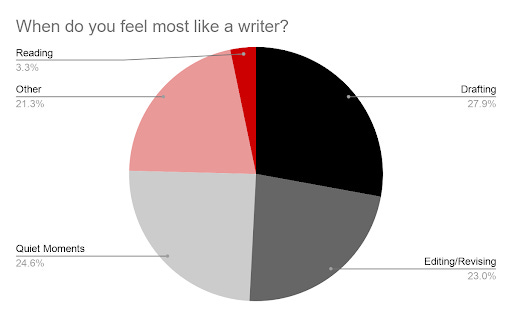
Overall, I was heartened by how many people embraced the various stages of the entire writing process, especially when they expressed their vulnerabilities with finding supportive readers and the unpredictable nature of the writing process itself. Never being able to shut off the ‘writer brain’ once it’s fully activated can make errands and everyday life a bit challenging, even with a portable notebook handy, as can the silent moments when nothing is happening or surfacing to write at all.
Yet nothing seems more challenging and vulnerable for writers than finding readers who engage with and support their work. Which is why I was somewhat dismayed that close to zero responders found the reading process to be essential to the writing process— but only somewhat, as I do realize the implications of the question itself (‘When do you feel most like a writer?’), which is centered around one’s identity as a ‘writer.’
So, why did that make me feel dismayed?
Because we all not only need readers to be writers, we also need to be readers to be writers. For both mutual support and inspiration.
“If you want to be a writer, you must do two things above all others: read a lot and write a lot. There’s no way around these two things that I’m aware of, no shortcut.” — Stephen King
“There is creative reading as well as creative writing.” — Ralph Waldo Emerson
“You should write because you love the shape of stories and sentences and the creation of different words on a page. Writing comes from reading, and reading is the finest teacher of how to write.” — Annie Proulx
“Basically, if you want to become a good writer, you need to do three things. Read a lot, listen well and deeply, and write a lot. And don’t think too much. Just enter the heat of words and sounds and colored sensations and keep your pen moving across the page. If you read good books, when you write, good books will come out of you.” — Natalie Goldberg
“I read widely—for news, the arts, science, for entertainment, and the value of being informed—and, as a fiction writer, I can’t help transposing what I learn into the scenario for a novel or story.” — T.C. Boyle
“Reading is like breathing in and writing is like breathing out, and storytelling is what links both: it is the soul of literacy.” — Pam Allyn
“Most important for a writer to read widely, enthusiastically. Writing is a consequence of reading and writing well is a consequence of reading well.” — Joyce Carol Oates
“Read and write. Read a lot. Read new authors and established ones, read people whose work is in the same vein as yours and those whose genre is totally different. You’ve heard of chain-smokers. Writers, especially beginners, need to be chain-readers. And lastly, write every day. Write about things that get under your skin and keep you up at night.” — Khaled Hosseini
“Read, read, read. Read everything—trash, classics, good and bad, and see how they do it. Just like a carpenter who works as an apprentice and studies the master. Read! You’ll absorb it. Then write. If it’s good, you’ll find out. If it’s not, throw it out of the window.” — William Faulkner
“I kept always two books in my pocket, one to read, one to write in.” — Robert Louis Stevenson
“The way to rock oneself back into writing is this. First gentle exercise in the air. Second the reading of good literature.” — Virginia Woolf


