SCROLL TO THE BOTTOM TO SEE TODAY’S WRITING PROMPT
It’s part of the human condition to compare ourselves to others sometimes, to see where we fall on the ever-elusive spectrum of ‘normal.’ And to emulate those we understand as setting the bar for the ‘normal’ standards we want to reach or feel we need to reach within our chosen professions and roles in life.
However, there are times when we wind up, even if unintentionally and subconsciously, comparing ourselves more to the stereotypical visions and versions of the roles we’ve chosen than what those roles actually entail on the ‘normal’ spectrum, or what feels most authentic and normal to us individually, especially as writers. Which is problematic for a number of reasons; chief among them: self-doubt and creative abstinence.
When writers compare themselves against stereotypical visions and versions of who they think they should be and what they think they should be doing in order to be considered a ‘normal’ or ‘serious’ writer, they often wind up flattening, or even eradicating, the most creative and authentic impulses and aspects of who they are as both writers and humans, and end up suffering from crippling self-doubt as a result. Which then ends up not being all that great for their writing, which in turn makes them continue to question their identity and abilities as a writer, which in turn makes them continue to search for other writers and practices to emulate that may not encourage them to be the writer they truly are and want to be. And on and on it goes— inert creativity trapped inside a never-ending spiral of self-doubt.
Of course, finding writers and writing practices you want to learn and emulate is essential to evolving into the writer you want to be, and is a never-ending process. Reading others’ work and seeing how they do it, however, should always be inspiring and inspire your own authentic work, not make you feel less worthy of calling yourself a ‘serious writer’ because you aren’t doing exactly what they’re doing, exactly how they’re doing it. Especially when stereotypical visions and versions of who you think they are and what inspires their writing begin to blur with who they actually are and what they actually do when they write, and those blurred visions and versions begin to influence you and your writing for the worse and make you start doubting yourself and your capabilities as a writer.
In other words, as you continue to fine-tune your writing identity and writing practices, be careful of falling victim to those stereotypical visions and versions of who you think other writers are and who you think you should be as a writer— those generic stereotypes that are often applied to writers— without allowing yourself to discover on a case-by-case basis which writers’ writing you genuinely admire and which writing practices of theirs you want to emulate, to become the most authentic writer you can be. Especially if you want to avoid being trapped inside a never-ending spiral of crippling self-doubt that prevents you from writing at all.
So, what stereotypical visions and versions of ‘normal’ or ‘serious’ writers am I talking about?
What writer stereotypes need to die?
Buckle up because there are a few, though they all have a common thread. See if you can pinpoint what that thread is.
1. You need to own a million vintage typewriters and leather journals or even care about vintage typewriters and leather journals.
There is nothing wrong with owning vintage typewriters or caring about vintage typewriters, of course. But you do not need to be obsessed with them in order to consider yourself a ‘serious’ or ‘normal’ writer. Personally, I don’t like how they take up a lot of space, collect dust, and can be difficult to maintain. I also don’t like the smell of white out and don’t like how noisy typewriters can be when I use them. If you don’t feel the same way I do, cool. But if you do, please know that’s okay, too.
Likewise for leather journals. Personally, I am a fan of collecting journals I never actually write in because my Notes app is always closer and easier to get to, and because, well, they’re just so pretty and I don’t like ruining them. But if you enjoy marking up all the pages in the leather journals you collect, please, be my guest, go nuts!
2. You need to be depressed, a heavy drinker, or partake in illicit or hallucinogenic substances on a regular basis to be a creative writer.
In fact, the opposite is true. Studies show that you can’t think clearly or creatively when you are on drugs or use them frequently, and that drugs damage creativity by dulling our awareness, making us self-absorbed, and impairing critical faculties. [1]
Not to mention that the tired stereotype that ‘serious writers’ need to be depressed or dark often leads to heavy drug use and addiction, which is a toxic and deadly stereotype to uphold. If you are an optimistic, generous, hopeful person who doesn’t need medication or want to use illicit drugs, you can still be a writer with something worthy and important to share and are in fact more likely to write anything creative at all long-term. I also wrote about this in A tortured artist is a myth. No?
3. You need to be a man or adopt stereotypical masculine habits and tropes (see above), and or only write about war and misery and death, in order to be considered a ‘serious writer’ worthy of attention or acclaim.
There’s a lot to be said about this stereotype because it seems to be the hardest stereotype for writers of all backgrounds to accept and confront let alone eradicate due to their deeply indoctrinated beliefs of what ‘real literature’ is— which is a direct result of stereotypical cultural, patriarchal, educational standards, which are solely based on a literary canon full of tomes by men, for men, promoted by men, for centuries and centuries, offering the illusion that women have not always been ‘serious writers’ since the invention of written language, despite their work continually being outright stolen by their male guardians or intellectual peers who seem to have no shame or embarrassment about passing women’s writing off as their own in the annals of history, albeit discreetly and dishonestly, all while deliberately and publicly sidelining those same women authors in every way imaginable (literally, legally, and professionally), belittling them as being ‘too feminine’ so therefore ‘not serious enough’ (whatever that is even supposed to mean), even as they steal from them and require institutional indoctrination to subordinate those women’s ideas and writing to their own entitled wills.
Whew. I know. There’s a lot to unpack there. I am already thinking of writing a post (or entire book!) dedicated to this topic, as we speak…
4. You need to be a pretentious, pompous pr*ck in order to be a ‘serious writer.’
This stereotype follows from the last but is more insidious as it tends to sneak up on those who are so indoctrinated by what they have been led to believe ‘real literature’ is that their creative sense of wonder and exploration via writing and reading becomes practically non-existent over time. So, they (likely as a coping mechanism based on their unresolved insecurities they refuse to tend to) end up shutting down and ignoring and sidelining everything that isn’t ‘real literature’ to them or the patriarchal literary canon and dictates they refuse to expand or edit— essentially working to shut down the natural evolution of human literature and its potential, as well as their own creative potential.
Again, I realize there’s a ton to unpack here, worthy of its own post or book… But for now suffice it to say that being a judgmental jerk about what is and is not ‘serious writing’ or ‘real literature’ just makes you a jerk, not a ‘serious writer’ who knows how to genuinely explore the possibilities of what’s written and what can be written, especially if you aren’t critical of your own work or limitations.
5. You should read and laud every Classic in the existing literary canon, and only enjoy those works, if you’re a ‘serious writer.’
There are thousands of Classics, so reading every single one of them would be challenging if not impossible, especially if you’re interested in dabbling in Eastern Classics as well as Western Classics. And the likelihood that you’ll enjoy every single one of them or want to emulate every single one of them is definitely impossible and straight-up disingenuous to claim, if you’re actually paying attention to what you’re reading and fine-tuning what you want to write. Statistically, there will be far more literary works outside the Classics canon that will resonate with you as a writer than not. Of course, some Classics will resonate with you and the writer you want to be. But all of them? To the point that you feel the need to laud works that don’t actually resonate with you or the writer you want to be? And belittle everything else in the process? I don’t think that’s reasonable or healthy or indicative of wanting to be a ‘serious writer.’
Please, it’s time to put the tired stereotype to rest that anything outside the Classics canon isn’t ‘real literature’ or worthy of reading or emulating, and that popular writing is essentially meaningless simply because it’s popular—especially when it’s propagated by those who don’t even bother to read what they’re judging at face value before making their stereotypical judgments without direct textual evidence. I believe whole-heartedly that readers of all stars and stripes and backgrounds should experience a book in its entirety before they can judge its merits— and even then, they’re only qualified to judge its merits for their own writing, not every person in human existence. (Note: this is coming from someone who has a master’s in English.) Besides, most of the Classics today were actually popular when they were first published… so there’s that to chew on, as well…
“Don’t judge everyone else by your own limited experience.” — Carl Sagan
6. You aren’t a ‘serious writer’ until you earn a prestigious award or acclaim, are traditionally published, or hold a degree.
You can still be a serious writer creating important work if you don’t earn a prestigious award or acclaim or hold a degree. And yes, even if you aren’t traditionally published. There are so many writers out there worthy of attention and acclaim, whose work is worthy of emulation, who don’t have awards or degrees, and aren’t traditionally published. In fact, most prestigious awards are based on, you guessed it— “deeply indoctrinated beliefs of what ‘real literature’ is and should be … as promoted by stereotypical cultural and patriarchal education [and institutional] standards,” so… I at least think it’s worth questioning what stereotypes aren’t even being questioned when it comes to prestigious awards and acclaim and traditional publishing norms, no? Which is not the same thing as saying that awards and acclaim and traditional publishing norms don’t have their own value, only that questioning what they represent and offer, especially in relation to one’s own writing, is essential.
I have a master’s in English and only perceive its value in relation to my own writing, not others’ writing. And I am still struggling to see how traditional publishers and their affiliated awards offer more benefits to most writers and authors (not just those who make it big) than self-publishing or indie publishing in the second quarter of the twenty-first century— especially those writers who want to make money, which the whole traditional book business is supposed to care about and spearhead, no?
7. You should be allergic to emotions if you’re a ‘serious writer.’
I enjoy literature that makes me think, but I also enjoy literature that makes me feel something and reminds me that I’m human. And I believe that ‘real literature’ or ‘important literature’ should do both. Personally, there is no in between for me. I didn’t include the following statement on my About page for no reason: “Always start writing with a vital question in mind or to better understand an emotional state. The best writing usually necessitates combining these two elements with great discretion and diplomacy, regardless of what’s written.” But again, I realize this is my opinion, and don’t think you necessarily have to agree with it.
At the same time, however, writers should be concerned about forfeiting real human emotions in what they’re writing for a stereotypical literary idea, or perceived intellectual standard (especially those mired in patriarchal dogma) they’re trying to achieve or believe they should be achieving in what they’re writing, as this does often lead to boring and inauthentic, superficial writing, sadly, instead of noteworthy writing.
8. You shouldn’t care about money if you’re a ‘serious writer.’
This stereotype stems from the fact that most writers who were able to pursue writing as a ‘serious’ vocation in the past had an elite education and came from wealth or had wealthy benefactors, as well as direct connections to the elite literati and traditional publishers. Bluntly: the writers that first promoted this stereotype didn’t have to care about money at all and whether their writing made money, so were therefore able to think of writing as a hobby or noble pastime, probably because everything they did was a hobby, including their intellectual pursuits.
But the truth is, many writers who come from humble beginnings must work hard writing a bit of anything and everything to make money before they are able to have the money, or the time that money affords them, to write their one opus that puts them on the map, unless they’re lauded for their work long after they’re already dead and therefore never compensated. Indeed, many writers who are not wealthy need money to pay their bills first in order to write. So, this stereotype also seems backwards when you think about it. Those who want to make money from their writing likely care about it a great deal more, and are more serious about their writing, as they are willing to put it as their main pursuit to live, not as a hobby they have the luxury to do on a whim while all their bills are being paid from a trust fund.
9. You can’t write different things across different genres and be a successful writer.
While it might be difficult for established writers to change their genres or styles of writing, I firmly believe that if you aren’t constantly evolving as a writer, you’re missing out on all the things that writing has to offer. If you write fantasy today, there’s no reason you can’t write a memoir tomorrow. If you write literary fiction today, there’s no reason you can’t write romance tomorrow. Etc. Why limit yourself or your writing?
Traditional publishing will have us believe that most authors are only one-trick ponies. But I bet if we were to look at those authors’ personal files, we would see a very different view of what they enjoy writing and what they feel they need to write or are compelled to write. There is a reason why many authors use pen names, for example, or why they sometimes switch publishers when tackling a new genre or niche. Don’t let niche-oriented algorithms and traditional book marketing practices make you believe that you can’t write what you want, when you want, even if you have to get a little creative or think outside the box to get it out to the right audience.
10. You need to write every day to be a writer.
I know, I know. This might seem weird coming from me, the person who started Daily Drafts & Dialogues. But it’s true. I don’t think you need to write every day to consider yourself a writer. However, I do believe whole-heartedly that writing every day makes the writing process more enjoyable and easier, and that when the writing process is more enjoyable and easier, writers are more likely to keep writing on a long-term basis. And I am not exempt from that. So, no matter what, I write every day.
Today’s Dialogue
What writer stereotypes do you want to say goodbye to for good?
Sources:
[1] How Do Drugs Affect Creativity? by Steve Taylor, Ph.D. Psychology Today. 8.15.2025
© This work is not available for artificial intelligence (AI) training. All Rights Reserved by K.E. Creighton; Creighton’s Compositions LLC.
Community Notes
THIS WEEK’S WRITING SHARE IS LIVE
What are you currently writing—or stuck on?
Share something you’re working on right now. It can be incomplete, messy, or uncertain.
What part of your writing feels unresolved at the moment?
Or share some of your writing based on a writing prompt shared in a previous Daily Drafts & Dialogues post.
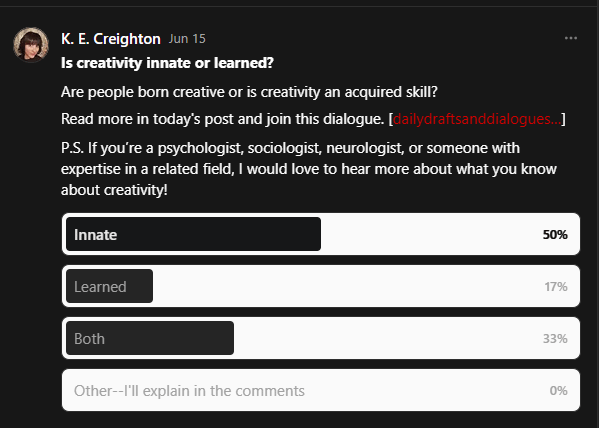
Here are the results from last week’s poll: Is creativity innate or learned?