

SCROLL TO THE BOTTOM TO SEE TODAY’S WRITING PROMPT
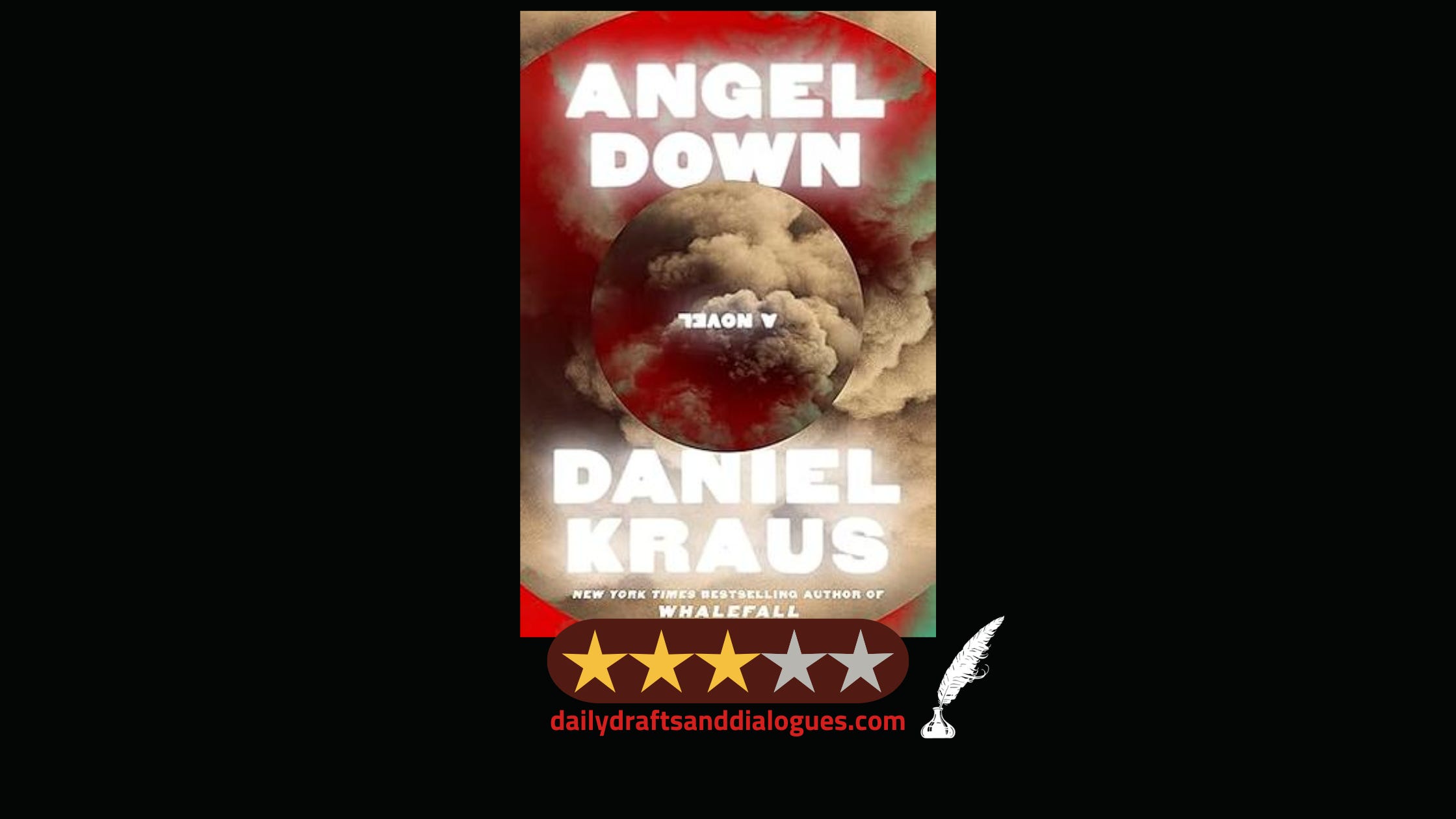
Angel Down by Daniel Kraus won the 2026 Pulitzer Prize for Fiction, and offers much to consider regarding war and human nature, or should I say the nature of men who war? The novel has been lauded for its unique, single-sentence narrative— no really, the entire novel is a single sentence that has no beginning or end, with every single one of its paragraphs beginning with ‘and.’ It’s also been lauded for how it blends genres like horror, allegory, and magical realism. Yet many readers may find it a bit gimmicky and superficial in the end. [Warning: There are a few spoilers in the rest of this review.]
The novel opens with a literal bang, and a promise for rebirth for Cyril Bagger, a con man who shirks the frontline by ensuring he’s relegated to gravedigging duty. He literally crawls out of the mass grave he’s digging, unscathed after a mortar blasts everyone else in it to shreds, covered in human body parts. He joins up with four other soldiers after the blast, who are then all ordered by their commanding officer, Lyon Reis, to end the shrieking coming from the center of the battlefield, in No Man’s Land. And they play Rochambeau (Rock, Paper, Scissors) to determine who’s going to be the sacrificial lamb to climb out of the trench to do it. Bagger ends up going with a fourteen-year-old kid soldier named Arno, who he has been looking out for and reading The Son of Tarzan to as if it were a field manual he gets to embellish. And they end up ‘saving’ and bringing back what appears to be a woman to their trench.
Shortly after, the soldiers determine the woman is actually an angel, as she has a glowing halo and is dressed like the Madonna in Old Glory’s colors and can grant “maybe-miracles” for the soldiers who start fighting and killing to possess her for what they believe she can and should give them or do for them. Then graphic scene after graphic scene ensues as each of the soldiers try to kidnap her, each meeting his own demise in direct relation to how he played Rochambeau. Until it is down to Bagger and Arno, whom Bagger has to make wagers with the ‘angel’ to save over and over again, until he threatens suicide and the angel spares him, but not until after she takes him to the underworld, where Bagger sees how human bodies are being forged into bullets and how the “... trenches of the Great War evolved into the entrenchments of ideology, of hatreds and superiorities and vanities and comforts and riches, most of all riches…”
The best part of this novel is how its narrative structure (a never-ending sentence that has no beginning or end) calls attention to the never-ending dread and carnage of war, allowing readers to internalize this lack of reprieve, this lack of a break. Since the characters never get a reprieve from the war, neither does the reader.
“... it could be male or female, human or animal, but whatever it is, it’s dying, dying slow, dying loud, ripple after glissading ripple of agonized lament, and Bagger, already weighed down in mud and blood, further heavies in the dreary certainty that the shriek won’t ever end, just like the war won’t ever end, like the carnage won’t ever end, it’s a sentence in a book careening without periods, gasping with too many commas, a sentence that, once begun, can’t ever be stopped, a sentence doomed to loop back on itself to form a terrible black wheel that, sooner or later, will drag each and every person to their grave,...” (p.6)
The novel’s structure, ending exactly where it begins, symbolizes the inescapable, unrelenting wheel of war. It acts as an indictment of the industrial and political machinery that continuously converts human lives into combat feedstock.
There’s also a ton of religious symbolism in this novel, which shouldn’t come as a surprise as its entire plot revolves around an ‘angel down,’ who represents both a beacon of hope and a deadly burden. Instead of inspiring innate goodness in the war-weary soldiers, her presence amplifies their inner demons. Her light becomes something to covet, hoard, and exploit by the soldiers, symbolizing how humanity’s spiritual bankruptcy transforms the miraculous into an object of greed and violence.
Bagger’s red pocket leather Bible (which belonged to his father who was a bishop) also transforms into a layered symbol of sacrifice and parental protection. When it literally stops bullets, saving the protagonist’s life, its imagery of the Solly Madonna absorbing violence, the collision between human devotion and the brutality of the trenches is highlighted, and parallels Bagger’s personal inner conflicts regarding his parents and faith.
Likewise, Bagger’s and Arno’s obsession with pulp adventure novels function as a cracked mirror. These stories represent idealized, antiquated concepts of masculinity and heroism, which stand in stark contrast to the dehumanizing, industrial slaughter they are trapped in— though the inclusion of the pulp novels ultimately remain part of and uphold the overtly masculine tone of the novel itself instead of negating or subverting it.
The Great War is also portrayed as an unsurpassed mechanized slaughter, where soldiers are transformed into consumable resources and their ‘heroism’ is exploited for personal gain— which is a direct commentary on the commodification and capitalistic nature of war. Rather than heroic patriots, the soldiers are treated as interchangeable units of labor. They suffer and die solely to advance an absurd “war machine” fueled by the greed and vanity of military leaders like Reis. Cyril Bagger is also the embodiment of cutthroat capitalism. He survives not through valor, but by swindling his peers, using gambling debts and financial leverage to force poorer, weaker men to take his place on the frontlines. The discovery of a fallen angel in No Man’s Land becomes an ultimate test of morality, as well, because the soldiers fall into a frenzy of jealousy and paranoia, attempting to hoard or profit off the celestial being instead of universally recognizing her presence as a miracle. And, of course, there is the unforgettable imagery offered by the underworld war machine the angel permits Bagger to see.
Needless to say, due to its structure and symbolism and literary elements, I can see how this novel won one of the most coveted literary prizes. However, it did venture into tired patriarchal, gimmicky territory.
First, I was not a fan of the clichéd and stereotypical testosterone-addled cartoon-like characters and viscera suffusing this story, which is driven by a con man with a tropey black-and-white noir-style gangster voice who is constantly sensorily bombarded by oozing body parts, as that’s already saturated most stories about the Great War for decades now.
Sure, one could attempt to argue that the angel’s presence and aims in the novel complicates the male characters’ ‘I am a man so therefore should be afraid of real human feelings’ and ‘I love violence and will kill blindly because I only care about myself no matter what’ logic and behavior, which is extremely debatable, as the angel ultimately only exists in relation to the warring soldiers’ flaws, to point out their flaws, bringing no profound moral counterweight or meaning to the underlying patriarchal narrative overall, essentially saying something akin to ‘Oh well, boys will be boys, forever and ever and ever, amen, and there’s nothing I can do ‘bout that, so bye,’ and not much else in the end.
There is also a lot to be said about the willingness of the angel to be literally manhandled, because would an angelic entity with a moral compass and divine affiliation subject themselves to human-generated games of war with no real aims to end said war or human suffering, etc.? Admittedly, angels often serve as detached messengers and harbingers of truth and nothing more. However, the angel in this novel doesn’t successfully embody that essence, as it directly partakes in and instigates the soldiers’ human games of war, not maintaining the angelic detachment and objective distance central to other parables and narratives with angels in them— therefore, it cannot be read strictly as parabolic.
I appreciated the technical risk this novel took by embodying a run-on sentence to embody the never-ending essence of war, overall, but wouldn’t say it pushed the literary envelope in a profound enough way, or that it captured the essence of war with a truly fresh, literary (or human) lens. At least, not in a way that will resonate past another year or so. Still, readers who enjoy getting lost in the unrelenting deluge and carnage of traditional war stories won’t want to miss this one.
Today’s Dialogue
What do you think makes a story about war memorable or resonant?
Have you read this book yet, or plan to read it soon?
© This work is not available for artificial intelligence (AI) training. All Rights Reserved by K.E. Creighton; Creighton’s Compositions LLC.
Community Notes
THIS WEEK’S WRITING SHARE IS LIVE

Share one line you wrote this week.
Drop one line (or a short excerpt) from anything you wrote this week. Then, if you want: why did this line matter to you?
Or share some of your writing based on a writing prompt shared in a previous Daily Drafts & Dialogues post.

CURRENTLY READING
Yesteryear by Caro Claire Burke
Week 1 (June 1-7) — Part I and Part II Chapters 1- 11
Week 2 (June 8- 14) — Part II Chapters 12- 27
Week 3 (June 15- 21) — Part II Chapters 28- 42
Week 4 (June 22- 30) — Finish Book
June 30th: Substack Chat to Discuss Entire Book
JULY BOOK: Poverty, By America by Matthew Desmond
Recommended Reading Schedule TBA

