
Book Review: Let the Poets Govern
Here’s my review of Let the Poets Govern by Camonghne Felix. Leave a comment if you’ve read it, plan to read it, or have any book recs to share. And don’t miss today’s writing prompt.

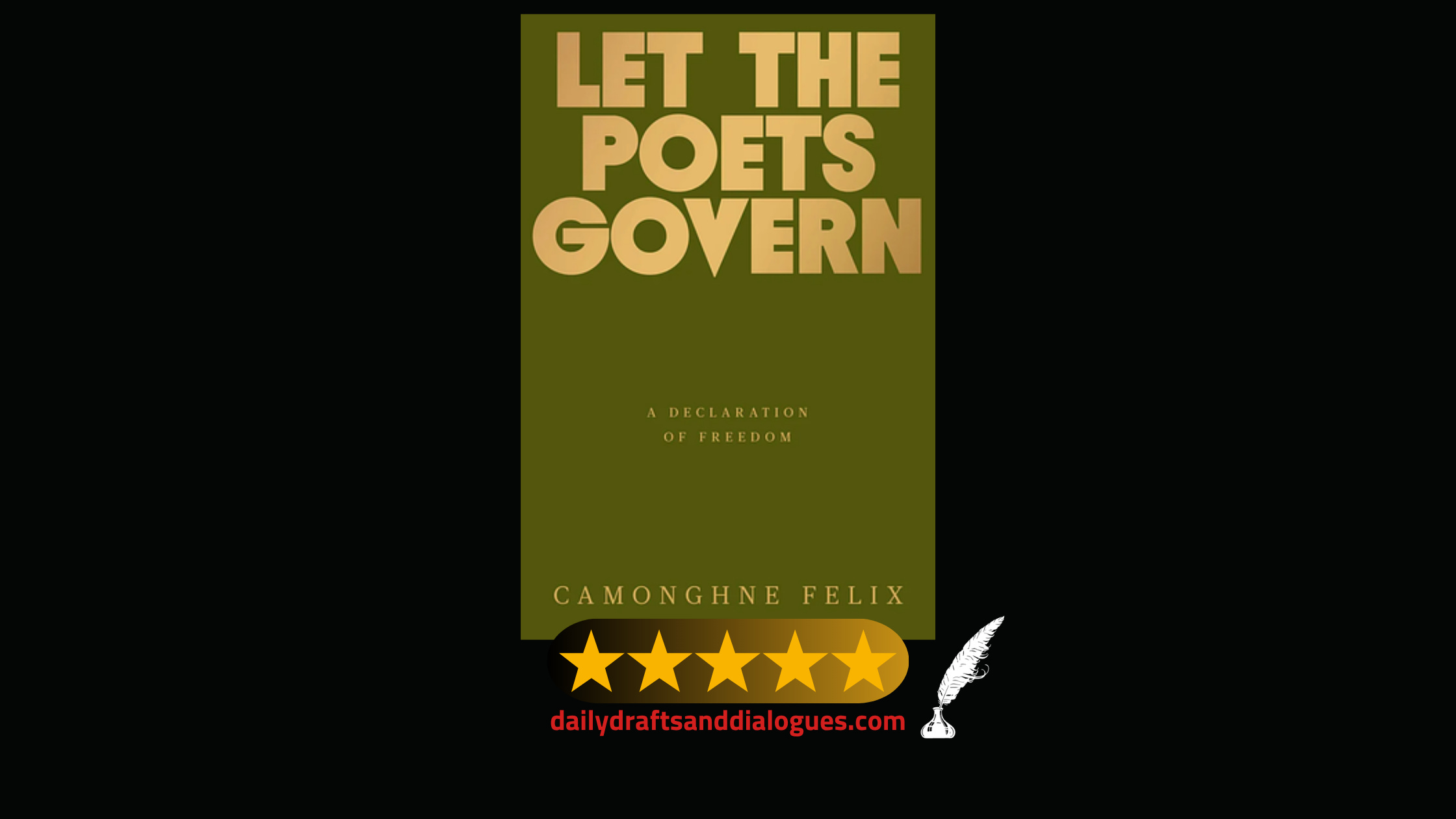
Let the Poets Govern by Camonghne Felix is an important book that will require you to reflect on the power of language and how we choose to wield it. So of course I loved it. It reads as part memoir, part manifesto, part homage. Poets, linguists, activists, lit nerds, anyone unsettled during this time in history, and anyone who appreciates what language has done and has the potential to do, will enjoy this book.
At the start of the book, Felix discusses her youth and unpacks the insidious and unconscious, racist effects of a nursery rhyme, ‘Eenie, meenie, miney, mo’ — a nursery rhyme that has its roots in fifteenth century papal edicts and slave laws and policing in the US South— to illustrate the power poetry has on us from a young age, often without our knowledge, or even our caregivers’ knowledge. Then she unpacks the power of lullabies and how they lull us to sleep and complacency from a young age, again detailing the political power poetry has on us and how it helps us internalize the world around us, our place in it, and who we are, from infancy.
Next, Felix goes on to unpack the Pledge of Allegiance and its poetic power in the US education system, and how her year-long truancy during high school led her to live in a world outside the lines it attempts to draw, and into the liberating world of poetry. And it is this formidable experience that shapes who she becomes and how she lives her early years as an activist after high school and beyond, learning about the world and others via poetry.
Felix then discusses her experiences as a speech writer later on in her career and how her personal poetics and understanding of poetry was continually tested as the many speeches she wrote on various campaign trails were disregarded or pared down in some excruciating ways. And then details the ways in which poetry worked to inform and revive her politics, and vice versa, especially during the post-pandemic period of her life. It is in this portion of the book that Felix shares her sincere feelings on the political power of poetics, which is moving.
Throughout the book, Felix outlines and discusses many poetic techniques and forms and how they work to inform our poetics in real life, and how they offer opportunities for freedom and resistance in real life. She also explores other poets’ poems and philosophies throughout the book and includes some of her own erasure poetry as well, in a way that clearly illustrates her own personal poetics. But there is one notable refrain throughout the book that sticks out among the rest, which she borrows from Audre Lorde, then hones: Poetry is a revolutionary act.
While this book is short, it packs a punch. You will leave it wanting to learn more about poetry and all it can do. And you will leave it wanting to read more of Felix’s poetry, or maybe even take one of her classes at The New School. I cannot recommend this book enough, as there is something in it for all aspiring and established writers and poets.
Here are some notable passages from the book:
“We cannot revise history but we can revise and redefine the language that governs history, the language that governs us. The permission to be a poet is accessible to any of us. When we are kept away from that access, when that permission is withheld from us, we lose our relationship to the musicality of language, to a certain kind of intellect that our ancestors took care to cultivate. We lose our relationship to storytelling and our relationship to remembering. We lose the romance of being alive. We fall into the traps of solipsism and individualism, forgetting that interreliance is where our liberty lies.”
“We all have it, and that “it” is the difference between an ending world and an endless world. The world we imagine is possible. Poetry allows us to trust that, to have faith in it, to see the impossible as possible. Poetry allows us to abstract the present in order to construct a new and unexpected future. It fractures—and deepens—time.”
“When we recognize that access to poetry is free and that we all have the opportunity to use it, then we take language’s intimacies back, and we take it away from those who abuse it. Language belongs to the hungry, and if we seek nourishment from a future that feeds us all, then language will be the thing that frees us.”
“The language of these lullabies and nursery rhymes is evidence of the reproduction and enforcement of ideas centered on dominating Black bodies, the same ideas that have been effectively woven into society’s fabrics. This is how efficiently language becomes a weapon.”
“Freedom is a pantoum. The language of the oppressor is alive. But so is the language of the oppressed.”
“Our job, as poet thinkers, is to hypostatize the imaginary, to ask the poem to say what we need it to say, to be the ones to proclaim freedom and to document it and then to get in sync with the other thinkers and imaginaries who need to be with each other to build the mass movements that create change and usher in peace. The poem can be a peaceful poem when it needs the reader to find peace. But peace can be unsettling too, which the poem can capture.”
“I spend my life thinking because that is greater than any single action I can take. I spend my life thinking and making material of that thinking because I am a poet. That’s all being a poet really is.”
Have you read this book yet, or plan to read it soon? Leave a comment to start a discussion. Or tell us what we should read next. And don’t forget to subscribe to receive future book reviews in your inbox, along with other engaging posts.
© This work is not available for artificial intelligence (AI) training. All Rights Reserved by K.E. Creighton; Creighton’s Compositions LLC.
Want to express your appreciation for this post and writing prompt?
My writing and I are fueled by loyal readers, caffeine, and kind words, so I appreciate any support you can offer that keeps me writing. Thank you so much!
Today’s Writing Prompt
Writing Prompt: The Metronome
Write a poem or piece of flash fiction that is centered around a metronome. Or write about the last time you used a metronome.
Writing Tip
Before you begin writing, find an app with a metronome if you don’t already have one. Set its tempo. Then listen to it for a minute or more. See what that elicits. Then start writing.


