
Book Review: Son of Nobody
Here’s my review of Son of Nobody by Yann Martel. Leave a comment if you’ve read it, plan to read it, or have any book recs to share. And check out the poll for June’sbook club pick in Community Notes

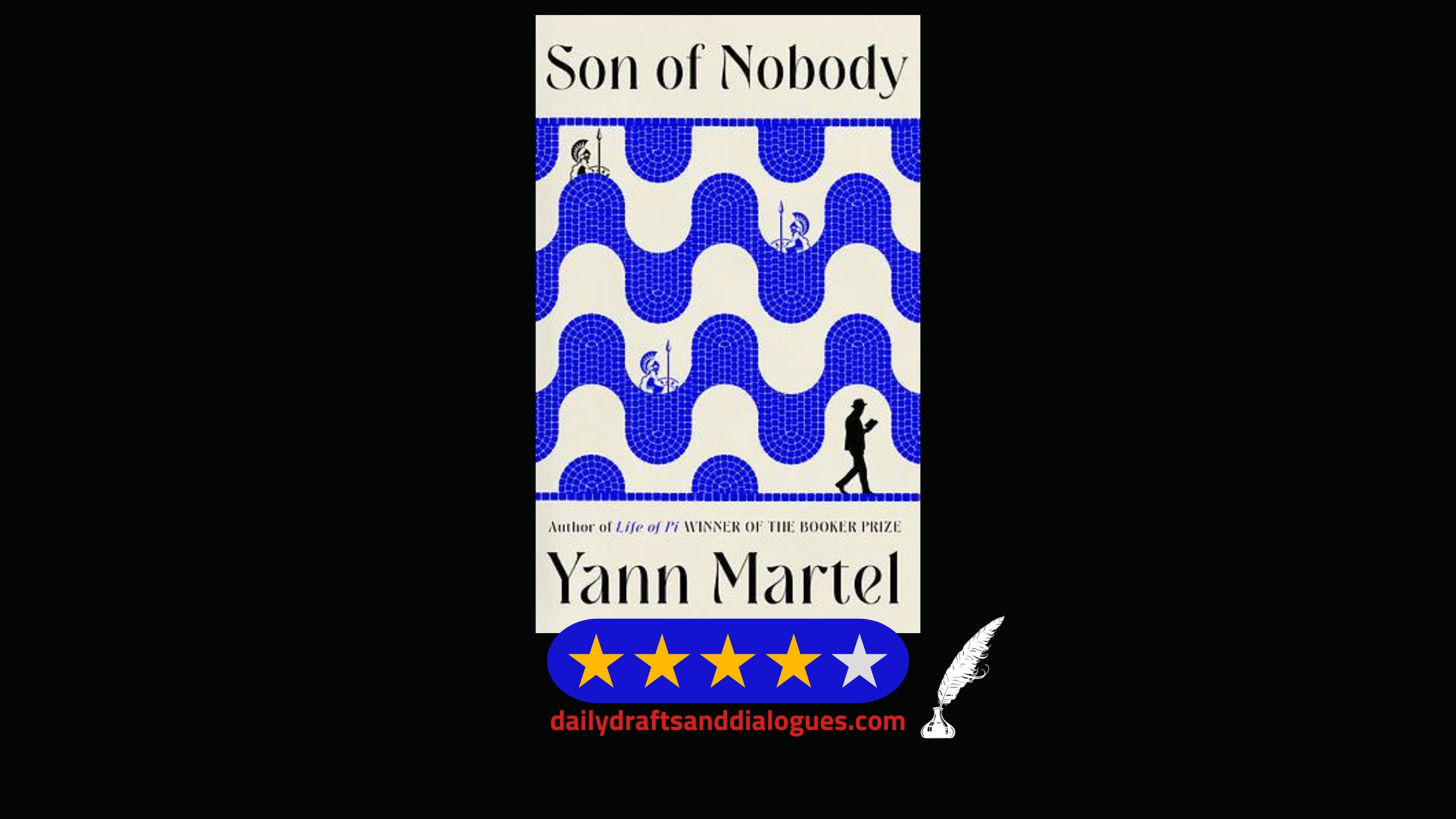
Son of Nobody by Yann Martel is a compelling retelling of the Trojan War told from the perspective of a commoner in ancient times as discovered and pieced together by a ‘common’ Classical scholar in the modern world. And it is a novel worth reading for those who enjoy retellings, translations, storytelling, metafiction, archeology, ancient history, Greek mythology, and works that dabble in all of those things simultaneously.
At the beginning of the novel, readers are introduced to Harlow Donne, a Classics scholar who leaves his family behind in Canada to go to Oxford to study ancient Oxyrhynchus papyri, a massive collection of roughly 500,000 papyrus and parchment fragments discovered in ancient rubbish dumps near Oxyrhynchus, Egypt that provide unparalleled insights into daily life, literature, early Christianity, and more in the ancient world. But when he finds an intriguing inscription referring to Psoas of Midea, Son of Nobody on an ancient pottery shard, he can’t let the reference or mysterious plight of Psoas go. And that obsession leads to his discovery and eventual reassembling of what he calls The Psoad, or epic retelling of the Trojan War as told by Thersites, a common foot soldier who is known to have railed against elite Homeric heroes like Odysseus, Agamemnon, and Achilles in other works.
Donne tells the story of Psoas via Thersites alongside his own annotations and storytelling notes to his young daughter Helen, who is back home in Canada. The reassembled epic text is on the top of the page while Donne’s annotations and personal notes are on the bottom of the page, offering a more literal dual perspective of the story of Psoas and the people behind its creation in ancient times alongside Donne’s contemporary retelling of it. So, in addition to prompting readers to recall and recalibrate everything they have learned or think they know about The Trojan war and its epics, the literal format of Son of Nobody invites readers to recall and posit their own understanding and convictions regarding the power of storytelling itself, making the novel’s metafictional elements come to the forefront in a powerful way. Readers are not simply invited to read this split text, they are invited to unpack its accuracy, meaning, and significance, alongside Donne.
Through the split narrative, Son of Nobody prompts readers to ask questions like: What is the value of ordinary lives in epic storytelling— both today and back then? When can and do ordinary men become heroes, if ever, and what makes them heroes? What is the purpose of war for the common foot soldier compared to those who orchestrate war? Is war, and its epics, a hiding place for monsters? Is a ‘hero’ someone who puts public interest above their personal lives and families, or someone who is ordained to act by divine forces? What is the nature of truth and myth, and in what ways do they intersect and or conflict with one another? Should stories, especially those told by ancient bards, be viewed as accurate, historical reporting or as isolated personal and emotional truths? In what ways do we impose our own personal lives, thoughts, and feelings onto the stories we are telling and why we are telling them? And what does it mean to be a ‘nobody’ or a ‘somebody’ in literature and in everyday life?
Overall, the lit geek in me appreciated the structure of this novel and all that it accomplished, which was a lot. Discovering an epic out of literal ancient garbage is every author’s, scholar’s, and reader’s dream.
At the same time, however, I was never fully able to empathize with the main character, Donne, who seemed way too self-absorbed and inept at basic communication and social skills to get behind. (Is this supposed to be ironic?) Which wasn’t a big deal until I began intuiting that I was supposed to compare him and his plight to literary heroes, or at the very least consider his work on the Psoad as heroic. And I just ultimately couldn’t do that, even though I really really really wanted to. Perhaps this was the case because we only ever get Donne’s solo perspective on absolutely everything and everyone throughout the novel. Or perhaps it’s because we never experience Donne truly emotionally connecting with his daughter, wife, coworkers, bosses, or others in any way at all that isn’t centered around him and his specific plight and interests. Either way, Donne’s lack of deep connection with others and their perspectives affected how I viewed Donne’s character, integrity, and translations, and not always in sympathetic ways I’m afraid. I do realize Donne’s character was likely contrived this way intentionally, more for intellectual sport, and I don’t think it will bother most readers the way it bothered me… but alas, it did ultimately influence my final opinion of the novel as being an intellectual triumph that falls somewhat emotionally flat in the end.
Here are some notable passages from the book:
“Time may move in a straight line, but memory does not. These footnotes have their share of things to say. Don’t neglect them. We all live lives that are footnotes to a greater story.”
“War has always been the locus of appalling possibilities.”
“ A story is a never-ending invention.”
“So if the bards were spouting fiction, their stories, in the absence of actual history, very nicely explained the end of a people, an age, a civilization, and laid the foundation for what followed. Their stories did something surprising: they made the facts unnecessary. Or, to put it another way, their stories became facts, as solid to build upon. This synergy makes sense. History, however true, needs interpreting, and fiction, however invented, arises from life and reflects it. With these old stories, to make them meaningful, to feed off them, we must take them at their word. So we take epic exaggeration seriously, as we do Gospel gravity, otherwise there is nothing to take.”
“Waiting fascinates the ancient and modern minds because to learn how to live is to learn how to wait, how to deal with the sand as it falls through the hourglass.”
“Today is today, for today. Free verse is the new verse, has been for the last hundred years. In the tussle between fidelity to language and fidelity to meaning—so hard to get both—I have chosen the second.”
“What is one to do with the sadness of mortals?”
Have you read this book yet, or plan to read it soon? Leave a comment to start a discussion. Or tell us what we should read and review next!
And don’t forget to subscribe to receive future book reviews in your inbox, along with other engaging posts.
© This work is not available for artificial intelligence (AI) training. All Rights Reserved by K.E. Creighton; Creighton’s Compositions LLC.
Want to express your appreciation for this post?
Daily Drafts & Dialogues is fueled by loyal readers, caffeine, and shares with kind words, so any support you can offer to keep it and me going is greatly appreciated. Thank you so much! — K.E. Creighton
Community Notes (New!)
In this new section of Daily Drafts & Dialogues, you will see additional notes on posts and what’s going on in the broader Daily Drafts & Dialogues community, more in depth questions to spur further dialogue, polls, discounts, contest opportunities, helpful links and resources, and opportunities to have your comments and work featured in the new Community Spotlight section below in future posts.
Community Spotlight
This new section will FEATURE YOUR WORK AND VOICES. Leave a thoughtful comment on a Daily Drafts & Dialogues post for a chance to have your writing, links, and profile featured here.
Egalitarian Book Club

Currently Reading: Westward Women by Alice Martin (Join the buddy read here.)
Recommended Reading Schedule:
Week 1 (May 1-10) — Chap. 1-7 (Part I)
Week 2 (May 11- 17) — Chap. 8-14 (Part II- III)
Week 3 (May 18- 24) — Chap. 15-21 (Part III- IV)
Week 4 (May 25- 31) — Part V, remaining chapters
June Pick:
What would you like to read together in June? Poll closes in 7 days!
Yesteryear by Caro Claire Burke
The City and Its Uncertain Walls by Haruki Murakami
Amerkia by Franz Kafka
A Brief History of Living Forever by Jaroslav Kalfar
Daily Drafters Features and Exclusives
Paid Subscribers: (NEW!) Don’t forget to check out this week’s chat thread, where you can share your responses to this week’s writing prompts or share anything you worked on this past week that you’d like to discuss or receive feedback on! If you have a link to something you’ve recently published or read, feel free to share that there too :) Remember: Your writing could be featured in the Community Notes section of a future Daily Drafts & Dialogues post or the next Daily Drafts & Dialogues Digest.
Learn more about what Paid Subscribers get here.
You’ll want to join the Daily Drafters chat to be notified of all writing prompts, tips, challenges, and other exclusive Daily Drafters content as soon as it’s shared or published.
**Current Special Offer: Message me after you switch to Paid to receive your first 30 days of chat access free.**


