

SCROLL TO THE BOTTOM TO SEE TODAY’S WRITING PROMPT
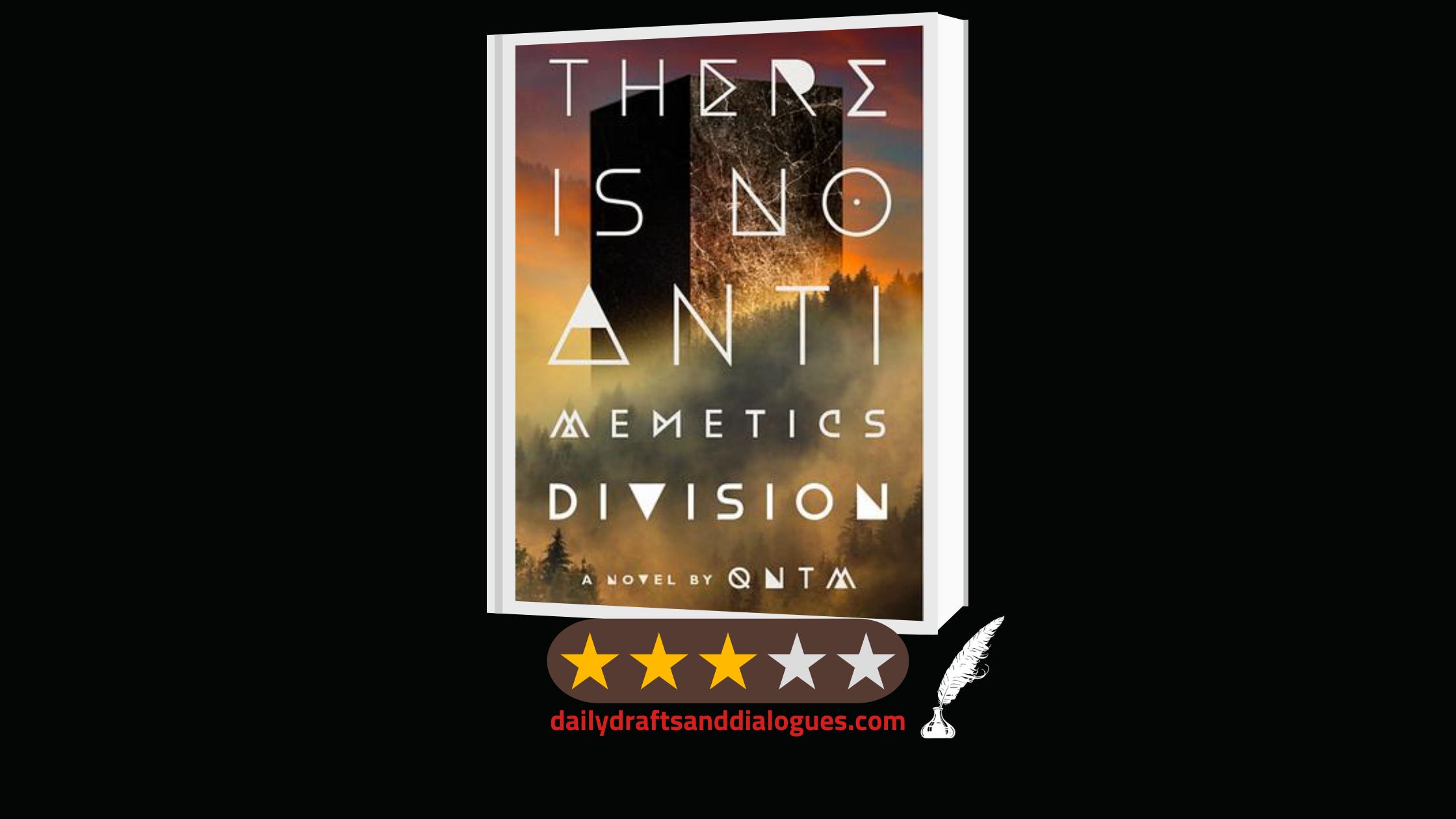
There Is No Antimemetics Division by qntm (a.k.a. Sam Hughes) is a compelling high-concept novel that retains many of its mysteries long after it ends and would be a great selection for many Sci-Fi and Fantasy book clubs. But I wouldn’t recommend it to readers who enjoy character-driven novels, or who appreciate clear-cut and easy-to-follow prose and plots, as it includes alternating timelines and identities and physical planes and metaverses that jump around and superimpose over one another. Someone who wants to enjoy this novel will need to remain open-minded yet science-oriented, willing to suspend their current belief systems, and will need to be prepared to pay close attention.
At first, this novel might seem confusing, as there are many details thrown at the reader right out the gate regarding its world of antimemes, their reports, and those who believe they are responsible for their containment. However, about halfway through the novel it becomes clearer that many (or any) of these antimemes aren’t supposed to be understood in concrete or static ways, as they represent the various and malevolent forms various ideas can and might take in various environments that may or may not exist in the physical or conceptual worlds we currently understand and experience— which is obviously hard to pin down.
Questions that will likely arise as you read this novel: How does one pin down an idea or define an idea? Where do ideas exist? How do we know ideas exist? Where do ideas and identity intersect? What makes up an idea (literally and figuratively)? What are the true limits of ideatic space itself? What distinguishes a dangerous idea from an inert idea? Are dangerous ideas possible to contain? If so, how and by whom or what? Is humanity itself an ideatic space or ecosystem? And so on.
One of the most notable achievements of this novel is how detailed its underlying concept of antimemes is, and how that concept is conjured via descriptive imagery in every scene, while simultaneously retaining its underlying sense of mystery that never fades. Up until the very last page, and beyond, readers will incessantly explore what antimemes are, their horrific effects on the world and humans, and how they should and could be handled.
As I was reading this novel, I couldn’t stop thinking of the Matrix series, though it is more metaphysical and abstract in concept than the Matrix in the end. It also offers incredibly vivid and heart-racing scenes with giant spiders and slugs, walls made of fingers, and graphic violence that Horror and Thriller readers will likely enjoy. And it has fast-paced scenes that will keep most readers flipping pages. But it does not have a tidy ending, which might frustrate some readers.
I also did not find myself rooting for any of the characters in the novel and even found them interchangeable at times, as none of them had relatable backstories or distinct personalities to empathize with and follow. There was a little backstory provided for the Quinns’ relationship, but even then, I wasn’t sure what made them tick as individuals, on an intimate level I could root for and rally behind. And I felt it was taken for granted that readers would care about the plight of the characters as they encountered all these antimemes and setbacks, even while the high concept driving them to act seemed to override their existence and motivations and the plot. Maybe this was intentional? Admittedly, I tend to enjoy character-driven novels best, so I am biased in this regard.
Overall, I would recommend this novel to readers who enjoy detailed, plot-driven high-concept novels that encourage them to think abstractly and who will likely appreciate this Nietzschean quote: “Whoever battles monsters should see to it that in the process he does not become a monster himself. And if you gaze long into an abyss, the abyss also looks into you.”
Here are some notable passages from the book:
“So, maybe the end of the world will be some other division’s problem.”
“‘Organization staff join Antimemetics for a lot of reasons, and one of those reasons is that they perceive the work to be easier. Safer. Lower-stakes. But an idea can end a world. An idea is alive. It can mutate, it can replicate, it can predate on other ideas…and it can hide. And—people deserve to be safe. This is the purpose of the Organization. It’s what we are for. Research, yes, Unknown science, because that helps, but ultimately we are here to keep everybody safe.’”
“The sheer alien scale of the adversary is enough to intimidate most into submission. From a cursory read, U-3125 looks like a nightmare scenario; it’s going to turn human civilization into something beyond Hix’s ability to imagine. But that’s every Monday in this job, and in any case Hix doesn’t have much of an imagination.”
“Adam asks, ‘What is it? The big idea.’ She shakes her head. ‘I can’t tell you. I wish I could. But I won’t know until I get there. And even then, the words don’t exist, and even if they existed, for me to speak them to you would blow you away. It’s too big for us.’ He leans on her, blindly, and says, ‘The seed, though. You can tell me that.’ She looks up at the sky. ‘People shouldn’t have to be afraid, Adam. Of anything. The universe is vast and terrifying and unthinkably dangerous and you deserve to be protected. To be kept safe and sound. Because otherwise those terrible things rule you and fear rules you and you can’t be who you really are. Freedom means no fear.’”
“Humanity is not adapted to withstand the presence of ideas so gigantic. Parts of it could survive, at the far end of probability, but not as humanity; not without being transformed into something incoherently alien.”
“‘But if we have learned nothing else, we have learned this: Humans can walk away from, and forget, anything. Civilization can go back to ‘normal’ after anything.’ He contemplates the archive shelves in silence, for some time. He worries, briefly, that he really does know the truth, and that there is nothing anomalous preventing him from knowing it. That it’s simple denial. But he won’t say that aloud, even here.”
Today’s Dialogue
What are your thoughts on ‘ideatic space’, or the place where ideas exist?
Are you a fan of high-concept novels like this? Why or why not?
Have you read this book yet, or plan to read it soon?
© This work is not available for artificial intelligence (AI) training. All Rights Reserved by K.E. Creighton; Creighton’s Compositions LLC.
Community Notes
JOIN THIS WEEK’S WRITING SHARE when it drops later today in the chat.
What did you write this week?
Share something you wrote this week—finished or unfinished. A paragraph, a fragment, a line, or even something you’re still shaping. What felt most alive in your writing this week?
Or share some of your writing based on a writing prompt shared in a previous Daily Drafts & Dialogues post.
Subscribe to be notified when the chat thread goes live.

CURRENTLY READING
Yesteryear by Caro Claire Burke
Week 1 (June 1-7) — Part I and Part II Chapters 1- 11
Week 2 (June 8- 14) — Part II Chapters 12- 27
Week 3 (June 15- 21) — Part II Chapters 28- 42
Week 4 (June 22- 30) — Finish Book
A public chat thread will be shared on Substack to discuss the entire book at the end of the month. Until then, join our Buddy Read in Storygraph to chat about the book as you read it at your own pace.
JULY BOOK
The POLL for July’s selection is up in Storygraph and closes in 7 days.
The options are:
Prophet Song by Paul Lynch
Poverty, By America by Matthew Desmond
The Edge of Space-Time: Particles, Poetry, and the Cosmic Dream Boogie by Chanda Prescod-Weinstein
Japanese Gothic by Sunyi Dean
