

October Theme: The Unknown
Big Question: Why are we drawn to mystery and uncertainty?
Week 1: Mystery
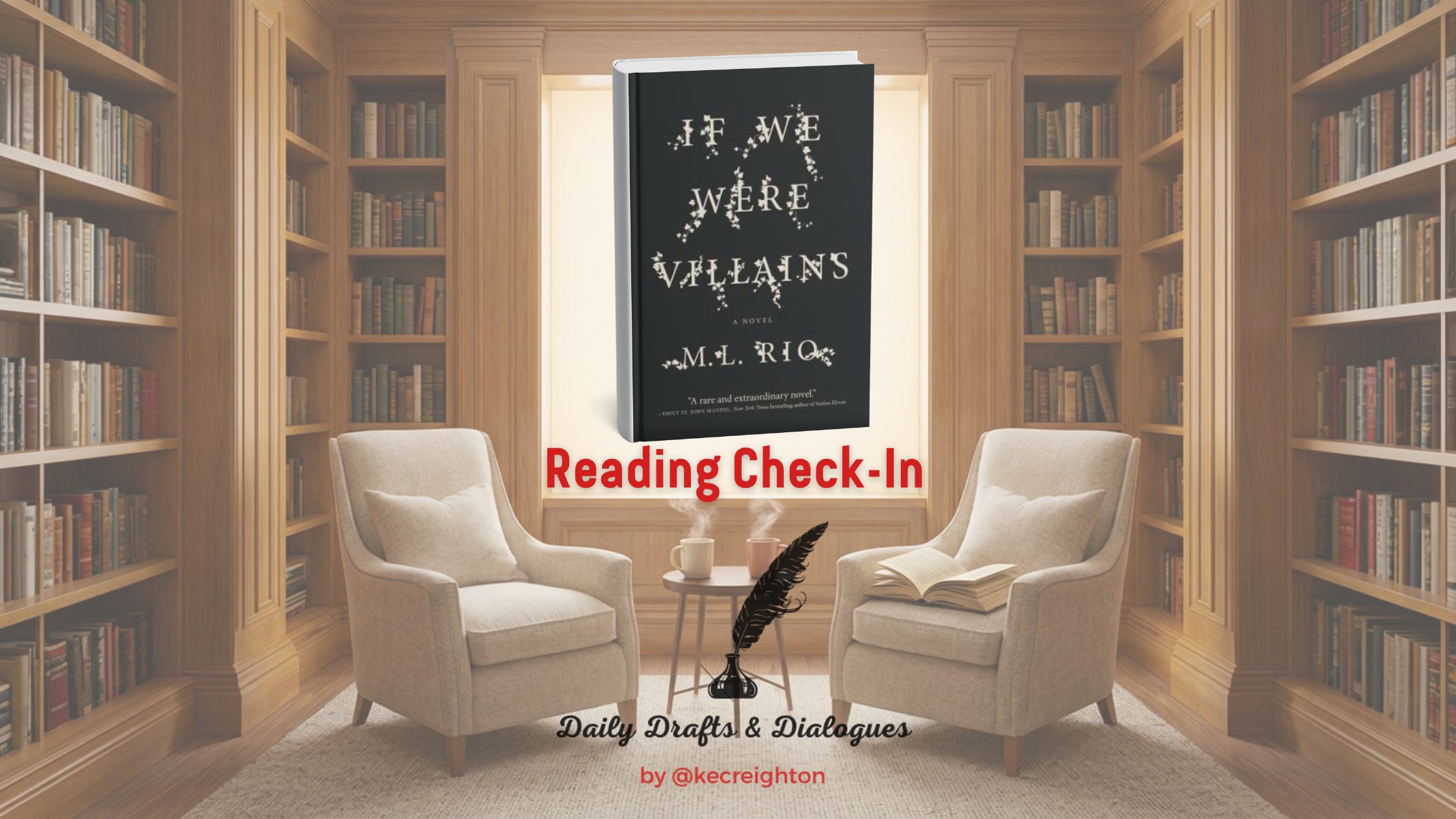
Our first book club selection in October is If We Were Villains by M.L. Rio, and it’s proving to be a unique choice for the week we’re covering Mystery.
According to Storygraph, If We Were Villains is for “someone who is drawn to atmospheric settings, obsessive intellectual circles, and the blurred lines between art and reality.” But it also includes a murder mystery and unreliable characters that will keep you turning pages until the very end, which is what makes it an ideal selection to read alongside this week’s drafts and dialogues.
Within the first few pages of the novel, we learn that Oliver Marks, the novel’s main protagonist, has just completed a ten-year prison sentence for a murder he may or may not have committed while he was a student at an elite liberal arts school, Dellecher Classical Conservatory, as he talks to the retired detective who put him away, who is still demanding the truth. And the novel uses this compelling premise to construct an eerie, suspenseful atmosphere and plot rooted in secrets and jealousies, performances both on and off the stage, and the unknown. The novel’s narrative unfolds as Marks’s final confession to Detective Colborne, a man who is walking away from his career as a detective but still can’t let go of Marks’s case, which haunted his career.
When Marks agrees to finally tell Colborne the story, the reader is plunged into a retrospective maze where memory and performance blur. The story immediately transports readers to the elite and isolated world of Dellecher Classical Conservatory, a place where seven fourth-year theater students (including Oliver) live, breathe, and sleep Shakespeare. Bound by intense rivalries and deep-seated obsessions, they find themselves cast in the same archetypal roles both on the stage and in their private lives. They embody the hero, the villain, the tyrant, the temptress, the sidekick, the extra, and others. Cut off from the outside world, their relationships are fueled by a toxic mix of passion and competition, creating an environment ripe for tragedy. And as Shakespearean dialogue and drama are interwoven into the novel’s main plot, the characters play their parts.
The central mystery of the novel ignites when hidden resentments and shifting power dynamics caused by role changes on the stage begin to destabilize the group, causing the boundary between make-believe and reality and secret passions and public appearances to warp and disintegrate. When a fatal act of violence shatters their close-knit circle one night, the unknown officially creeps into their lives and relationships, as well as their public and private performances. And the students are suddenly forced to navigate a real-world tragedy using the only tools they truly understand, which include those things they use and rely on in the plays they perform— deception, careful staging, passionate declarations, and dramatic misdirection.
As the police circle the conservatory, the student actors must collaborate on their most challenging performance yet. They twist the truth and manipulate evidence and stories of what happened to protect one another, but the psychological toll of their secrets and what they don’t know about one another begins to fracture not only their relationships with one another but how they understand themselves. Trust then becomes a luxury none of them can afford as growing and lingering suspicions turn them against one another in mysterious and unexpected ways, leaving the reader to wonder who is playing a part and who is telling the truth about what happened, especially their part in it.
Ultimately, the deepest enigma of the novel lies within the human mind and the true nature of complicity and camaraderie. As the characters attempt to orchestrate a final act of sorts, to convince the authorities of their innocence or the roles they’re playing, they become hopelessly lost in their own shadows and performances. The overarching suspense of this novel is driven not just by the question of what happened on one fateful, tragic night, but by the chilling and methodical discovery of how far each actor is willing to go to not only protect their secrets but play the roles they believe they are destined to play.
As we read If We Were Villains, let’s ask ourselves how mystery is not only driving its plot but each of its characters’ evolutions, and whether this leads to an ending we find satisfying or an engaging reading experience we would want to have again.

💭Initial Reflections on If We Were Villains
I have a confession: I have already finished the book. So, writing today’s post will prove a little challenging, as I don’t want to give anything away. But suffice it to say that I was deeply invested in the mysteries this novel contains from start to finish, so much so that I often found it difficult to put down, which definitely explains its high rating and rave reviews across reading apps like Goodreads and Storygraph.
From the first page, I needed to know whether Oliver Marks was truly guilty of what he went to prison for, so ended up wary of his account of events for the entire novel. I was fully expecting him to be an unreliable narrator, which he sort of was, though not in the ways I originally thought he’d be.
One thing I appreciated about this novel was how complex its characters were, even though readers are constantly being given the impression that they aren’t or shouldn’t be. While the characters are literally being cast into roles for Shakespearean plays throughout the novel, it’s instinctual to want to cast stereotypes onto them as a reader too. But as the novel and its Shakespearean excerpts keep reminding us as we read, actors are never who they seem and often play more than one role or will have a change of heart in a later scene, etc.
Personally, I loved the Shakespearean metafictional elements in this novel, which brought it and its characters to life in a compelling way, constantly reminding the reader of the plays they might be witnessing outside of each character’s playacting on stage, as well as how their acting inevitably affects their inner worlds and psychological states. And I loved the extra layer of drama it brought to the story as well (all the puns intended).
The seven fourth-year theater students at Dellecher Classical Conservatory in the novel are strictly typecast by their professors into distinct theatrical roles. These archetypes dictate not only their stage presence but also their social dynamics and private relationships throughout the novel, ultimately driving the central tragedy of the novel.
The group is anchored by James Farrow, the brilliant and handsome golden boy permanently cast as the Hero, and Richard Stirling, the physically imposing and volatile student who embodies the Tyrant. While James struggles under the pressure of his flawless facade, Richard inevitably brings his aggressive, bullying stage persona into their daily lives, dominating the group through sheer intimidation.
The female students are similarly bound by their prescribed roles, led by Meredith Dardenne as the Temptress. Despite her immense intelligence and emotional complexity, Meredith is constantly objectified and cast as the sharp, alluring femme fatale. Opposite her is Richard’s cousin, Wren Stirling, who serves as the tragic Ingénue. Wren is delicate and gentle, permanently relegated to playing the innocent maiden, which leaves her uniquely vulnerable to the fractures and emotional trauma that eventually ripple through the conservatory.
The remaining students occupy the margins of the stage, yet they are crucial to the brewing mystery in the novel. Alexander Vass is the default Villain, a sarcastic and pragmatic realist who uses substance abuse to cope with isolation in real life, while Filippa Kosta acts as the Chameleon, a modular actor capable of blending into any scene, allowing her to serve as the group’s quiet observer and resident peacekeeper. And the narrator, Oliver Marks, occupies the role of the Loyal Sidekick, rarely given the spotlight and defined by his steady, agreeable nature and a fierce devotion to his friends, which forces him to bury his own identity in the shadows.
The rigidity of the Dellecher typecasting structure eventually shatters, however, when the professors force the students to swap roles during a production of Macbeth, a choice that acts as the catalyst for the novel’s central tragedy.
When Richard Stirling, the established Tyrant, is stripped of his dominant status and relegated to a secondary, weaker role, his real-world insecurity manifests as genuine, dangerous aggression. So, the theatrics of the stage (or the lack thereof in Richard’s case) allow his inner reality to surface.
Conversely, James Farrow, who has only ever known the golden-boy spotlight of the Hero, is cast as the murderous Macbeth. This casting shift unlocks a dark, volatile intensity within James, proving that his noble stage persona was merely a mask concealing a much more fragile and desperate psyche in the real world.
This theatrical upheaval forces the rest of the ensemble to confront the darker, hidden sides of their own personalities off the stage as well. Oliver Marks, long comfortable as the passive Loyal Sidekick, is thrust into the position of a primary protector and conspirator, actively taking control of a narrative he usually just observes.
Meanwhile, characters like Meredith Dardenne shed their superficial Temptress labels to display fierce, protective intelligence, and Alexander Vass proves that his Villain persona is just a defense mechanism for someone deeply traumatized by the group’s real-world actions and dynamics.
While her peers collapse under the weight of their roles or violently spiral when forced into new ones, Filippa uses her adaptability as the Chameleon to survive the chaos of the unfolding tragedies around her. Usually underestimated and treated as an ‘extra’ by the faculty and her peers, her ability to effortlessly shift between the foreground and background becomes her greatest tactical advantage in the real world. She likely does not break emotionally or psychologically because she never tied her identity to a rigid, fragile archetype in the first place.
Filippa’s chameleonic nature conceals the fact that she is the most perceptive and strategic character in the novel. While the others are blinded by their own personal dramas and imposed roles, Filippa quietly observes everything happening, managing to uncover the central truth of the mystery long before anyone else. But instead of using her adaptability to change her persona, she uses it to leverage the narrative from the shadows, seamlessly stepping into the role as the group’s protector and secret-keeper as she tries to prevent her chosen family from completely dissolving.
Ultimately, by forcing the actors out of their safe, predictable boxes, the conservatory exposes the terrifying truth that anyone can become a villain when the right cues and stage settings are in place. And the tragedy at Dellecher Classical Conservatory unfolds because the boundaries between performance and reality begin to collapse when the students are forced to subvert their original rigid castings.
While Richard’s descent into genuine tyranny and James’s dark transformation as Macbeth fracture the group’s foundation, Oliver is pushed from the passive sidelines into a desperate role of active complicity to protect those he loves. Amidst this volatile downward spiral, Filippa utilizes her unique position as an underestimated chameleon to survive the fallout, shifting from a quiet extra into one of the most strategic and perceptive players. And by refusing to break under a singular archetype, she is able to navigate the chaos from the shadows, becoming the main secret-keeper for a tight-knit circle that has become hopelessly lost in its own dark performance.
Overall, I really enjoyed not only the well-developed characters and Shakespearean dramas they both manifested and played out in this novel, but also the art-mimics-life and life-mimics-art components of this novel, and how they made its mysteries all the more compelling and bingeable.
However, I was not really a fan of the way this novel ended and still really need to talk about that!
As I read, I keep asking myself questions like:
Which Shakespearean character would I have been typecast as, if I were in this novel?
Will I really like any of the characters in the end, and does this matter?
Why was Oliver in prison, and how realistic are his choices in the end, and does that matter?
What Shakespearean excerpts are my favorite and why?
How many mysteries are actually going on here?
Does every character have a secret, or is it just that their identities are being suffocated or warped by the roles they must play?
💬Notable Quotes and Passages from the First Half of the Novel
“I looked down at the text of Pericles I was scanning, for what felt like the hundredth time. Only half as talented as any of the rest of them, I seemed doomed to always play supporting roles in someone else’s story. Far too many times I had asked myself whether art was imitating life or if it was the other way around.” (p.8-9)
“...Per aspera ad astra… Through the thorns, to the stars.” (p.35)
“How could we explain that standing on a stage and speaking someone else’s words as if they are your own is less an act of bravery than a desperate lunge at mutual understanding? An attempt to forge that tenuous link between speaker and listener and communicate something, anything, of substance. Unable to articulate it, we simply accepted their compliments and congratulations with the appropriate (and, in some cases, entirely contrived) humility.” (p.114)
“One thing I’m sure Colborne will never understand is that I need language to live, like food— lexemes and morphemes and morsels of meaning nourish me with the knowledge that, yes, there is a word for this. Someone else has felt it before.” (p.147)
“The moral outrage we should have suffered was quietly put down, suppressed like an unpleasant rumor before it had a chance to be heard. Whatever we did— or, more crucially, did not do— it seemed that so long as we did it together, our individual sins might be abated. There is no comfort like complicity.” (p.154)
✨ All of Act III, Scene 9 and the Epilogue
✨ Oliver’s dialogue with Colborne, where they discuss whether Oliver blamed Shakespeare for anything that happened on pages 248-249.
🗣️Book Discussion Questions
The characters are strictly typecast into roles like the Hero, the Tyrant, and the Temptress. Do you think the tragedy occurred because the characters were forced to change their roles in Macbeth, or did those new roles simply expose the dark truths they were already hiding?
Oliver narrates the entire story as a ten-year-old recollection to Detective Colborne. How does his fierce loyalty as the Loyal Sidekick affect his reliability as a storyteller, and what parts of the mystery do you think he might still be keeping in the dark at the end of the novel?
Filippa is the only character who adapts smoothly because she is a Chameleon. Does her ability to blend into the background make her the most innocent member of the group, or does her shape-shifting role make her the most complicit in the cover-up?
The students use Shakespeare’s language and theatrical staging to process reality and handle a real-world tragedy. In what ways does treating their lives like a play protect them, and at what point does this dramatic performance become a lethal trap?
Detective Colborne states at the beginning that he isn’t looking to punish anyone anymore and that he just wants to know the truth. By the end of the novel, who do you believe carries the true moral guilt of the students’ tragedy, and can justice ever truly be served when everyone is playing a part in it?
👇 Drop your thoughts, reading progress updates, and favorite quotes from the book below! Or join our Buddy Read in Storygraph to share your thoughts there based on where you are in the book. I can’t wait to see what everyone thinks of this book so far! 👇
📝 Bonus Writing Prompts for Drafts
This is for the active writers, journalers, and literary artists in our community. If this book has your creative or analytical wheels spinning, consider completing one or both of these writing prompts.
Creative Prompt
Write a scene about a tight-knit group of friends who are suddenly forced to change their established roles within their social dynamic (e.g., the quiet one must take charge, the leader is pushed to the sidelines, or the group caretaker steps back). Focus on a tense, atmospheric moment where they realize that playing these new parts isn’t just an act, but is permanently changing who they are, as well as their relationships. Use the setting and subtext to hint at a dark secret they are all trying to hide from either themselves or one another.
Reflective Journaling Prompt
In If We Were Villains, the characters lose themselves or start to unravel because they cannot separate their true identities from the archetypes assigned to them. Reflect on the roles you find yourself playing in your own life (whether at work, with your family, or among your friends). Which of these roles feels the most authentic, and which one feels like a performance sometimes or all the time? What part of yourself do you keep hidden from the audience of your daily life, and what do you think would happen if you let that part step into the spotlight?
Share what you write in the Drafters Workshop Chat.
💬 Let’s Dialogue
Writers and readers can have varied creative lifestyles and approaches to what they read and write. Let’s discuss them!
For readers: When did the story feel the most suspenseful or eerie? For writers: What specific techniques (like the isolated setting or the countdown structure) did the author use to build that tension?
As a reader, did you find yourself rooting for these characters even when they made terrible choices? As a writer, how did the author manage to make highly exaggerated, theatrical archetypes feel like real, complex people?
The book starts at the end of the story, with Oliver leaving prison. For readers: Did knowing he went to prison make you more curious or less curious about the plot? For writers: What are the pros and cons of revealing the ending of a story in the very first chapter?
For readers: Did the heavy use of Shakespeare quotes enhance the dark academia mood, or did it ever pull you out of the story? For writers: How hard is it to weave existing historical text into a modern mystery without slowing down its plot?
As a reader, did the mystery feel like it was more about who committed the crime or why they did it? As a writer, how does shifting the focus from a whodunit to a psychological study change the way a thriller or mystery needs to be structured?
Share your responses in the Dialoguers chat or leave a comment.
See all our October Book Club Picks with customizable reading schedules.

Whether you join a chat, one of our Buddy Reads in Storygraph, or lay it all out in the comments, I look forward to hearing more about your thoughts on our book club picks this month!
If you enjoyed this post, please like and share it so others can enjoy it and read with us too. Thank you and happy reading!
Continue Exploring October’s Theme, The Unknown
Writing Prompts That Stir Up Mysteries
Does mystery drive a better story than predictability?
ICYM September’s Posts about The Stories We Carry
Popular Posts
Writing Prompts for Stories That Last
Drafting Diaries: The Stories We Carry
Drafting & Dialoguing Digest: The Stories We Carry
Writing Prompts About The Stories We Tell Others
The ‘Death of the Author’ in the Age of AI
Reading Notes: Interior Chinatown
The Story of My Flaws Sounds Like Death Metal
Historical Fiction that Challenges the Stories We Tell Ourselves
The Art of Autofiction: Memory, Markets, and the Modern Confessional
Writing Prompts About Books That Changed Us
What My Favorite Books Say About Me