

SCROLL TO THE BOTTOM TO SEE TODAY’S WRITING PROMPT
I have been writing every day for years now, and one of the most important things it has taught me is that writing brings me hope every single time I do it, without fail. But that hope doesn’t always appear in ways I might expect or want it to. In fact, most of the time, the hope writing offers me often appears as some sort of struggle or void at first, only surfacing when I am toward the end of a writing session, or once a writing session is complete.
Some days when I begin writing in the dawning hours of the morning, I don’t have hope. To be honest, that’s mostly due to the fact that my first cup of coffee hasn’t kicked in yet and I haven’t had much time to do anything or feel or think about anything at all, other than getting some clothes on and getting said cup of coffee and shuffling to my office to write something out of sheer habit. But sometimes it’s because, like many other writers, I’m highly attuned to what is going on in the world and have had my fair share of doubts about what it all means and what my part, my writing part specifically, has to do with it all. I take my role and responsibility as a writer seriously, in other words, which is one of the many reasons I am as diligent as I can be about doing it daily, especially in a world full of misinformation and negative content and AI bots that need to be circumvented.
When I’m not writing, I often wonder: How can my words leave a lasting impact? Will they have a positive and or necessary impact? Should I care if they do, and is it even up to me? If so, for whom, and in what way do I want my words to resonate? Have my words already left an impact? If so, in what ways? … and on and on the questions go… UNTIL I get lost in the flow of writing, which usually happens as soon as I open my word doc and start typing about all those questions rolling around in my mind, even if indirectly and subconsciously via fictional, possible worlds.
When I start writing anyway, over and through and under my endless questions, despite my uncertainties about the world and my miniscule role in it, my writing’s miniscule role in it, I find myself getting closer and closer to answering them, one word, one draft, one dialogue, one day at a time, remembering that the writing process itself will work out all the answers for me in one way or another, even though I will likely never find concrete answers anyway, because why should I expect that when me and my writing and the world and all its inhabitants are constantly in flux and ever-evolving? Which is what makes the writing process so frustratingly magical and necessary… and hopeful.
As I write, I become subsumed by a greater world full of possibility, not the other way around. A world that I can only begin to write into existence when my self-centered ego and concerns begin to fade into the background and I enter a state of flow. A possible world that is by its very feasible nature full of hope, as hope is nothing more than the anticipation or desire to make something true— and what else is writing but the anticipation or desire to make something true on the page, and then the world in which that page exists alongside others’ pages?
As I write, I get to imagine everyday heroes and remember forgotten people and make complex people seem relatable and center worlds around communities and love and kindness and justice and grit and vulnerable humanity and determination and perseverance and resourcefulness… and write those things into existence so they become a part of the narrative of the greater world and stories in which I live, in which they live. In essence, as I write, I get to hope because it is only when I write that I can sense how a new world beyond myself and my words is possible. And that is, to me, the essence of hope: what is possible, what I want to make possible.
As I write, I find and get lost in that liminal space between where I have been and what I have written and read and where I am going and what I am going to write next. A space somewhere between despair and uncertainty and a desire for The Divine and limitless knowledge and harmony. A space in motion that transports me toward and into something that is difficult to hold onto for long: hope. Because hope is more than a feeling or state of mind— it is a nuanced state of being that is in constant flux, and deep inside the flow of writing is where I experience it the most. When I am becoming subsumed by possible worlds made by others’ possible worlds alongside my possible words, I feel hope.
This is why I write daily: to feel hope.
When I don’t write daily, hope, what is possible, starts to disappear from my purview, which for me isn’t optional during the times we’re living in right now.
There is also hope in knowing that whatever you write is not finite, that your words don’t have to be finite, and that they are a part of a greater human story that far exceeds your words alone that is ever evolving. There’s power in that, liberation in that, and hope in that— a level of hope I want other writers to experience too.
Today’s Dialogue
Does the writing process bring you hope? If not, why?
© This work is not available for artificial intelligence (AI) training. All Rights Reserved by K.E. Creighton; Creighton’s Compositions LLC.
Community Notes
JOIN THIS WEEK’S WRITING SHARE when it drops later today in the chat.
Share one line you wrote this week.
Drop one line (or a short excerpt) from anything you wrote this week. Then, if you want: why did this line matter to you?
Or share some of your writing based on a writing prompt shared in a previous Daily Drafts & Dialogues post.
Subscribe to be notified when the chat thread goes live.
EGALITARIAN BOOK CLUB
The POLL for July’s selection is up in Storygraph and closes in 1 day.
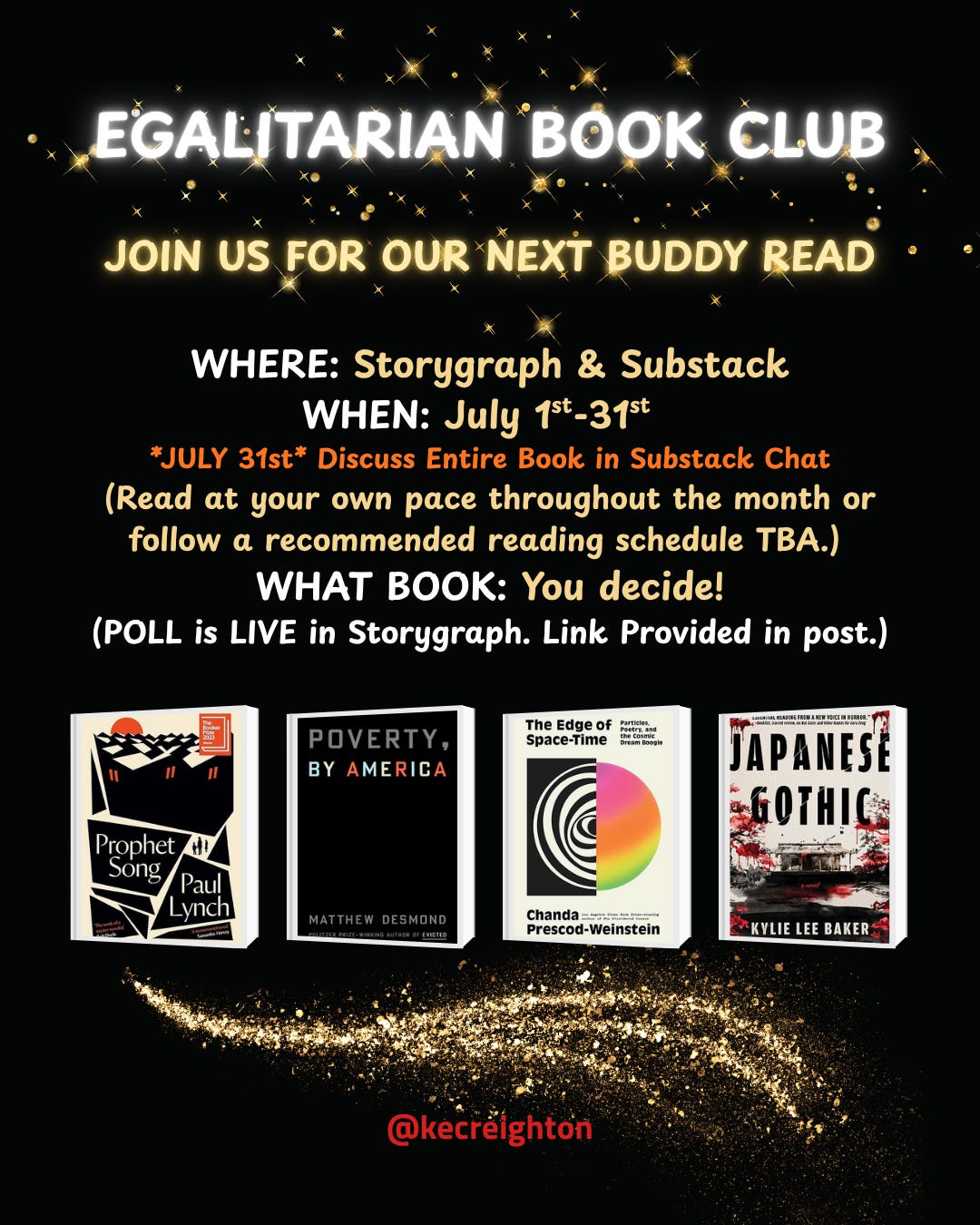
The options are:
Prophet Song by Paul Lynch
Poverty, By America by Matthew Desmond
The Edge of Space-Time: Particles, Poetry, and the Cosmic Dream Boogie by Chanda Prescod-Weinstein
Japanese Gothic by Sunyi Dean
